
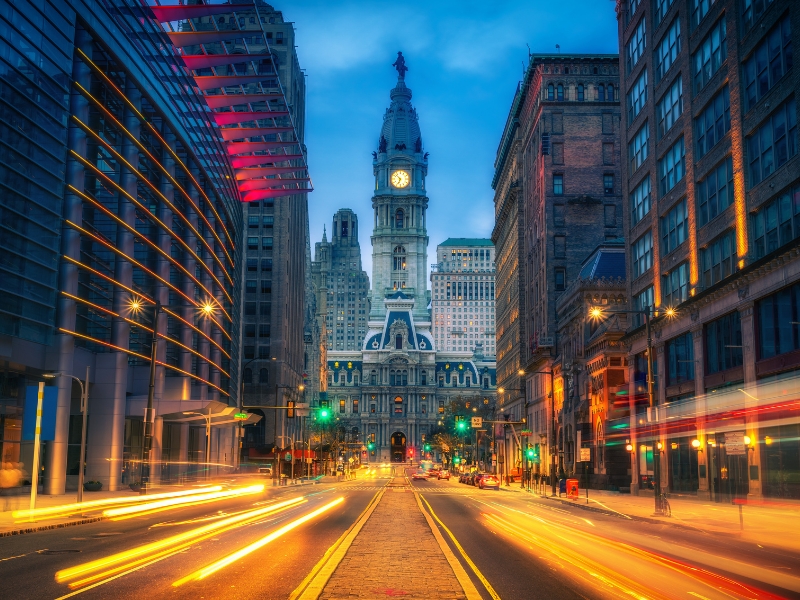
This guide covers four places that trace Philadelphia from William Penn's plan to the early republic: City Hall, which stands on the central square Penn laid out in 1682, Independence Hall, where the Declaration of Independence and the Constitution were debated and signed, the Betsy Ross House and Elfreth's Alley in Old City. They lie in a line from the centre to the Delaware River, so you can see them in one walk.
Philadelphia City Hall
City Hall stands on Centre Square, the middle of the five squares in Penn's plan for the city. It was built from 1871 to 1901 to designs by John McArthur Jr., with Thomas Ustick Walter, in the French Second Empire style, in brick faced with marble, limestone and granite. It is often described as the largest free-standing masonry building in the world, and from 1894, when its tower was topped out, until 1908 it was the tallest habitable building in the world. It still houses the mayor's office, the City Council and several courts.
On top of the tower stands a bronze statue of William Penn by Alexander Milne Calder, about 37 feet tall and hoisted up in fourteen pieces in 1894. For decades an unwritten gentlemen's agreement kept new buildings lower than Penn's hat, until One Liberty Place broke it in the 1980s. Local folklore then spoke of the Curse of Billy Penn on the city's sports teams, which fans say ended after a small Penn figure was attached to the final beam of the Comcast Center and the Phillies won the 2008 World Series. City Hall is one of our scavenger hunt stops.
- The statue of Penn faces north-east, towards Penn Treaty Park, where by tradition he made a treaty of friendship with the Lenape.
- The more than 250 sculptures by Calder and the stonemason William Struthers that decorate the facades.
- The observation deck just below the statue, about 500 feet above the street, reached by a small lift.
Independence Hall
Independence Hall was built between 1732 and 1753 as the Pennsylvania State House, to designs by Edmund Woolley and Andrew Hamilton. In its Assembly Room the Second Continental Congress named George Washington commander-in-chief in 1775, voted for independence on 2 July 1776 and approved the Declaration of Independence on 4 July; the delegates signed it there on 2 August. In 1787 the Constitutional Convention drafted the United States Constitution in the same room. The building has been a UNESCO World Heritage Site since 1979.
The room saw later moments too. Abraham Lincoln spoke here in 1861 on his way to his inauguration, and after his assassination in 1865 his body lay in the Assembly Room while tens of thousands of people filed past. The Liberty Bell first hung in the original wooden steeple; the steeple you see today was added by William Strickland in 1828. Independence Hall is one of our scavenger hunt stops.
- The Rising Sun chair in the Assembly Room, made in 1779: during the Convention, Franklin said he was happy to know that the sun carved on Washington's chair was rising, not setting.
- The courtroom of the Pennsylvania Supreme Court, across the hall from the Assembly Room.
- Congress Hall to the west and Old City Hall to the east, which frame the building on Independence Square.
Betsy Ross House
This small brick house at 239 Arch Street was built around 1740, with the stair hall and back rooms added some years later. It is presented as the home of Betsy Ross, an upholsterer and flag-maker of the Revolutionary era, but historians disagree on this: the best archival evidence suggests that she actually lived next door. The house was restored in the 1930s with money from the radio maker Atwater Kent, passed to the city in 1941, and is run today by Historic Philadelphia.
The famous story that Betsy Ross sewed the first Stars and Stripes for George Washington is a legend. It comes from her family, especially her grandsons, and spread around the 1876 Centennial; there is no document from the 1770s that confirms it. Remains believed to be those of Ross and her third husband, John Claypoole, were moved to the courtyard before the Bicentennial. The house is one of our scavenger hunt stops.
- The small colonial front on Arch Street, with the stair hall and rear rooms added behind it.
- The courtyard with the grave of Betsy Ross and John Claypoole, and the fountain added in 1974.
Elfreth's Alley
Elfreth's Alley, a narrow lane between Front Street and North 2nd Street, is often called the oldest residential street in the United States. It was opened around 1703 and is named after Jeremiah Elfreth, an 18th-century blacksmith who owned property here. Its 32 houses were built between about 1720 and 1836, and over the centuries they were home to shipwrights, silversmiths and pewterers, glassblowers and furniture makers.
People still live in these houses, so keep your voice down and stay off the doorsteps. The Elfreth's Alley Association has worked to preserve the street since 1934, and in 1960 it became a National Historic Landmark. Numbers 124 and 126 form a small museum in the former home of two dressmakers. Elfreth's Alley is the last stop of our scavenger hunt.
- The brick house fronts, many with shutters and flower boxes, along the narrow lane.
- Fete Day in early June, the street's annual celebration of its history and heritage.
How to see them in one walk
Start at City Hall and walk east along Market Street towards the river. At 5th and 6th Streets turn south to Independence Square for Independence Hall, with the Liberty Bell in its pavilion just to the north. From there continue north-east through Old City to the Betsy Ross House on Arch Street, and finish a block further on at Elfreth's Alley, just off 2nd Street. The walk follows the city's history from Penn's central square to its colonial waterfront.
See Philadelphia with World City Trail
Our Philadelphia scavenger hunt turns the city centre into a game you play on your phone. The route links 10 stops, from the Academy of Natural Sciences to Elfreth's Alley, and all four places in this guide are stops. On the way you also visit LOVE Park, the Chinatown Friendship Gate, Franklin Square, the Liberty Bell and the Museum of the American Revolution. At each stop you solve a puzzle and learn a story, at your own pace.
There is also a self-guided walking tour and an outdoor escape game in Philadelphia, for people who prefer a different format.
Play the Philadelphia scavenger hunt →
Take the self-guided walking tour of Philadelphia →
Play the outdoor escape game in Philadelphia →
Facts checked in October 2026.