
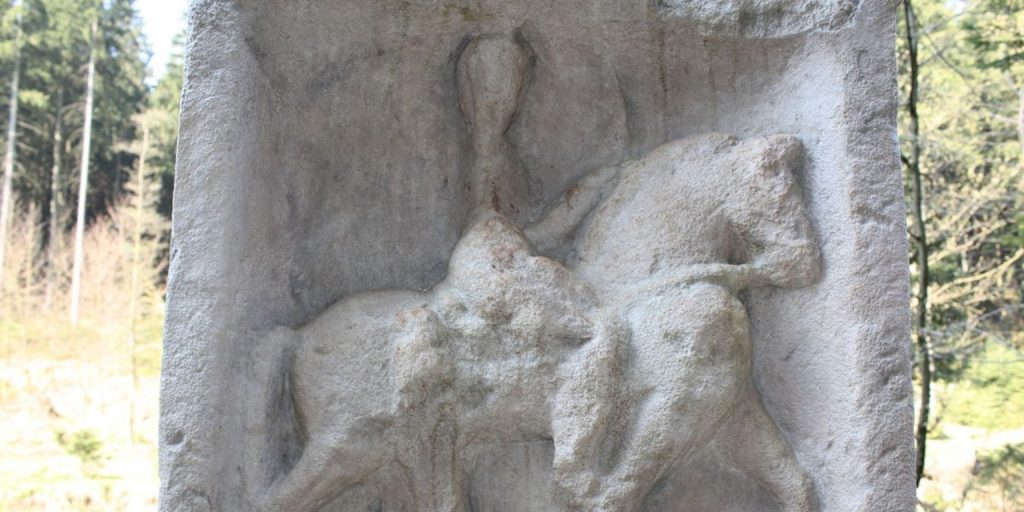
Most visitors to Stuttgart stay close to the Schlossplatz and its palaces. This guide covers four places that show other sides of the city: the Schillerplatz with Germany's first Schiller monument, the Städtisches Lapidarium with its Roman grave stones, the TV Tower on the Hoher Bopser and the Weissenhof Estate, a showcase of modern architecture from 1927. Together they take you from Roman stone to 20th-century concrete, and from the old centre up onto the hills around it.
Schillerplatz
The Schillerplatz is the old square of the centre, once the forecourt of the Old Castle. For centuries it was simply the Schloßplatz; when the New Palace got its own, larger square in the 18th century, this one became the "Old Schloßplatz". In 1839 a statue of the poet Friedrich Schiller by the Danish sculptor Bertel Thorvaldsen was set up in the middle, the first Schiller monument in Germany, and people soon called the square after him. The name only became official in 1934.
The square is framed by some of the few older buildings left in the city centre: the Old Castle to the east, the Stiftskirche and the Fruchtkasten, a former granary, to the south, the Prinzenbau to the west, now the state Ministry of Justice, and the Alte Kanzlei, the old chancery, to the north. Twice a week a market fills the square, and during big events on the Marktplatz, such as the Christmas market and the wine village, the stalls spread over here too. The Schillerplatz is one of our scavenger hunt stops.
- Thorvaldsen's Schiller, based on a drawing of the poet made in 1787 by Johann Christian Reinhart, a drawing that has since been lost.
- The Mercury column on the Alte Kanzlei: a slender round tower from 1598, crowned since 1862 by a gilded young Mercury.
Städtisches Lapidarium
On the slope of the Karlshöhe, in the south of the city on Mörikestraße, the city's Lapidarium is an open-air museum of stones set in the garden of a former villa. Its owner, Carl von Ostertag-Siegle, had the terraced garden laid out in 1905 on the model of Italian terrace gardens and filled it with his collection of Roman antiquities. In the same year the city began keeping architectural fragments saved during the renovation of the old town. After the Second World War the city bought the villa and garden, and the Lapidarium opened here in July 1950.
Today the museum shows more than 200 monuments, most of them in stone, from five centuries of Stuttgart's history: pieces of houses, fountains and statues from a town largely lost in the war. Ostertag-Siegle's Roman collection adds almost 200 more objects, among them grave slabs with Latin inscriptions, carved to remember the dead nearly two thousand years ago. If you are curious about Roman grave stelae, this is the place in Stuttgart to see them up close. The garden is open mainly in the warm months, so check before visiting in winter.
- The Roman inscriptions and grave stones in the Unterer Wandelgang, the lower covered walkway of the garden.
- Fragments of old Stuttgart buildings, collected after the war, placed among the terraces and plants.
- The terraces themselves, an Italian-style garden from 1905 in the middle of a residential district.
Fernsehturm (TV Tower)
Stuttgart's TV Tower stands on the Hoher Bopser, a wooded hill south-east of the centre. It was designed by the engineer Fritz Leonhardt, who also shaped its architecture; work began in June 1954 and the tower opened in February 1956. It was the first reinforced-concrete tower of its kind with a visitor cabin projecting out below the antenna, and it became the prototype for later towers that combine a viewing platform, an all-round view and a place to eat or drink.
The tower is 216.6 metres high including the antenna, and the main observation platform is about 150 metres above the ground. Near the top there is a café and bar. In March 2013 the tower was closed to visitors over fire safety concerns and only reopened in January 2016. The Stadtbahn lines U7, U8 and U15 stop at the tower, so you can reach it easily from the centre.
- The view from the platform over the city lying in its valley, with forests and the Filder plateau on the other side.
- The small children's platform a few metres above the main one, reached by a spiral staircase.
Weissenhof Estate
In 1927 the Deutscher Werkbund, an association of architects and designers, held an exhibition in Stuttgart, and its main exhibit was a whole new housing estate on the Weissenhof in the north of the city. Ludwig Mies van der Rohe directed the project: he chose the architects, coordinated their budgets, oversaw the building work and designed Houses 1 to 4 himself. Seventeen architects from across Europe built 21 buildings with 60 homes, among them Walter Gropius, Bruno Taut, Hans Scharoun, J.J.P. Oud, Mart Stam and Le Corbusier with Pierre Jeanneret. The estate opened on 23 July 1927, about a year late, and drew large crowds.
Not everyone liked it: in the Nazi era critics mocked the estate as an "Arab village". Bombing in the Second World War destroyed several buildings, two more were demolished later, and 11 of the original 21 survive. In 2016 Le Corbusier's two buildings were inscribed on the UNESCO World Heritage list together with other works by the architect. Since October 2006 his double house, restored to its original state after three years of work, has been home to the Weissenhofmuseum.
- Le Corbusier's double house, where the museum lets you step inside one of the 1927 homes.
- Mies van der Rohe's Houses 1 to 4, the work of the man who ran the whole project.
How to see them in one walk
These four places are spread around the city, so think of them as a half day or more rather than a single stroll. Start at the Schillerplatz, ideally on a market morning, and look at the Schiller statue and the Mercury column. From the centre, walk south to the Lapidarium on the Karlshöhe while its garden is open. Then take the Stadtbahn up to the TV Tower; a clear afternoon gives the best view. Keep the Weissenhof Estate in the north for another outing, or begin your day there.
See Stuttgart with World City Trail
Our Stuttgart scavenger hunt turns the city centre into a game you play on your phone. The route links 10 stops, from the beer garden in the Schlossgarten to the Hans im Glück fountain. Of the places in this guide, the Schillerplatz is a stop; the Lapidarium, the TV Tower and the Weissenhof Estate lie outside the route and are good for the rest of your stay. The route also takes in the Staatsgalerie, the Stiftskirche and the Marktplatz.
If you prefer a different format, there is also a self-guided walking tour and an outdoor escape game in Stuttgart.
Play the Stuttgart scavenger hunt →
Take the self-guided walking tour of Stuttgart →
Play the outdoor escape game in Stuttgart →
Facts checked in October 2026.