
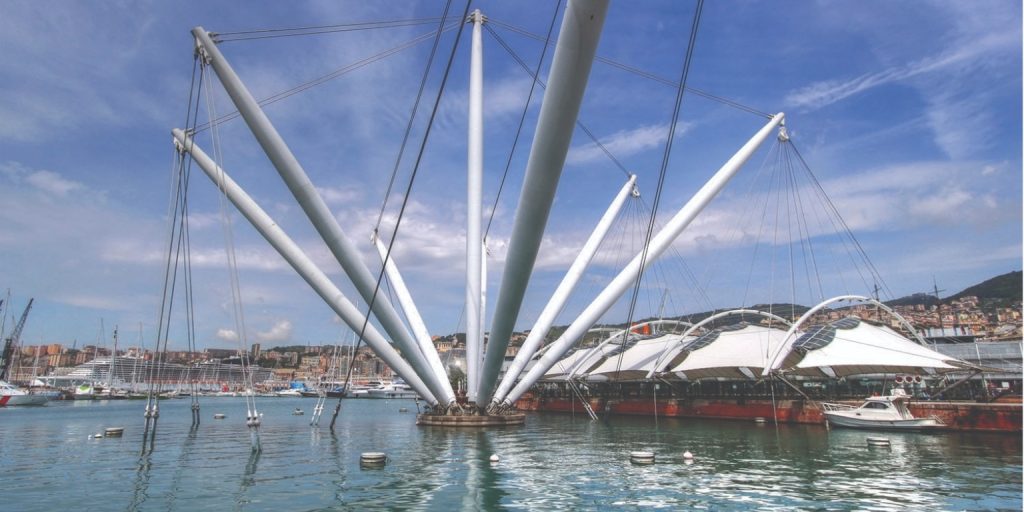
This guide follows Genoa from the water to its main square: the Bigo and the aquarium in the old port, Palazzo San Giorgio on the harbour front, a tiny historic barber's shop in the lanes behind it, and Piazza De Ferrari with its big bronze fountain. Together they show two sides of the city, the port that made Genoa rich and the old town that grew up right behind it, and you can link all five on one easy walk.
The Bigo
The Bigo is the white steel structure that rises from the quay of the Porto Antico, the old port, like a set of giant ship's derricks. Renzo Piano, the Genoese architect, designed it for Expo '92, the exhibition that marked 500 years since Columbus reached the Americas, and it was inaugurated in May 1992. Its name and shape come from the bigo, the type of crane once used to load and unload ships in the harbour.
Piano's redesign of the old port turned a run-down stretch of docks back into a public waterfront, and the Bigo is its symbol. Its longest arms hold up the tent-like canopy over Piazza delle Feste, the covered square next to it, while another arm carries a panoramic lift. The round cabin climbs to a height of about 40 metres and turns a full circle on the way, so you get a view over the port, the rooftops of the old town and the hills behind it.
- The panoramic lift, which rotates through 360 degrees as it rises, so you see the port and the city from every side.
- The white membrane roof of Piazza delle Feste, held by cables from the Bigo's arms.
- Columbus' Wind, a sculpture by the Japanese artist Susumu Shingu, standing near the Bigo.
The Aquarium and the Biosfera
Right next to the Bigo, on Ponte Spinola, is the Aquarium of Genoa, also designed by Renzo Piano for Expo '92. It opened to the public in October 1993 and is the largest aquarium in Italy, with dozens of tanks of sea creatures from the Mediterranean and other oceans. Its long, low building on the pier is often compared to a ship ready to leave port.
In the water beside it floats the Biosfera, a sphere of glass and steel, again by Piano, which opened in 2001 when Genoa hosted the G8 summit. Inside, a small tropical forest of ferns and plants is home to butterflies and other small animals. Even if you do not go in, the glass ball over the water is one of the best photo spots of the old port.
- The Biosfera from the quay, especially when the light is low and the glass reflects the sea.
- The Magazzini del Cotone, the long early 20th-century cotton warehouses at the end of the old port, now used for a congress centre, shops and a cinema.
Palazzo San Giorgio
Facing the harbour stands Palazzo San Giorgio, one of the most important buildings in Genoa's history. The older part was built around 1260 for Guglielmo Boccanegra, the 'captain of the people', as a seat of city government. After the naval battle of Curzola in 1298, Marco Polo was held prisoner here, and it was in this prison that he told the story of his travels to his fellow prisoner Rustichello da Pisa, who wrote it down.
From 1451 the palace belonged to the Bank of Saint George, the powerful institution that managed the Republic's debts and taxes until 1797. A new wing facing the sea was added in 1570, and its facade was painted by Lazzaro Tavarone in the early 17th century, with Saint George killing the dragon. The paintings were redone in the early 20th century and restored again in the late 1980s. Today the palace is the seat of the port authority. It is one of the stops on our scavenger hunt.
- Saint George and the dragon on the painted sea-facing facade, the side most visitors photograph.
- The older medieval wing at the back, with its stone and brick arches, restored in the late 19th century.
- The view from the square in front: the palace with the Bigo and the masts of the old port behind it.
Barberia Giacalone
In the narrow lanes, or caruggi, of the old town, at Vico dei Caprettari 14, is one of Genoa's oldest shops: the Antica Barberia Giacalone. A barber named Giacalone opened it in 1882, and in 1922 his son Italo redecorated the interior in the style that still survives. The family kept the shop until Italo's death in 1992.
That year the FAI, Italy's national trust, bought the shop with money raised by a public appeal in Genoa, restored it with great care and reopened it, still as a working barber's shop. The room is only about ten square metres, but every surface counts: coloured glass and oval mirrors line the walls and ceiling and multiply the light, set against the white tiles of a traditional barber's.
- The coloured glass panels and oval mirrors that cover the walls and ceiling.
- The Liberty-style lamps and the white tiles, a reminder that this is still a working shop where you can get a shave.
Piazza De Ferrari
Piazza De Ferrari is Genoa's main square, the meeting point between the medieval old town and the city built in the 19th and 20th centuries. It took its present shape in the early 1900s, after a small hill was dug away, and became a centre of finance, with the stock exchange and a branch of the Bank of Italy. The square is named after Raffaele De Ferrari, Duke of Galliera, a banker and politician of the 19th century.
Its centre is the large bronze fountain designed by Giuseppe Crosa di Vergagni and inaugurated in 1936, now one of the symbols of the city. In April 1945 German troops surrendered to the partisans here. In the 1990s the square was largely closed to traffic, which makes it a pleasant place to stop. It is another stop on our scavenger hunt.
- The fountain with its wide basin and jets, especially lit up after dark.
- The Teatro Carlo Felice, the opera house with a neoclassical portico, and the equestrian statue of Garibaldi in front of it.
- The Palazzo della Nuova Borsa, the former stock exchange from 1912, and the side of the Palazzo Ducale facing the square.
How to see them in one walk
Start at the Bigo and take the lift if it is running, then walk along the quay to the Aquarium and the Biosfera. Come back along the waterfront to Palazzo San Giorgio and cross into the old town behind it to find the Barberia Giacalone on Vico dei Caprettari. From there wind uphill through the lanes to finish at Piazza De Ferrari. The caruggi are narrow and can be confusing, so keep a map open on your phone.
See Genoa with World City Trail
Our Genoa scavenger hunt turns the old town into a game you play on your phone. The route links 10 stops, from the Basilica di San Siro to Christopher Columbus' House, and Palazzo San Giorgio and Piazza De Ferrari are both stops, along with the Cathedral of San Lorenzo, the Doge's Palace and Porta Soprana. At each stop you solve a puzzle and learn a story, at your own pace.
There is also a self-guided walking tour and an outdoor escape game in Genoa, for people who prefer a different format.
Play the Genoa scavenger hunt →
Take the self-guided walking tour of Genoa →
Play the outdoor escape game in Genoa →
Facts checked in October 2026.