
This guide covers nine places in the centre of Milan that line up on a single walk, from Sforza Castle in the west to the Duomo and the Galleria. Between them lie the church of the Last Supper, a neo-medieval villa, the basilica of the city's patron saint, a First World War memorial, a convent church covered in frescoes and the old market square of the medieval city. All nine are stops on our Milan scavenger hunt, and they are listed here in the order you would walk them.
Sforza Castle (Castello Sforzesco)
The castle began as a Visconti fortress built for Galeazzo II Visconti from 1358. From 1450 Francesco Sforza, the new duke of Milan, rebuilt it as his residence, and under the later Sforza court Leonardo da Vinci worked here. The tall gate tower facing the city is a reconstruction: Filarete's original tower, designed in 1452, was destroyed by an explosion in 1521, and the architect Luca Beltrami rebuilt it between 1900 and 1905 from 16th-century drawings, as a monument to King Umberto I. Today the castle holds several civic museums, including a picture gallery, an Egyptian collection and a museum of musical instruments.
- Michelangelo's last sculpture, the Rondanini Pietà, which has its own museum inside the castle.
- The Sala delle Asse, whose ceiling Leonardo painted around 1498 with branches and leaves; it has been under long restoration work, so check whether it is open.
Piazza di Santa Maria delle Grazie and the Last Supper
This quiet square opens in front of the Dominican church of Santa Maria delle Grazie. The church was begun in 1463, with a Gothic nave by Guiniforte Solari. Ludovico Sforza later chose it as his family's burial place and had the east end rebuilt with a large domed Renaissance apse, usually attributed to Donato Bramante. In the refectory of the convent next door, Leonardo da Vinci painted the Last Supper in the 1490s. When an Allied air raid hit the convent on the night of 15 August 1943, much of the refectory was destroyed, but the wall with the painting, protected by sandbags, survived. If you want to see the painting, book well ahead. The church and the Last Supper have been a UNESCO World Heritage Site since 1980.
- The contrast between the Gothic brick nave and the rounded Renaissance east end with its dome.
Castello Cova
Despite the name, Castello Cova is not a medieval castle but a house built between 1910 and 1915 at Via Carducci 36. Rosalinda Viviani, the widow of Leonardo Cova, commissioned it from the architect Adolfo Coppedè, brother of Gino Coppedè, who created the fairy-tale Coppedè quarter in Rome. With its towers, battlements and brick walls it imitates a fortified medieval house, a typical piece of the eclectic style of early 20th-century Italy. You see it from the street, and it stands close to the Pusterla di Sant'Ambrogio, an old city gate.
Basilica di Sant'Ambrogio
St Ambrose, bishop of Milan and the city's patron saint, founded this basilica between 379 and 386, in an area where martyrs of the Roman persecutions had been buried. The building you see today is mainly Romanesque, from the 12th century, entered through a long arcaded atrium. Its two bell towers recall a community split in two: the shorter one belonged to the monks and dates from the 9th century, while the taller one on the left was built for the canons in 1144.
- The golden altar made in the 9th century by Volvinius, covered in gold and set with precious stones.
- The crypt under the altar, where the remains of Ambrose lie with those of the martyrs Gervasius and Protasius.
- The Devil's Column in the square outside: according to legend, the two holes in the marble were made by the Devil's horns.
Temple of Victory (Tempio della Vittoria)
Behind the apse of Sant'Ambrogio, in Largo Agostino Gemelli, stands the memorial to the Milanese who died in the First World War. Giovanni Muzio designed it with Gio Ponti and other architects; it was inaugurated on 4 November 1928 and completed in 1930. The white marble building is octagonal, its eight sides turned towards the eight gates of Milan, and it stands on the site of an early Christian cemetery of the martyrs. The shrine below ground, enlarged in 1973, lists about ten thousand names of the fallen in bronze.
- At the entrance, the bronze statue of St Ambrose trampling the vices, about four and a half metres tall, by the sculptor Adolfo Wildt.
San Maurizio, the convent church
On Corso Magenta stands a church whose walls are covered in 16th-century frescoes. San Maurizio was the church of the Monastero Maggiore, one of the main Benedictine convents for women in Milan, and it was rebuilt from 1503 to 1518. Inside, a wall divides it in two: the front hall was for the public, the rear hall for the nuns, who followed Mass through a grating. Bernardino Luini painted the frescoes on the dividing wall and his sons decorated the chapels. The former convent now houses Milan's Civic Archaeological Museum, and a square Roman tower from the old circus was reused as the church's bell tower.
- The organ of 1554 by Giovan Giacomo Antegnati in the nuns' hall.
Piazza Mercanti
A few steps from the Duomo, this enclosed square was the seat of government in the medieval city. Its main building is the Palazzo della Ragione, built in 1233 as the town hall; a relief on its wall shows Oldrado da Tresseno, the official who had it put up. Opposite stands the Loggia degli Osii, built in 1316 for Matteo I Visconti, with the balcony from which the authorities addressed the people. The baroque Palazzo delle Scuole Palatine and the Gothic Casa Panigarola complete the square, and in the middle stands an old well framed by two columns.
- Also on the Palazzo della Ragione, a small relief of a sow half covered in wool, the scrofa semilanuta. A legend links it to the city's name, Mediolanum, said to mean 'half wool'.
Duomo di Milano
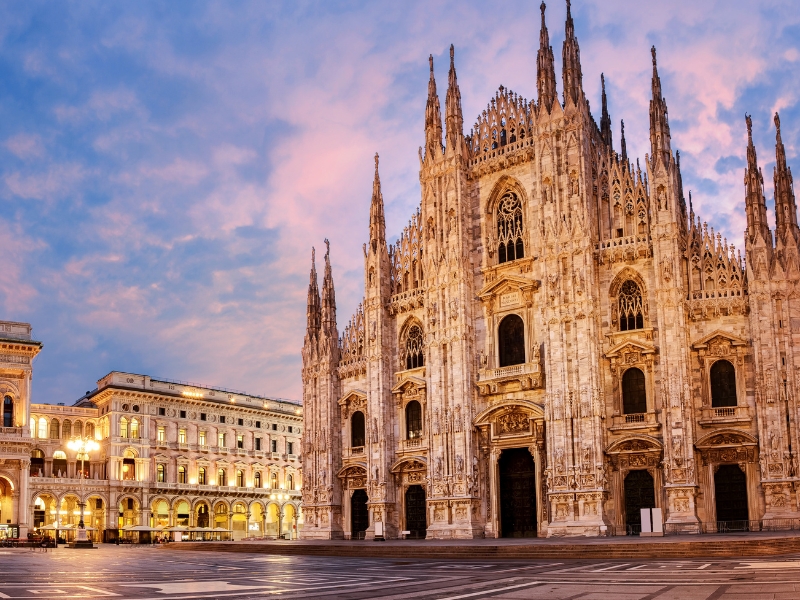
Milan Cathedral was begun in 1386 under Archbishop Antonio da Saluzzo, and work went on for centuries. Napoleon, who was crowned King of Italy here, ordered the facade finished in 1805, and the last bronze door was inaugurated only in 1965. The highest spire, completed in 1762 at 108.5 metres, carries the statue of the Madonnina, the symbol of the city. You can go up to the roof terraces, among the spires and flying buttresses, for a close look at the carvings. Inside, a meridian line laid into the floor from 1786 by astronomers of the Brera Observatory marks solar noon, which was once used to set the city's clocks.
- The statue of St Bartholomew flayed by Marco d'Agrate (1562), near the altar, with the saint's own skin draped over his shoulders.
- A small red light high above the apse, marking the place where a nail said to come from the Cross is kept.
Galleria Vittorio Emanuele II
The glass-roofed arcade between Piazza del Duomo and Piazza della Scala was designed by Giuseppe Mengoni and built between 1865 and 1877. Two arcades cross in an octagon under a glass dome. Among the shops and cafés inside are the Biffi café, founded in 1867, and the Borsalino hat shop, which dates from 1883.
- The floor mosaics with the coats of arms of Turin, Florence, Rome and Milan. Tradition says that spinning three times with your heel on the bull of Turin brings luck, which has worn a hole in the mosaic; it was restored in 2017 and again in 2026.
How to see them in one walk
The order above is the order of the walk. Start at Sforza Castle and walk to Santa Maria delle Grazie on Corso Magenta. From there head to Via Carducci for Castello Cova and on to Sant'Ambrogio, with the Temple of Victory just behind its apse. Walk north back to Corso Magenta for San Maurizio, then east into the centre for Piazza Mercanti, the Duomo and the Galleria, and finish in Piazza della Scala, in front of the opera house.
See Milan with World City Trail
Our Milan scavenger hunt turns the centre into a game you play on your phone. The route links 10 stops, from Sforza Castle to Piazza della Scala, and all nine places in this guide are stops. At each stop you solve a puzzle and learn a story, at your own pace.
There is also a self-guided walking tour and an outdoor escape game in Milan, for people who prefer a different format.
Play the Milan scavenger hunt →
Take the self-guided walking tour of Milan →
Play the outdoor escape game in Milan →
Facts checked in October 2026.