
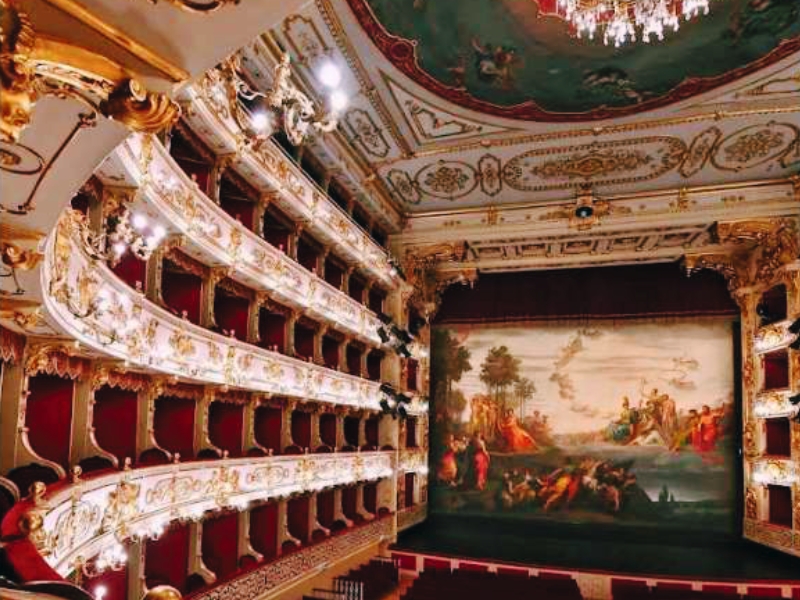
Parma is a city of opera and of Romanesque stone, and this guide follows both: the Teatro Regio, the museum of the Constantinian Order inside the Steccata church, what is left of the great Verdi monument in Piazzale della Pace, the cathedral and the baptistery beside it. All five lie in the compact old centre on the east bank of the Parma stream, and together they show the city's two faces, the ducal court that loved music and the medieval commune that built in marble.
Teatro Regio
Parma's opera house was commissioned by Marie Louise, the Austrian archduchess and former wife of Napoleon who ruled the duchy from 1816 to 1847. Her architect Nicola Bettoli began work in 1821 on the site of a former monastery next to the ducal palace, and the theatre opened on 16 May 1829 with the premiere of Bellini's opera Zaira. It was first known as the new ducal theatre, was called Teatro Reale from 1849 and took the name Teatro Regio after Italian unification.
Giuseppe Verdi was born in the countryside near Busseto, in the province of Parma, and the Regio has staged every one of his operas since he directed Nabucco here on 17 April 1843. Every autumn the city holds the Festival Verdi, built around his music. The house seats about 1,400 people in four tiers of boxes topped by a gallery, and its audience is famous for making its approval or disapproval heard: a singer who is not in good voice will know it.
- The neoclassical facade with its row of columns facing Strada Garibaldi.
- Inside, the ceiling painted by Giovan Battista Borghesi with portraits of famous playwrights, best seen on a guided visit or from your seat at a performance.
Museo Costantiniano della Steccata
The Basilica of Santa Maria della Steccata, a Renaissance church a short walk from the Regio, is the seat of the Constantinian Order of Saint George, an order of chivalry whose first official record dates from 1551 and which traces its origins, by tradition, to the emperor Constantine. In 2006 the Order decided to create a museum route inside the basilica, and the Museo Costantiniano is the result. Its entrance is on the left side of the church, on Via Dante.
The most striking part is the crypt, two flights of stairs below the church, which holds the tombs of almost all the Farnese dukes of Parma and of some of the Bourbon-Parma dukes who followed them, including Alessandro Farnese and his wife. Upstairs the sacristy keeps baroque wooden cabinets and a Holy Family altarpiece of 1607 by Giovanni Sons. The Steccata church is one of the stops of our scavenger hunt, so the museum makes a good pause on the route.
- The treasury: 16th- and 17th-century chasubles, a silver altar frontal of 1717 and a silver-gilt reliquary of 1713.
- Among the relics of the Farnese and Bourbon families, a shirt described as the one Louis XVI of France wore on the scaffold, and the wedding cloak of Maria Luisa of Bourbon.
Monumento a Giuseppe Verdi and Piazzale della Pace
Parma once had one of the largest monuments to Verdi anywhere. Designed by Lamberto Cusani, with sculptures by Ettore Ximenes, it was inaugurated on 22 February 1920 in the square in front of the railway station: a huge triumphal arch crowned by lions pulling a chariot, with two curved colonnades carrying 28 statues of characters from Verdi's operas. Allied bombs hit it on 13 May 1944, and although the damage was not very serious, it was later demolished to make room for new buildings. Only the central altar survived, and it now stands in Piazzale della Pace, beside the Palazzo della Pilotta. Of the 28 statues, nine are today in a theatre in Roccabianca, a village in the province.
The square around it is itself a result of the war. The same raid of May 1944 destroyed the ducal palace and a theatre that stood here, and the space stayed largely empty for about forty years. The Swiss architect Mario Botta designed the large lawn, built between 1998 and 2001, with a fountain by the Pilotta, and a further renovation was opened in 2019. Both the Verdi monument and Piazza della Pace are stops of our scavenger hunt.
- On the altar, the front relief of Verdi surrounded by the Muses, and on the back three scenes about Parma's annexation to the Kingdom of Italy in 1859.
Parma Cathedral
The Duomo was begun after a fire in 1058 and consecrated by Pope Paschal II in 1106, and only eleven years later the earthquake of 1117 damaged it so badly that it had to be restored. Its sandstone facade, with three tiers of loggias and three portals, was completed in 1178. Beside it rises the Gothic bell tower, built between 1284 and 1294 and topped by a gilded copper angel; a matching tower on the other side was planned but never begun.
Inside, look up. The dome is covered by Correggio's Assumption of the Virgin, painted between 1526 and 1530, a swirl of figures rising into the light. In the right transept is the Deposition from the Cross, a relief carved in 1178 by Benedetto Antelami for the old pulpit, which was later taken apart. The cathedral is the last stop of our scavenger hunt.
- The two marble lions supporting the columns of the main portal, carved in 1281 by Giambono da Bissone.
- The portal doors, sculpted in 1494 by Luchino Bianchino.
- In the crypt, fragments of ancient floor mosaics and the monument to Saint Bernardo degli Uberti, bishop of Parma in the early 12th century.
Baptistery of Parma
Facing the cathedral across the square is the baptistery, an octagon of pink Verona marble begun in 1196 by Benedetto Antelami, the same sculptor who carved the Deposition in the Duomo. Its four tiers of open loggias are topped by eight turrets. Building stopped for decades in the early 13th century, when wars with Ezzelino da Romano cut off the supply of marble from Verona, and the baptistery was consecrated in 1270.
Around the lowest level runs a band of 75 small panels with animals and fabulous beasts: centaurs, mermaids, sea monsters and unicorns. Inside, the plan becomes sixteen-sided, with niches painted in the 13th and 14th centuries and a dome divided into concentric bands of frescoes, and a large octagonal basin made for baptism by immersion. The baptistery is one of the stops of our scavenger hunt.
- The three portals: the Virgin on the north side, the Last Judgment on the west, and on the south a lunette with a man eating honey in a tree.
- Inside, Antelami's high reliefs of the months and seasons; the cycle is incomplete, and summer and autumn are missing.
How to see them in one walk
Start at Piazzale della Pace and the Verdi altar, then cross Strada Garibaldi to the Teatro Regio. From there it is a short walk to the Steccata church and its museum, so plan time for the crypt. Continue east through the centre to Piazza Duomo, where the baptistery and the cathedral stand side by side, a fitting place to finish. Check the times of guided visits to the Regio before you go, as the theatre is a working opera house.
See Parma with World City Trail
Our Parma scavenger hunt turns the old centre into a game you play on your phone. The route links 10 stops, from the Parco Ducale to the cathedral, and the Verdi monument, Piazza della Pace, the Teatro Regio, the Steccata church, the baptistery and the cathedral from this guide are all stops, along with the Palazzo della Pilotta, the Governor's Palace and Piazza Garibaldi. At each stop you solve a puzzle and learn a story, at your own pace.
There is also a self-guided walking tour and an outdoor escape game in Parma, for people who prefer a different format.
Play the Parma scavenger hunt →
Take the self-guided walking tour of Parma →
Play the outdoor escape game in Parma →
Facts checked in October 2026.