
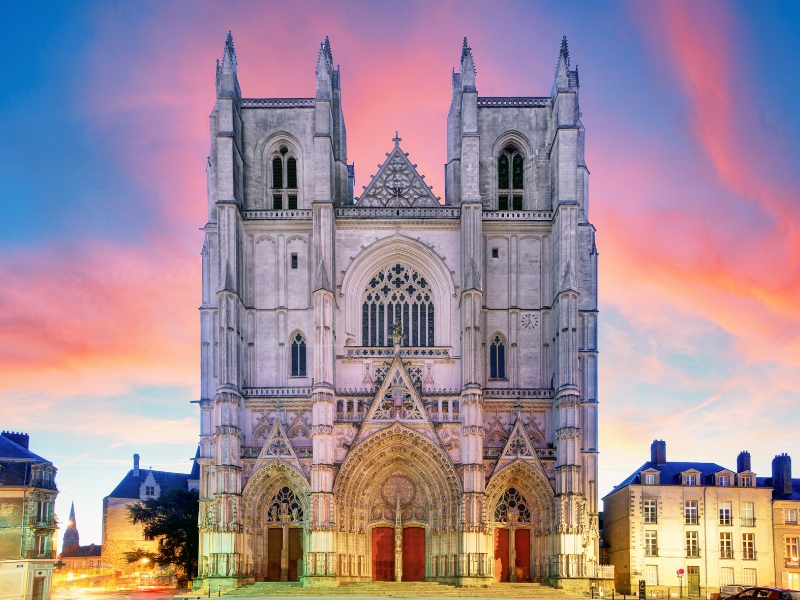
This guide covers four places on our Nantes route: the Cathedral of Saint Peter and Saint Paul, the Musée d'arts, the Théâtre Graslin and the Natural History Museum. Two stand in the old town around the cathedral, two in the 18th-century district built by the merchants of the port, and together they show how Nantes grew from a bishop's city into a wealthy trading town.
Nantes Cathedral (Saint-Pierre-et-Saint-Paul)
The cathedral took a remarkably long time to finish. Duke John V of Brittany and Bishop Jean de Malestroit laid the foundation stone on 14 April 1434, on the site of an earlier Romanesque cathedral, and the choir was only completed in 1891, some 457 years later. Despite that, the building looks surprisingly unified: it is Late Gothic throughout, in a pale stone that makes the interior unusually bright. The nave rises about 37.5 metres under the vaults.
The cathedral has had a hard 20th and 21st century. It was hit by Allied bombing in June 1944, and a fire started by a workman's blowtorch badly damaged the roof in 1972, which led to a full restoration of the interior. On 18 July 2020 an arsonist set fires in three places; the great organ of 1621 at the west end, the large west window and a painting by Hippolyte Flandrin were destroyed. Repairs after the 2020 fire may still affect access to parts of the building, so check before you go.
- The tomb of Francis II, Duke of Brittany, and his wife Marguerite de Foix, the parents of Anne of Brittany, made between 1502 and 1507 by Michel Colombe and Jean Perréal, with the twelve apostles and four figures of the cardinal virtues: Justice, Strength, Temperance and Prudence.
- The outdoor pulpit on the west front, built for preaching to crowds in the square.
- The five carved portals of the west front, dedicated from north to south to the Nantes martyrs Donatien and Rogatien, Saint Peter, the Last Judgement, Saint Paul and Saint Yves.
- The 11th-century Romanesque crypt, a survivor of the earlier cathedral, where liturgical objects are on show.
Musée d'arts de Nantes
The city's art museum, a short walk from the cathedral on Rue Georges-Clemenceau, was created by a consular decree of 1801. Its collection grew in 1810 when the city bought the paintings of the brothers Pierre and François Cacault. The present palace was designed by the Nantes architect Clément-Marie Josso; work began in 1893 and it opened in 1900, the year of the Paris Universal Exhibition. Its galleries are arranged around a central courtyard covered by a glass roof, the patio.
After closing in 2011, the museum was renovated and extended by the British firm Stanton Williams, and it reopened in 2017 under its new name, Musée d'arts de Nantes. The extension added new buildings for contemporary art and brought the nearby Oratory chapel into the museum. The collection runs from the 13th century to today. The museum is the first stop of our scavenger hunt.
- Three paintings by Georges de La Tour: The Dream of Saint Joseph, The Hurdy-Gurdy Player and The Denial of Saint Peter.
- Ingres's Portrait of Madame de Senonnes (1814) and Courbet's The Wheat Sifters.
- Monet's The Water Lily Pond (1907) and eleven works by Kandinsky from 1922 to 1933.
Théâtre Graslin
The Théâtre Graslin closes the north side of Place Graslin, the square at the centre of a new district laid out in the late 18th century. Jean-Joseph-Louis Graslin, who owned the land, launched a speculative development here in the late 1770s, with a theatre meant to draw wealthy residents. The local architect Mathurin Crucy designed it, and it was inaugurated on 23 March 1788. Its prestige helped pull the life of the city towards the new district.
In 1796 a fire broke out during a performance of the opera Zémire et Azor; the roof, the dome and the great chandelier collapsed, and seven people died. Crucy rebuilt the theatre from 1811, and it reopened on Easter Day 1813. Today the Théâtre Graslin is one of the two home stages of Angers Nantes Opéra, together with the Grand Théâtre in Angers. It is a stop on our scavenger hunt.
- The portico of eight Corinthian columns on the front, with a projecting cornice above.
- The statues of eight of the nine Muses on top of the facade, by the sculptor Dominique Molknecht, put in place in 1825.
- Inside, if you see a performance: the oval auditorium with gilded balconies and the dome painted by Hippolyte Berteaux in 1881.
Natural History Museum
The Muséum d'histoire naturelle stands on Place de la Monnaie, a short walk from Place Graslin. Its collection began as the private natural history cabinet of the pharmacist François-René Dubuisson, created in 1799. The present building, designed by Gustave Bourgerel, was begun in 1868 next to the old Hôtel de la Monnaie, the former mint built by Colomb Gengembre in 1821–1826.
The galleries cover zoology, with more than a thousand vertebrates, and Earth sciences, with minerals, rocks, fossils and meteorites, and the museum also keeps large botany and shell collections. In 2023 the city council approved a major renovation, with work planned from 2025, so check whether the museum is open before you visit. The museum is a stop on our scavenger hunt.
- The skeleton of a fin whale more than 18 metres long, an animal struck by a ship in 1991 whose bones were recovered at Donges, on the Loire estuary.
- The vivarium, opened in 1955, with live regional species, including insects, turtles, snakes and lizards.
- The building on Place de la Monnaie and the old mint beside it, which gave the square its name.
How to see them in one walk
Start at the Musée d'arts on Rue Georges-Clemenceau, the first stop of our scavenger hunt, then walk the few minutes to the cathedral and the old town around it. From there head west through the city centre to Place Graslin and the theatre, and continue a short way south-west to the Natural History Museum on Place de la Monnaie. The Loire quays and the Memorial to the Abolition of Slavery, where our route ends, are not far beyond.
See Nantes with World City Trail
Our Nantes scavenger hunt turns the city into a game you play on your phone. The route links 10 stops, from the Musée d'arts to the Memorial to the Abolition of Slavery, and all four places in this guide are stops, along with the Château des ducs de Bretagne, Sainte-Croix Church, the Basilica of Saint-Nicolas, Place Royale and the Passage Pommeraye. At each stop you solve a puzzle and learn a story, at your own pace.
There is also a self-guided walking tour and an outdoor escape game in Nantes, for people who prefer a different format.
Play the Nantes scavenger hunt →
Take the self-guided walking tour of Nantes →
Play the outdoor escape game in Nantes →
Facts checked in October 2026.