
Most visitors to Sintra head straight up the hill to the Pena Palace and the Moorish Castle, but the town below has plenty to see on its own. This guide covers three places in the historic centre that sit along the same short walk: the Sintra National Palace with its two giant chimneys, the Parque da Liberdade, a public park laid out in the 1930s, and the Volta do Duche, the curving road that links them and is lined with fountains. All of them lie inside the Cultural Landscape of Sintra, a UNESCO World Heritage Site since 1995.
Sintra National Palace
The Sintra National Palace, also called the Palácio da Vila, stands in the main square of the old town, Largo Rainha D. Amélia. Parques de Sintra, which runs it, calls it the oldest palace in Portugal. Its first building probably goes back to the 10th or 11th century, when Sintra was under Moorish rule and the site was a residence of the local Muslim rulers; King Afonso Henriques took it in the 12th century. Most of what you see today comes from two kings. João I began a large building campaign around 1415 that created the wings around the central courtyard, and between 1497 and 1530 Manuel I added a wing in the Manueline style and had many rooms covered with tiles made in Seville.
For centuries the palace was a favourite royal retreat. Kings and queens came for the hunting, for the cool summers and to escape outbreaks of plague in Lisbon, and in the late Middle Ages it was the centre of a large territory under the care of the queens of Portugal. It also served as a prison: King Afonso VI, deposed by his brother Pedro II, was confined here from 1676 until his death in 1683.
The interior is a sequence of rooms named after their ceilings. The Coats of Arms Room, made around 1515 to 1518, has a wooden domed ceiling with 72 coats of arms of the king and the noble families of the time; the arms of the Távora family were later taken out. In the Magpie Room, painted magpies hold a motto in their beaks. Legend says that João I was caught kissing a lady-in-waiting and had one magpie painted for every woman at court, to put an end to the gossip.
- The two tall conical chimneys over the royal kitchen, which give the palace its outline and can be seen from all over town.
- The Swan Room, named after the swans painted on its ceiling, and the Arab Room, with tiled walls and a fountain in the middle in a Moorish style.
- The royal chapel, possibly from the early 14th century, with a tiled floor and a wooden ceiling in Moorish latticework.
- The Renaissance fountain on the palace stairs, the Chafariz do Paço Real, topped by a small castle with five towers.
Parque da Liberdade
The Parque da Liberdade was once the garden of the Palácio Valenças, a 19th-century mansion next to it. In 1936 the town's tourism commission announced that it had bought the grounds to give Sintra a public park, and the park opened in July 1937 in the presence of the President of the Republic. A tennis court and a roller-skating rink followed in 1939. It is one of the stops on our scavenger hunt.
Unlike the formal gardens of the palaces up the hill, the park has been left to grow largely in its own way. The town council counts about 410 trees and plants of some 60 species, and the shady paths climb the slope above the Volta do Duche, so it is a cool place to walk on a hot day.
- The Fonte dos Plátanos, a rectangular stone basin by the Palácio Valenças, on Rua Visconde de Monserrate.
- The different levels of the park, with paths and steps winding up the hillside among old trees.
Along the Volta do Duche
The Volta do Duche is the curving road that leads from the newer part of Sintra, around the town hall, into the historic centre and the palace square. It is the classic way to walk into the old town, with the park rising on one side. The entrance to the Parque da Liberdade is on this road, and on the way you pass several fountains, a reminder of how much Sintra's water has always been prized.
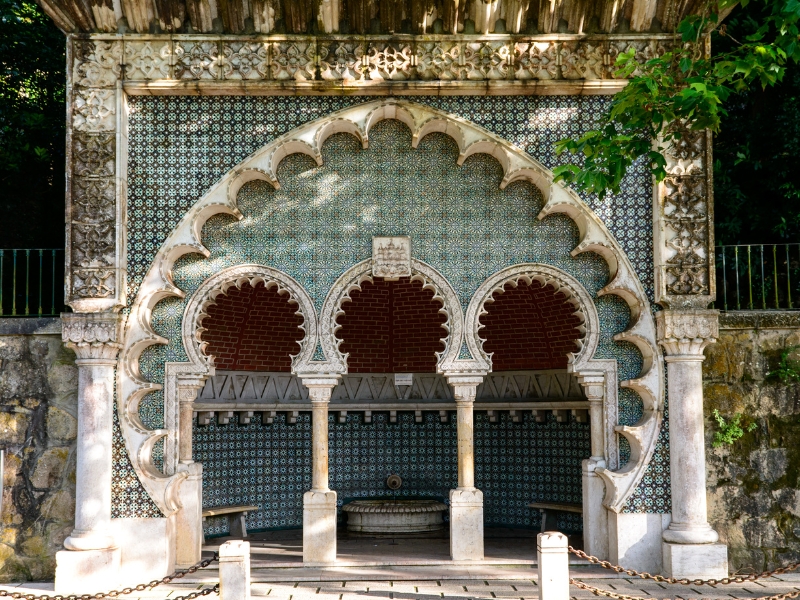
The best known is the Fonte Mourisca, the Moorish Fountain, built in 1922 by José da Fonseca, who had worked with Luigi Manini on the Quinta da Regaleira. It has a horseshoe arch, neo-Moorish tiles and an oval basin with a scalloped edge. When the road was widened in 1960 the fountain was taken apart, and twenty years later it was put back together a short distance further along, where it stands today.
How to see them in one walk
Start in the newer part of town near the station and the town hall, and follow the Volta do Duche towards the old town. Step into the Parque da Liberdade for a loop under the trees, then come back to the road and continue past the Fonte Mourisca until the palace chimneys come into view. Finish in the square in front of the Sintra National Palace and visit the interior. Arrive early if you can, and leave the hilltop palaces for another day or for the afternoon.
See Sintra with World City Trail
Our Sintra scavenger hunt turns the town into a game you play on your phone. The route links 10 stops, starting at Sintra train station and finishing at the Pisões waterfall, and both the Parque da Liberdade and the Sintra National Palace are stops. Along the way it also passes the town hall, the Palácio Valenças, St. Martin Church, the Marco Histórico Carlos França and the Fonte dos Pisões. At each stop you solve a puzzle and learn a story, at your own pace.
There is also a self-guided walking tour and an outdoor escape game in Sintra, for people who prefer a different format.
Play the Sintra scavenger hunt →
Take the self-guided walking tour of Sintra →
Play the outdoor escape game in Sintra →
Facts checked in October 2026.