
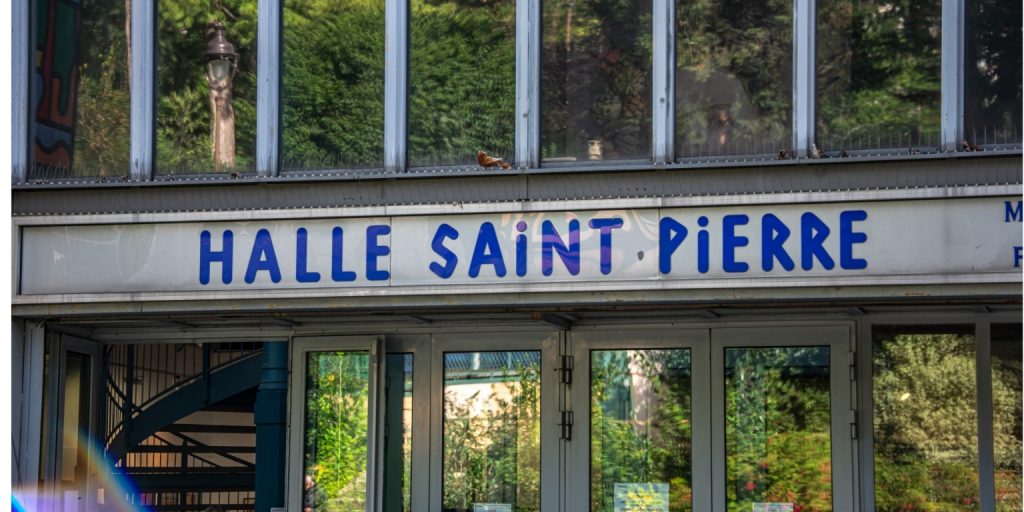
Montmartre is more than the basilica and the painters' square. This guide covers four places that tell the story of the hill through art and storytelling: the Halle Saint-Pierre at the foot of the slope, the Musée de Montmartre and its Renoir Gardens, the Passe-Muraille statue of a man stuck in a wall, and the bronze bust of the singer Dalida. All four sit on the north and south sides of the same small hill, so you can see them in one walk.
Halle Saint-Pierre
The Halle Saint-Pierre stands on rue Ronsard, at the foot of Montmartre, next to the gardens of the Square Louise-Michel that climb towards Sacré-Cœur. The building is a former market hall in the style of Victor Baltard, the architect of the iron pavilions of the old Les Halles. It began as a market, later became a school and then a garage for the city's street-cleaning service. The City of Paris still owns it, and since 1985 an association of the same name has run it.
Today it is a museum and exhibition space for naive art, art brut and outsider art: work by self-taught artists, patients and people outside the art world. Since 1995 it has put on three or four temporary exhibitions a year, from national surveys such as Haiti, Brazil and Japan to shows devoted to single artists. In 1995 its bookshop also launched the French edition of Raw Vision, a magazine about outsider art.
- The exhibition of the moment: the shows change several times a year, so check what is on before you go.
- The bookshop, specialised in art writing, artists' books and outsider creation, and the café next to it.
Musée de Montmartre and the Renoir Gardens
The Musée de Montmartre occupies a group of old houses on rue Cortot, behind the Sacré-Cœur and next to the Montmartre vineyard. The Maison du Bel Air, built in 1660, is one of the oldest buildings on the hill and holds the permanent collection. For a long time it was believed to have belonged to Rosimond, an actor in Molière's company, but a study in 2012 showed that attribution was wrong. The museum opened in 1960 as the Musée du Vieux-Montmartre and is one of the stops on our scavenger hunt.
The houses were full of artists. Pierre-Auguste Renoir rented a studio here in 1876, and while living here he painted Bal du moulin de la Galette and La Balançoire (The Swing). Suzanne Valadon lived here with her son Maurice Utrillo and her partner André Utter, a trio nicknamed the Trio infernal. Raoul Dufy, Émile Bernard and the illustrator Francisque Poulbot also worked at the address. Valadon and Utrillo's studio apartment was reconstructed from photographs, letters and her paintings and opened in October 2014.
The collection covers the artistic, religious, political and festive history of the hill, with paintings, posters, prints and photographs, and themed rooms on the Bateau-Lavoir, the Chat Noir cabaret and its shadow theatre, the Lapin Agile and the building of the Sacré-Cœur. The gardens behind the houses were redesigned in 2012 after Renoir's paintings of the area and are named the Renoir Gardens.
- The fruit trees, lilacs, roses and climbing hydrangeas, planted to echo Renoir's views of these gardens.
- The view down over the Clos Montmartre vineyard, replanted in 1933 on a slope where vines had grown since the Middle Ages.
- The reconstructed studio apartment of Suzanne Valadon and Maurice Utrillo.
Le Passe-Muraille
At the bottom of rue Norvins, on the small Place Marcel-Aymé, a bronze man is caught halfway through a stone wall, his head and a hand sticking out. He is Dutilleul, the hero of Marcel Aymé's short story Le Passe-muraille (The Man Who Walked Through Walls), first published in 1941 and collected in 1943. Dutilleul is a shy, third-class clerk at a ministry who discovers he can pass through walls. He uses the gift to steal as Garou-Garou, escapes from prison and falls in love, until one night, leaving his lover's room, he loses the power and stays stuck in a wall on rue Norvins, exactly where the statue now stands.
The sculpture was made by the actor Jean Marais, who gave Dutilleul the features of Marcel Aymé himself. The story has had a long life: a 1951 film with Bourvil, television versions in 1977 and 2016, and a musical by Didier van Cauwelaert and Michel Legrand that played in Paris and, as Amour, on Broadway. Le Passe-Muraille is one of the stops on our scavenger hunt.
- The face: look closely and you are looking at Marcel Aymé, the author, caught in his own story.
Bust of Dalida
A short walk down rue Girardon brings you to Place Dalida, a tiny square at the crossroads of rue Girardon, rue de l'Abreuvoir and the allée des Brouillards. It was named in 1996, and in 1997, for the tenth anniversary of the singer's death, a bronze bust by the sculptor Alain Aslan was unveiled here. It is one of the stops on our scavenger hunt, and the square has become a place where admirers come to remember her.
Dalida was born Iolanda Cristina Gigliotti in Cairo in 1933, to Italian parents. In 1956 her song Bambino reached number one in France and stayed there for a record-breaking run, and later hits included Paroles, paroles, a duet with Alain Delon, and Gigi l'amoroso. She lived on nearby rue d'Orchampt, died at her Montmartre house in May 1987 and is buried in the Montmartre Cemetery, further down the hill.
- The view down rue de l'Abreuvoir, a lane first recorded in 1325 and later named after the old watering trough for horses at the corner of rue Girardon.
How to see them in one walk
Start at the Halle Saint-Pierre at the bottom of the hill, then climb through the Square Louise-Michel or take the funicular next to it up to the Sacré-Cœur. Walk behind the basilica to rue Cortot and the Musée de Montmartre. From there, follow rue Norvins west to Place Marcel-Aymé and the Passe-Muraille, and finish by going down rue Girardon to Place Dalida. The streets are steep and cobbled, so wear good shoes, and if you want to visit the museum or an exhibition at the Halle, plan your walk around them.
See Montmartre with World City Trail
Our Montmartre scavenger hunt turns the hill into a game you play on your phone. The route links 10 stops, from the Wall of Love to the Square Louise-Michel, and three places in this guide are stops: the Musée de Montmartre, the Passe-Muraille and the bust of Dalida. The Halle Saint-Pierre is not a stop, but it stands right next to the Square Louise-Michel, where the route ends. At each stop you solve a puzzle and learn a story, at your own pace.
There is also a self-guided walking tour and an outdoor escape game in Montmartre, for people who prefer a different format.
Play the Montmartre scavenger hunt →
Take the self-guided walking tour of Montmartre →
Play the outdoor escape game in Montmartre →
Facts checked in October 2026.