
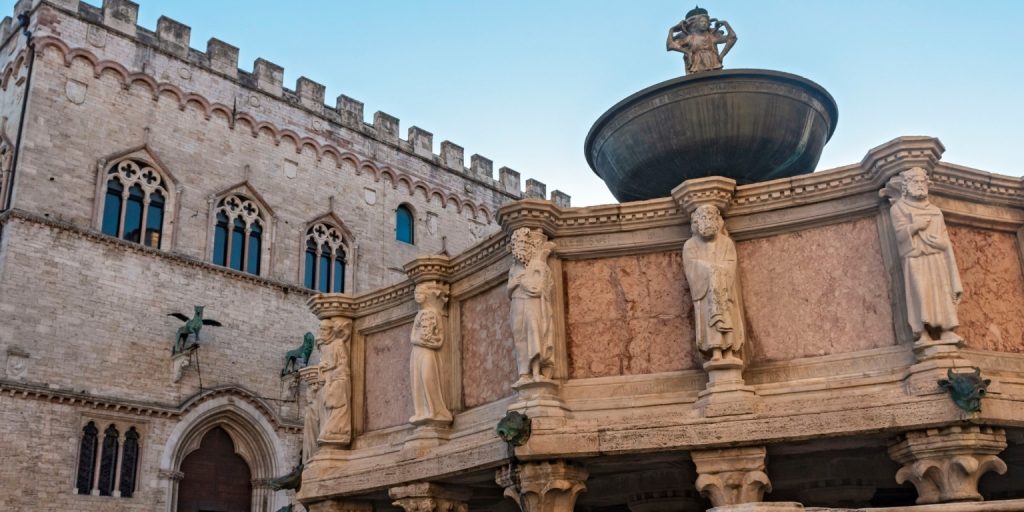
Perugia's hilltop centre packs more than two thousand years into a short climb. This guide covers four places on the oldest part of the hill, from the Etruscan Arch in the old city wall up to Piazza IV Novembre, where the cathedral, the Fontana Maggiore and the Palazzo dei Priori stand around one square, and ends with the classic day trip from Perugia to Assisi.
The Etruscan Arch (Arco Etrusco)
The Etruscan Arch, also called the Arch of Augustus, was one of the eight gates in the Etruscan walls of ancient Perusia and is one of only two that survive from the original circuit. It dates from the second half of the 3rd century BC. In 40 BC, after Octavian, the future Augustus, had won the Perusine War against Mark Antony's brother Lucius, the gate was restored, and the city took the name Augusta Perusia. Two trapezoidal towers flank the arch, and later centuries added their own layers: a loggia on top of the left-hand tower in the 16th century and a fountain at its base, completed in 1621.
- The inscriptions: Augusta Perusia on one face, and Colonia Vibia on the other, a reference to the colonial status granted by Emperor Trebonianus Gallus in the 3rd century AD.
- The huge blocks of the towers, then the Renaissance loggia sitting on top of the left one: it shows how later Perugians simply built on the ancient gate.
The Cathedral of San Lorenzo
Perugia's cathedral is dedicated to Saint Lawrence and, from the beginning, also to the city's patron Sant'Ercolano. The design goes back to a project of 1300 by Fra Bevignate; building started in 1345 and finished in 1490, and the church was consecrated in 1587. Unusually for a cathedral, it turns its long side, not its front, towards the main square, Piazza IV Novembre. The planned facing of white and pink marble in a lozenge pattern was never finished, and only a trial section shows what it was meant to look like.
Inside, the first chapel keeps the Holy Ring (Santo Anello), a relic said to be the Virgin Mary's wedding ring, which was stolen from the town of Chiusi in 1473 and brought to Perugia. The church's most important painting is the Deposition by Federico Barocci, painted between 1567 and 1569 and hanging in the Chapel of San Bernardino. A cathedral museum holds altarpieces by painters such as Luca Signorelli and Agnolo Gaddi.
- The outdoor pulpit set into the wall on the square side, from which Saint Bernardino of Siena preached in 1425 and 1427, made from ancient fragments and Cosmatesque mosaic.
- The bronze statue of Pope Julius III by Vincenzo Danti, from 1555, beside the steps; it was moved to the side to make room for the electric tram that opened in 1899.
- The Loggia di Braccio, an early Renaissance loggia commissioned in 1423 by the condottiere Braccio da Montone, once part of the Palazzo del Podestà that burned down in 1534.
The Fontana Maggiore
In the middle of Piazza IV Novembre stands the Fontana Maggiore, built between 1275 and 1278 to celebrate the arrival of running water on the hilltop. The hydraulic engineer Boninsegna Veneziano brought the water from Monte Pacciano through a pressurised pipe that carried it uphill without pumps. The fountain itself was designed by Fra Bevignate, and its marble reliefs were carved by Nicola Pisano and his son Giovanni, two of the leading sculptors of their age. The bronze cup on top, with three female figures holding a jug, was cast by the Perugian Rosso Padellaio.
The fountain has two polygonal marble basins, one above the other. The lower basin has 25 sides with two panels each, around 50 in all, and the upper basin carries 24 statues of saints, biblical figures and characters from Perugia's history and legend. The earthquake of 1348 damaged it, and when the panels were put back they ended up in a random order. It was restored in 1948–49 and again between 1995 and 1999.
- On the lower basin, find the twelve months of the year, each with its typical farm work and its sign of the zodiac, from January with Aquarius to December with Capricorn.
- Look for Perugia's griffin and the Guelph lion, the liberal arts, Adam and Eve, Samson, David and Goliath, Romulus and Remus with the she-wolf, and two fables of Aesop among the panels.
- On the upper basin, look for the figure of Augusta Perusia, the personification of the city, with the nymph of Lake Trasimeno (Domina lacus) and Euliste, the city's legendary founder, among the figures around her.
The Palazzo dei Priori
The long Gothic town hall that closes the square was built in several phases between 1293 and 1443, swallowing older tower houses and even churches as it grew along the Corso. The oldest part is the Sala dei Notari, built in 1293–97, a great hall whose vaults rest on eight arches and whose walls carry frescoes from the late 13th century. It was the hall of popular assemblies before the notaries' guild took it over in 1582. The fan-shaped staircase that climbs to it from the square is much younger than it looks: it dates from 1902.
The guilds left their mark here too. The Collegio del Cambio, the hall of the money changers, was frescoed by Perugino and his workshop between 1498 and 1500, and the neighbouring Collegio della Mercanzia, used by the merchants since 1390, is lined entirely with late-Gothic wood panelling. The third floor houses the Galleria Nazionale dell'Umbria, the region's main art museum.
- Above the Gothic portal on the square, the bronze griffin of Perugia and the Guelph lion; the originals, made around 1274, are kept in the atrium. The chains hanging from them were taken from the gates of Torrita di Siena after a victory in 1358.
- The main portal on the Corso, built in 1346 and paid for by the butchers' guild, carved with reliefs of city life and statues of Perugia's patron saints.
- The bell tower standing on the bridge over Via dei Priori; its great bell was first rung on 12 November 1388.
A day trip to Assisi
Assisi is a separate town in the same province, on the western slope of Monte Subasio, and an easy day trip from Perugia. Its centre is the Basilica of Saint Francis, built between 1228 and 1253, with frescoes by Cimabue and Giotto in the lower church; part of the vault collapsed in the earthquake of September 1997, and the restoration took two years. In 2000 the basilica and other Franciscan sites were added to the UNESCO World Heritage list. In town, see the Basilica of Santa Chiara with the tomb of Saint Clare, and the well-preserved Roman Temple of Minerva on the Piazza del Comune, now a church.
How to see them in one walk
Start at the Etruscan Arch, at the northern edge of the old centre, and climb into the old town. You reach Piazza Danti in front of the cathedral's main facade, then step round onto Piazza IV Novembre with the cathedral's flank, the Fontana Maggiore and the Palazzo dei Priori all in view. Finish by walking along the front of the palace onto the Corso. Save Assisi for a separate day.
See Perugia with World City Trail
Our Perugia scavenger hunt turns the old town into a game you play on your phone. The route links 10 stops, starting at the Etruscan Arch, and four of them are in this guide: the Etruscan Arch, the Cathedral of San Lorenzo, the Palazzo dei Priori and the Fontana Maggiore. It also includes the Teatro Morlacchi, the Church of San Filippo Neri, the National Gallery, Corso Vannucci and Piazza della Repubblica, and finishes in Via della Viola. Assisi is not part of the route.
If you prefer a different format, there is also a self-guided walking tour and an outdoor escape game in Perugia.
Play the Perugia scavenger hunt →
Take the self-guided walking tour of Perugia →
Play the outdoor escape game in Perugia →
Facts checked in October 2026.