
Tallinn's Old Town is compact enough that six of its best-known places lie on a single walk, from the merchant quarter of the lower town up to Toompea hill and out to the square where the old town meets the modern city. This guide covers Town Hall Square, the monument to the writer Eduard Vilde, Freedom Square, Alexander Nevsky Cathedral, the Great Guild Hall with the Estonian History Museum and the House of the Blackheads. The Old Town has been a UNESCO World Heritage Site since 1997, and its street plan goes back to the 13th century.
Town Hall Square and the Town Hall
The sloping square below the Town Hall has been the centre of the lower town since the Middle Ages. The Town Hall took its present form in 1402–1404 and is described as the oldest town hall in the Baltic Sea region and Scandinavia, and the last surviving Gothic town hall in Northern Europe. Its slim tower is 64 metres tall; the spire was destroyed by bombing in 1944 and rebuilt in 1952. Town Hall Square is one of the stops on our scavenger hunt.
- Vana Toomas (Old Thomas), the soldier-shaped weathervane on top of the tower: the original dates from 1530, and the one you see now is an exact copy put up in 1996.
- The dragon-head gargoyles on the façade, hammered in copper by the coppersmith Daniel Pöppel, and the arcade of nine arches at street level.
- Inside, copies of tapestries ordered in 1547 with scenes from the life of King Solomon; the originals are kept in the City Museum.
Eduard Vilde Monument
Eduard Vilde (1865–1933) was a journalist and one of Estonia's best-known novelists. He wrote for several Estonian newspapers and from 1890 worked in Berlin as a freelance journalist. His opposition to the tsarist government forced him abroad after the 1905 revolution, and he lived in Switzerland, Finland, Germany, the United States and Copenhagen until 1917. His main work is a historical trilogy that opens with Mahtra sõda (The War in Mahtra, 1902), and Mäeküla piimamees (The Milkman of Mäeküla, 1916) is another of his best-known novels. He spent his last years in a house in Kadriorg and died in Tallinn. His monument in the city centre is one of the stops of our scavenger hunt.
Freedom Square
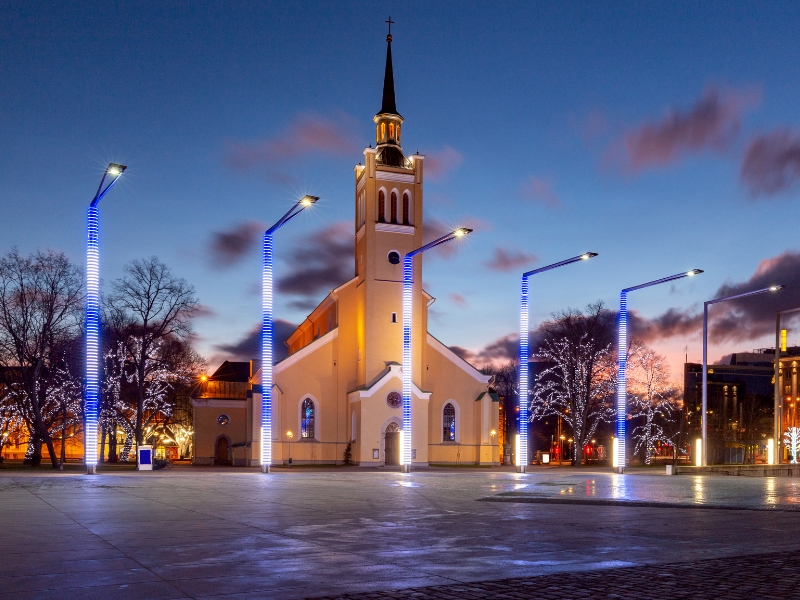
At the southern edge of the Old Town, Freedom Square (Vabaduse väljak) is where the medieval town meets the modern city. It was laid out on the site of a Swedish bastion in front of the Harju Gate, which was demolished in the mid-19th century. Its name has followed Estonia's history: the Soviets renamed it Victory Square in April 1941, the German occupiers restored the old name later that year, and from 1944 it was Victory Square again, the setting for Soviet parades. It was a car park until its redesign around 2009 and is now used for state ceremonies and concerts. Freedom Square is a stop on the scavenger hunt.
- The War of Independence Victory Column on the west side, topped by the Cross of Liberty and opened on 23 June 2009 in memory of those who died in the Estonian War of Independence of 1918–1920.
- St John's Church on the east side, built between 1862 and 1867.
Alexander Nevsky Cathedral
Up on Toompea hill rise the domes of Alexander Nevsky Cathedral. It was built in 1894–1900, when Estonia was part of the Russian Empire, to designs by the architect Mikhail Preobrazhensky in the Russian Revival style. Its eleven bells were cast in Saint Petersburg, and the largest weighs about 16 tonnes, more than the other ten together.
After independence the cathedral was controversial. In 1924 the architect Karl Burman proposed demolishing it or turning it into a pantheon of Estonian independence, and demolition was even scheduled for 1 May 1929 before the plan was cancelled. It is a working Orthodox church, so dress modestly and keep quiet during services. The cathedral is a stop on the scavenger hunt.
The Great Guild Hall and the Estonian History Museum
Back down in the lower town, on Pikk, then the main street, stands the Great Guild Hall, the Gothic seat of Tallinn's merchants, dating from 1410. A wine cellar called Das Süsse Loch, the "sweet burrow", occupied its basement from 1437 or earlier until the Second World War. Since 1952 the building has housed the Estonian History Museum, founded in 1864, and in 2014 it was among the first sites in Europe to receive the European Heritage Label.
The main exhibition, The Splendour of the Hanseatic League, on show until 2027, follows a medieval merchant to explain how Hanseatic trade brought wealth to the town, with archaeological finds and loans from Hamburg and Riga. The Armoury Room holds the largest weapons collection in Estonia. The Great Guild Hall is a stop on the scavenger hunt.
House of the Blackheads
Further along Pikk, at numbers 24–26, is the House of the Blackheads. The Brotherhood of Blackheads was an association of unmarried merchants, ship-owners and foreigners that began as a military body and became mainly social after the Great Northern War. Its patron was Saint Maurice, shown as a Black Egyptian Christian, whose head appears on the brotherhood's coat of arms. The brothers rented the house by 1406, bought it in 1531, rebuilt it in Renaissance style and kept it until the Soviet annexation in 1940. It is the only Blackheads' house to survive intact into the 21st century.
The brotherhood also has a place in the history of the Christmas tree. Records show that it put up a tree in its house in 1441, 1442 and 1514, the first documented Christmas trees in Estonia. The members danced around it, and on the last night they took it to Town Hall Square; the chronicler Balthasar Russow wrote in 1584 that the young men sang and danced there and then set the tree on fire. The House of the Blackheads is a stop on the scavenger hunt.
How to see them in one walk
Enter the Old Town through the Viru Gate, where the scavenger hunt begins, and pass the cloister of the Dominican St Catherine's Monastery on the way to Town Hall Square. Head south to the Vilde monument and Freedom Square, then climb Toompea for Alexander Nevsky Cathedral and the views. Come back down to Pikk for the Great Guild Hall and the House of the Blackheads, and follow the street north to the Estonian Maritime Museum, the last stop.
See Tallinn with World City Trail
Our Tallinn scavenger hunt turns the Old Town into a game you play on your phone. The route links 10 stops, from the Viru Gate to the Estonian Maritime Museum, and all six places in this guide are among them, along with the cloister of St Catherine's Dominican Monastery and Pikk street itself. At each stop you solve a puzzle and learn a story, at your own pace.
There is also a self-guided walking tour and an outdoor escape game in Tallinn, for people who prefer a different format.
Play the Tallinn scavenger hunt →
Take the self-guided walking tour of Tallinn →
Play the outdoor escape game in Tallinn →
Facts checked in October 2026.