
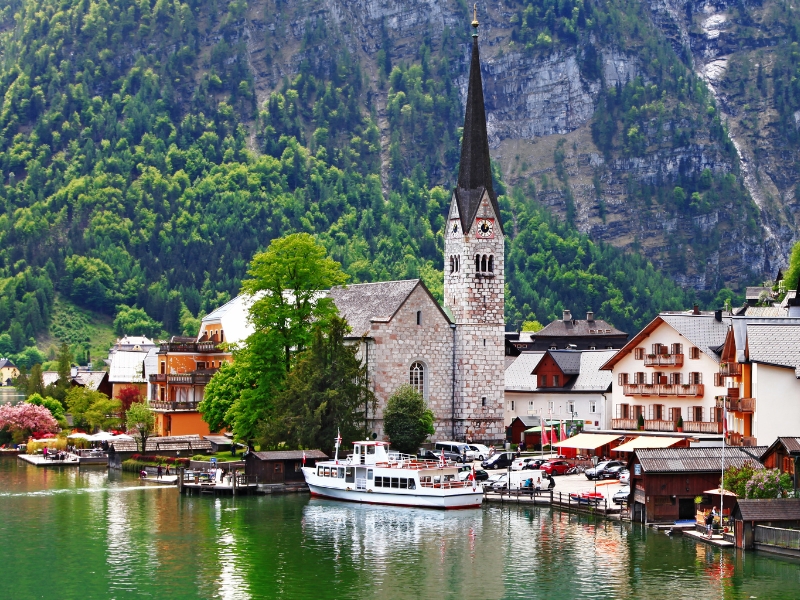
Most visitors to Hallstatt stay on the narrow strip of houses between the lake and the rock. This guide goes above and around it: the salt mine in the high valley, the Rudolfsturm and the Skywalk platform, the old brine pipeline, the Hallstätter See itself and Seestraße, the lakeside lane whose story explains why traffic passes the village in a tunnel. Together they show what Hallstatt lived on for thousands of years: salt, and the water that carried it away.
The Hallstatt salt mine
High above the village, in the Salzbergtal, lies the salt mine that made Hallstatt rich. Mining here can be traced back to around 1500 BC, in the Bronze Age, and the mine is often called the oldest salt mine in the world; it is still worked today. Its 21 levels run from about 514 metres up to around 1,267 metres above sea level. Visits are run by Salzwelten and include a ride on the mine train, the miners' wooden slides and an underground salt lake.
Finds from the mountain are remarkable because salt preserves what would rot anywhere else. A Bronze Age wooden staircase found in the mine, dated by its tree rings to 1344 and 1343 BC, is described as the oldest preserved wooden staircase in Europe. In 1734 miners came across the body of a man in the Kilbwerk section, so well preserved by the salt that he had become part of the rock; later research linked him to the early La Tène period. And in 2025, digging for a new funicular station turned up a Roman-era cameo with the head of Medusa.
- The high valley itself, where the Iron Age cemetery lay: it was used from about 800 to 400 BC and may once have held 5,000 to 6,000 graves, which is why an entire period of prehistory carries Hallstatt's name.
- The Dammwiese, a raised bog in the high valley at 1,357 metres, where remains of later mines and settlements from the La Tène period have been found.
Rudolfsturm
Up by the salt mine, on a spur above the rooftops, stands the Rudolfsturm. Duke Albrecht I of Habsburg had it built between 1282 and 1284 to protect the mine and named it after his father, Rudolf I. It served as a stronghold during the Salt War and then, for centuries, as the home of the mine manager, until the 20th century. Today it houses a restaurant, so you can sit with the lake far below you.
Skywalk Welterbeblick
The Skywalk, also called the Welterbeblick or World Heritage View, is a viewing platform that sticks out from the mountainside 360 metres above the ground. From it you look straight down on the roofs and the lake, and across to the Dachstein massif, which gives the UNESCO World Heritage landscape of Hallstatt-Dachstein Salzkammergut its name. It belongs to the salt mine area, so it is easy to combine with a mine visit or a meal at the Rudolfsturm.
- The view down the length of the Hallstätter See, with the far shore where the railway station and the ferry landing are.
The brine pipeline (Soleleitung)
Salt did not leave Hallstatt as rock. It was dissolved in water inside the mountain and sent away as brine to be boiled down elsewhere. The brine pipeline from Hallstatt to Ebensee, further north in the Traun valley, is often described as the oldest pipeline in the world: it was laid about 400 years ago from some 13,000 hollowed-out tree trunks.
Long sections of its route are now protected monuments, among them a staircase cut into the rock, a gallery carved into the cliff and the bridge at Gosauzwang, where the pipeline crosses the Gosau stream on its way along the lake. Walking a stretch of it is a quiet way to see how much engineering lay behind the village's wealth.
Hallstätter See
The lake that fills every view of Hallstatt reaches about 125 metres deep in its southern basin. The river Traun flows in from the south and leaves at the north end, where the Seeklause at Steeg, a weir about 500 years old, still controls the water level. A ferry runs all year between Hallstatt-Markt on the west shore and Hallstatt railway station on the east shore, and the short crossing gives one of the best views of the village from the water.
Traditional flat wooden boats called Plätten still take visitors out on the lake. Every year on Corpus Christi, a tradition kept since 1623, a procession of boats decorated with flowers crosses the water, led by a Plätte carrying an altar and a priest.
- The ferry crossing itself: from the boat you see the whole village at once, the Protestant spire at the water and Maria am Berg on its terrace above.
Seestraße and the road that was never built
Seestraße is the lane that runs through the village along the waterfront. In 1958 the people of Hallstatt were asked whether a road should be built along the lake straight through the village, and they voted no; it was the first local referendum of its kind in Austria. The solution came in 1966 with a double tunnel west of the village, which made the western shore passable without cutting the houses off from the water.
Before the tunnel, the only road reached Hallstatt from Gosaumühle to the north, built in 1875. Today the pressure comes from visitors instead: since 2020 tour bus arrivals have been capped at a fixed number of time slots a day. Walk Seestraße early in the morning or in the evening to see it at its quietest, and remember that people live in these houses.
How to see them in one day
Start in the village and walk along Seestraße to get your bearings. Then go up to the high valley for the Skywalk, the Rudolfsturm and, if you want to go underground, a guided visit to the salt mine. Back in the village, follow the scavenger hunt through the centre, past the war memorial, the Ramsauer memorial, the Welterbemuseum, the Marktplatz, the two churches and the charnel house to the viewpoint. End on the water: take the ferry across the Hallstätter See and back for the view of Hallstatt from the lake.
See Hallstatt with World City Trail
Our Hallstatt scavenger hunt turns the village into a game you play on your phone. The route links 10 stops in the village centre, from the memorial to the victims of both world wars and the memorial of Johann Georg Ramsauer to the Marktplatz, the two churches, the charnel house and the viewpoint. The places in this guide are not stops, so they make a good second half of the day after the game. At each stop you solve a puzzle and learn a story, at your own pace.
There is also a self-guided walking tour and an outdoor escape game in Hallstatt, for people who prefer a different format.
Play the Hallstatt scavenger hunt →
Take the self-guided walking tour of Hallstatt →
Play the outdoor escape game in Hallstatt →
Facts checked in October 2026.