
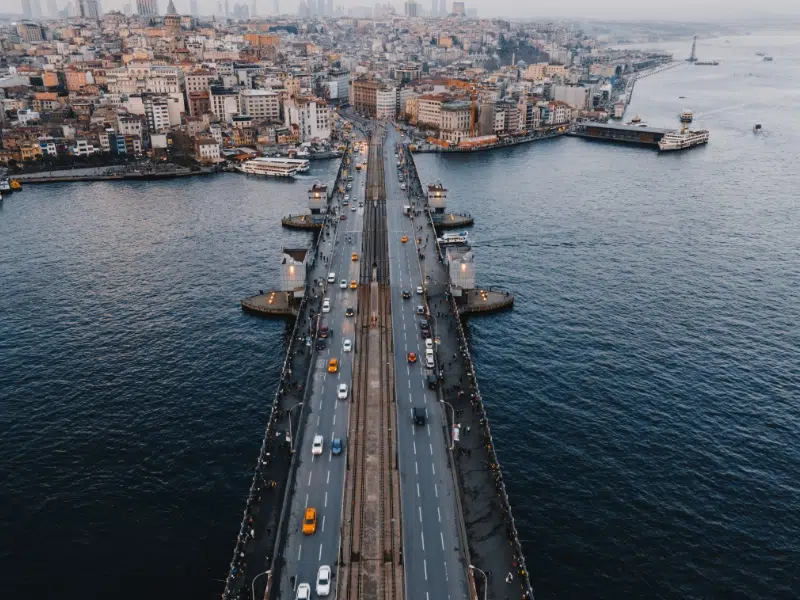
This guide follows seven places along one line through old Istanbul, from the Byzantine and Ottoman monuments of Sultanahmet down to the Golden Horn and across it to Galata: Hagia Sophia, the Blue Mosque, the tomb of Sultan Abdul Hamid I, the New Mosque in Eminönü, the İşbank Museum, the Galata Bridge and the Galata Tower. Together they cover fifteen centuries of the city's history, and you can link them all on foot in a day.
Hagia Sophia
Hagia Sophia (Ayasofya in Turkish) was built for the emperor Justinian I between 532 and 537 and inaugurated on 27 December 537. Its architects, Isidore of Miletus and Anthemius of Tralles, were among the first to rest a dome fully on pendentives, the curved triangles that let a round dome sit on a square base, and for centuries it was the largest interior space in the world. Earthquakes soon damaged it: part of the vault fell in 558 and was rebuilt higher by Isidore the Younger.
After the Ottoman conquest in 1453, Mehmed II turned the church into a mosque, and minarets were added later. In 1935 the young Turkish Republic made it a museum; in 2020 a court ruling annulled that decision and it became a mosque again. Most of the ground floor is now kept for prayer, and visitors go up to the galleries, which reopened to them in 2024. Women need to cover their hair. Hagia Sophia is one of the stops on our scavenger hunt.
- The eight huge round medallions with the names of God, the Prophet Muhammad, the first four caliphs and Muhammad's grandsons Hasan and Husayn, designed in the 19th century by the calligrapher Kazasker Mustafa İzzet Efendi.
- The Byzantine mosaics of Christ, the Virgin and emperors in the galleries and above the doors, plastered over in Ottoman times and uncovered again in the 19th and 20th centuries.
The Blue Mosque
Across the park stands the Sultan Ahmed Mosque (Sultanahmet Camii), which most visitors know as the Blue Mosque. Sultan Ahmed I had it built between 1609 and 1617 by the architect Sedefkâr Mehmed Ağa, on the south-east side of the old Byzantine Hippodrome, where the stands and the emperor's box once were. The nickname comes from the interior, covered with more than 20,000 İznik tiles in over fifty designs. The sultan was so set on the project that in 1613 he banned tile production for any other purpose.
It is also the mosque with six minarets. A popular legend says the sultan asked for golden minarets, altın minareler, and the architect heard altı minare, six minarets. A long restoration ended when the mosque reopened in April 2023. It is a working mosque, so visitors use the side entrances and should avoid prayer times. The Blue Mosque is a stop on the scavenger hunt.
- The heavy iron chain at the north-west gate from the Hippodrome: only the sultan could ride into the courtyard on horseback, and he had to bow his head under the chain, a sign of humility before God.
- The tomb of Ahmed I on the north-east side, begun in 1619 and finished by his son Osman II, where Ahmed lies with his wife Kösem and four of his sons.
Tomb of Sultan Abdul Hamid I
Down the hill towards the Golden Horn, at the corner of Hamidiye Street in Eminönü, stands the tomb of Sultan Abdul Hamid I, built in 1790 by the court architect Mehmed Tahir Ağa. It belonged to a charitable complex with an almshouse built a few years earlier. Abdul Hamid I lies here with his son Mustafa IV, who was killed after a short reign, and other princes, princesses and consorts: twenty sarcophagi in all. The tomb is one of the stops of our scavenger hunt.
The New Mosque and its square
At the bottom of the hill, the square in front of the New Mosque (Yeni Cami) is where Eminönü meets the water, with ferries, the Spice Bazaar and crowds all day. The mosque was begun in 1597 by Safiye Sultan, mother of Mehmed III, with Davut Ağa, a pupil of Mimar Sinan, as architect. Work stopped after Mehmed III died in 1603, and it was Turhan Sultan, mother of Mehmed IV, who restarted it after the great fire of 1660; it was finished in 1663 and inaugurated in 1665. So "new" is relative: the mosque is more than 350 years old. New Mosque Square is a stop on the scavenger hunt.
- The courtyard on the west side, with a colonnade of 24 small domes around a central fountain.
- The Spice Bazaar, also called the Egyptian Bazaar, built as part of the same mosque complex, and the royal pavilion at the north-east corner, linked by a raised passage to the sultan's screened loge inside the mosque.
İşbank Museum
A few streets away, on Bankalar Caddesi, the İşbank Museum tells the story of Türkiye İş Bankası, the first national bank of the Turkish Republic, founded in İzmir on 26 August 1924 with Atatürk as its founder and Celal Bayar as its first general manager. The museum opened on 14 October 2007 in a building from 1892 that became an İşbank branch in 1927, and the bank kept many of the old fittings: the cash desks on the ground floor, the safe-deposit boxes and the vault. It is not a stop on the scavenger hunt, but it is a short detour from New Mosque Square.
Galata Bridge
The Galata Bridge links Eminönü with Karaköy across the Golden Horn. The bridge you walk on today is the fifth on this site: built by the Turkish company STFA and completed in December 1994, it is a bascule bridge with the T1 tram running down the middle and walkways on both sides. Since 2003 a row of restaurants has filled its lower level, in imitation of the ones under the old bridge.
Its predecessor, a floating bridge built in 1912 by the German firm Hüttenwerk Oberhausen, was badly damaged by fire in 1992 and towed away. Much earlier, around 1502 or 1503, Sultan Bayezid II asked for designs for a bridge here, and Leonardo da Vinci proposed a single span that would have been the longest in the world at the time. The sultan did not approve it. The Galata Bridge is a stop on the scavenger hunt.
- The view back from the middle of the bridge to the New Mosque, with the domes and minarets of the old city rising behind it.
Galata Tower
On the Karaköy side, steep lanes climb to the Galata Tower. The Genoese, who had a trading colony here, built it in 1348 as a watchtower at the highest point of their walls and called it Christea Turris, the Tower of Christ. After 1453 the Ottomans used it as a prison, and from 1717 as a fire lookout. It is about 63 metres tall, and since a restoration in 2020 it has been a museum with an observation deck all the way round. A famous story, which historians doubt, says that in 1638 Hezârfen Ahmed Çelebi jumped from the tower with wings and glided across to the Asian side; it comes from the travel writer Evliya Çelebi. The tower is the last stop of the scavenger hunt.
- The view from the deck, at about 52 metres: the Golden Horn, the Bosphorus and the skyline of the old city in a single turn.
How to see them in one walk
Start in Sultanahmet at the Obelisk of Theodosius in the old Hippodrome, then visit the Blue Mosque and Hagia Sophia, which face each other across a park. The scavenger hunt route continues past Topkapı Palace and the Basilica Cistern, then down through Eminönü to the tomb of Abdul Hamid I and New Mosque Square, with the İşbank Museum close by. Cross the Galata Bridge on foot and climb the hill to the Galata Tower to end with the view. Both mosques close to visitors at prayer times, so plan your visits around them.
See Istanbul with World City Trail
Our Istanbul scavenger hunt turns the old city into a game you play on your phone. The route links 10 stops, from the Obelisk of Theodosius to the Galata Tower, and six places in this guide are stops: the Blue Mosque, Hagia Sophia, the tomb of Abdul Hamid I, New Mosque Square, the Galata Bridge and the Galata Tower. The others are Topkapı Palace, the Basilica Cistern and the Vilayet Mosque. At each stop you solve a puzzle and learn a story, at your own pace.
There is also a self-guided walking tour and an outdoor escape game in Istanbul, for people who prefer a different format.
Play the Istanbul scavenger hunt →
Take the self-guided walking tour of Istanbul →
Play the outdoor escape game in Istanbul →
Facts checked in October 2026.