
This guide covers six places in Wrocław that sit on one line through the city: a park on the old moat, the Gothic town hall, the tallest church tower in the old town, the university on the Oder, and, a little further east, the National Museum and the park with the Racławice Panorama. All six are stops on our scavenger hunt, so you can see them in a single walk.
Nicolaus Copernicus Park
Wrocław's old town is ringed by the former city moat, and the land along it, where walls and bastions once stood, was turned into promenades and gardens in the 19th century. The green space on ul. Teatralna that the route calls Nicolaus Copernicus Park was laid out as the Zwingergarten, later bore the name of Hanka Sawicka and is now known as the Old Town Garden (Ogród Staromiejski).
It is a small, quiet park between the busy ul. Świdnicka and the old town, with old trees, benches and a playground. A statue of Copernicus stands on the square of the same name close by, next to a restored stretch of the moat promenade.
- What to look for: the old-fashioned carousel and the pigeon house, two of the park's best-loved details.
- Also look out for the moat itself, a reminder that this was the edge of the fortified city.
Museum of Bourgeois Art (Old Town Hall)
The Old Town Hall in the Market Square is one of the finest Gothic civic buildings in Central Europe. It grew in stages from the late 13th century to the early 16th, as the merchant city became richer, and its gables, pinnacles and oriel windows show that wealth.
Inside is the Museum of Bourgeois Art, a branch of the City Museum of Wrocław. The rooms of the town hall are the main exhibit: vaulted Gothic halls where the city council met and where the burghers held feasts, plus displays of the work of Wrocław's goldsmiths and silversmiths. In the cellar is the Piwnica Świdnicka, a beer cellar with a history going back to the Middle Ages.
- What to look for: the astronomical clock on the east facade, one of the town hall's oldest decorations.
- Walk all the way round the building: each side looks different, and the south facade with its oriels is the richest.
St Elizabeth's Church
St Elizabeth's is a brick Gothic church begun in the 14th century, and its tower, 91.5 metres high, is the tallest in the old town. It was originally much taller but lost its spire in the 16th century. The church was Lutheran from the Reformation until 1946, when it was handed to the Catholic military chaplaincy; it is still Wrocław's garrison church today.
In 1976 a fire gutted the interior and destroyed the famous organ. The church was restored, and the tower has a viewing platform near the top, reached by a long climb of steps, with one of the best views over the Market Square.
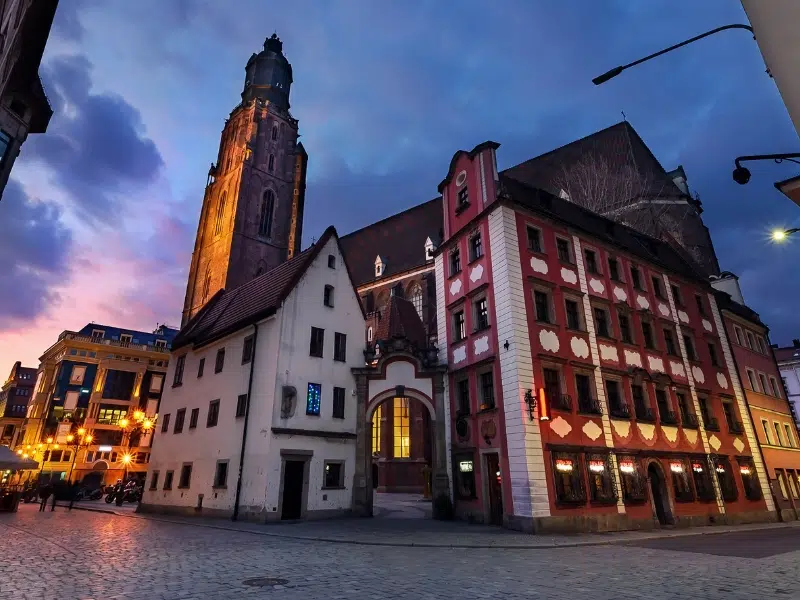
- What to look for: Jaś i Małgosia (Hansel and Gretel), two tiny houses at the corner of the churchyard, joined by an arched gateway. They were once homes for the church's altar priests.
- Also look at the old gravestones and epitaphs set into the church's outer walls.
University of Wrocław
The university's main building stretches along the Oder riverbank. It goes back to the Jesuit academy founded in 1702 by Emperor Leopold I, which is why it was called the Leopoldina. The long Baroque building was finished in the first half of the 18th century and is one of the largest Baroque buildings in the city.
Inside are the Aula Leopoldina, a ceremonial hall full of paintings and sculpture, and the Oratorium Marianum, a former chapel used for concerts. The Mathematical Tower above the main entrance has a terrace with a view of the old town and the river.
- What to look for: the Fencer fountain on the square in front of the building, a bronze student with a sword, a popular meeting point.
- Walk round to the river side for the full length of the facade seen from the Oder.
National Museum in Wrocław
The National Museum stands just east of the old town, on the bank of the Oder. Its large Neo-Renaissance building was built in the 1880s for the Silesian provincial government and became the museum after the Second World War. The museum's collections cover medieval Silesian art, Polish painting and sculpture from several centuries and modern art.
From late spring to autumn the building is famous for something that has nothing to do with art: its walls are almost completely covered in Virginia creeper, which turns deep red in October.
- What to look for: the facade in autumn, one of the most photographed views in Wrocław.
- Inside, look for the Silesian Gothic sculpture and altarpieces, the strongest part of the collection.
Juliusz Słowacki Park
Słowacki Park lies next to the National Museum and is named after the Polish Romantic poet Juliusz Słowacki, whose monument stands among the trees. Most visitors come for the round building at its edge: the home of the Racławice Panorama, a giant painting about 15 metres high and 114 metres long.
The panorama was painted in 1894 by Jan Styka and Wojciech Kossak and shows the Battle of Racławice of 1794, a Polish victory during the Kościuszko Uprising. It was kept in Lwów until the Second World War, came to Wrocław afterwards and has been shown in this rotunda since 1985.
- What to look for: the Słowacki monument in the middle of the park.
- The rotunda of the panorama, a modern building designed to show the painting in the round.
How to see them in one walk
Start at The Passage, the bronze figures sinking into the pavement at the corner of ul. Świdnicka, and walk to Copernicus Park and the moat. Head up ul. Świdnicka to the Market Square and the Old Town Hall, then turn into the northwest corner of the square for St Elizabeth's. From there walk north to the university on the river. Cross to the islands for Tumski Bridge and the cathedral, then follow the river back to the National Museum and finish in Słowacki Park at the panorama.
See Wrocław with World City Trail
Our Wrocław scavenger hunt turns the city into a game you play on your phone. The route links 10 stops, from The Passage to Słowacki Park, and all six places in this guide are among them, along with the Market Square, Tumski Bridge and the Cathedral of St John the Baptist.
If you prefer a different format, there is also a self-guided walking tour and an outdoor escape game in Wrocław.
Play the Wrocław scavenger hunt →
Take the self-guided walking tour of Wrocław →
Play the outdoor escape game in Wrocław →
Facts checked in October 2026.