
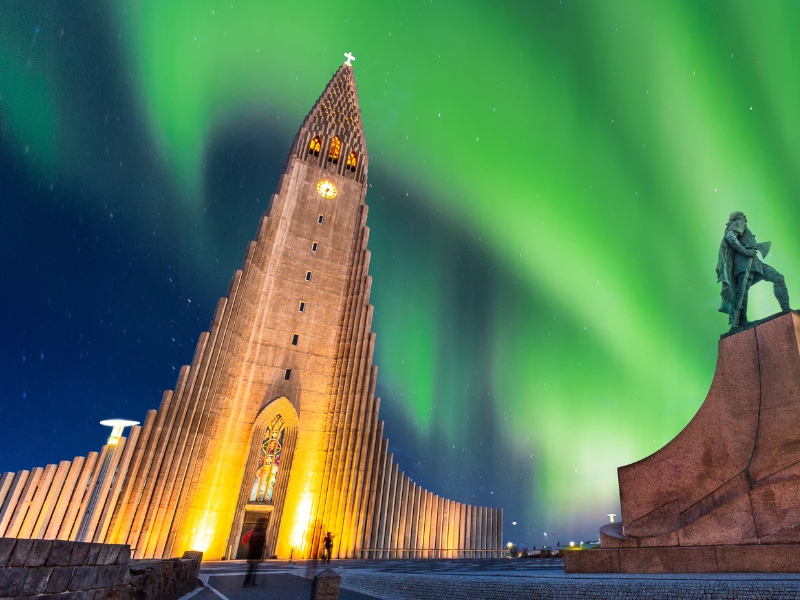
Reykjavík is small enough that its best-known buildings are all within a walk of each other. This guide covers the three that shape the skyline and the city's idea of itself: the church on the hill, the glass concert hall on the harbour and the stone parliament house. It adds two stops of our scavenger hunt that people photograph almost as often: the Sun Voyager sculpture and the rainbow-painted street that leads up to the church.
Hallgrímskirkja
Hallgrímskirkja is the Lutheran parish church at the top of Skólavörðuholt hill, and at about 74.5 metres it is one of the tallest buildings in Iceland. It was designed by the state architect Guðjón Samúelsson, who received the commission in 1937. Building began in 1945 and took more than four decades: the church was only completed in 1986, long after its architect's death.
The church is named after Hallgrímur Pétursson, a 17th-century priest and poet whose Passion Hymns are still read in Iceland every year before Easter. The stepped concrete wings on either side of the tower are often compared to the basalt columns that form when lava cools, a shape you see all over Iceland.
- The interior: plain and white, with tall Gothic-style windows and a large organ by the German firm Klais at the back.
- The tower: a lift takes visitors up to a viewing level with views over the colourful roofs of the city to the sea and the mountains.
- The statue of Leif Erikson in front of the church, a gift from the United States for the 1,000th anniversary of the Althing in 1930. It is older than the church itself.
Harpa Concert Hall
Harpa stands on the old harbour and is the home of the Iceland Symphony Orchestra. It was designed by Henning Larsen Architects with the Danish-Icelandic artist Olafur Eliasson, who created its facade of glass panes set in a steel frame. The first concert was held in May 2011, and in 2013 the building won the European Union's Mies van der Rohe Award for contemporary architecture.
Its story is tied to Iceland's banking crash. Construction started in 2007, and when the economy collapsed in 2008, the half-built hall was nearly abandoned. The government decided to finish it, and for several years it was practically the only construction site in the country. The name Harpa was chosen in 2009.
- The facade: the glass changes colour with the light and the weather, and at night its LED lights show light works by Eliasson.
- The foyer: you can walk in, climb the stairs and look out through the glass over the harbour and Mount Esja.
- The four halls are named Eldborg, Norðurljós, Silfurberg and Kaldalón; Eldborg, the largest, is named after a volcanic crater and is lined in red.
Alþingishúsið (Parliament House)
Alþingishúsið is the seat of the Althing, Iceland's parliament, an assembly that first met in the open air at Þingvellir in 930 and is one of the oldest parliaments in the world. The building on Austurvöllur square is much younger: it was designed by the Danish architect Ferdinand Meldahl, built in 1880–1881 and opened on 1 July 1881.
It is a modest building for a national parliament, built of hewn Icelandic dolerite, a dark volcanic stone. Iceland was still under Danish rule when it was built; the country gained home rule in 1904 and became a republic in 1944.
- Look at the reliefs above the four outer first-floor windows: they show the four landvættir, the guardian spirits of Iceland, a dragon, a bird of prey, a bull and a giant, which also appear on the country's coat of arms.
- Austurvöllur, the square in front, with a statue of Jón Sigurðsson, the 19th-century leader of the independence movement, facing the parliament.
- The cathedral, Dómkirkjan, right next door: on the day parliament opens, members walk from the church service to the house.
Sun Voyager
Sun Voyager (Sólfar) is a steel sculpture by Jón Gunnar Árnason on the seafront path along Sæbraut, unveiled in 1990. It grew out of a competition held for Reykjavík's 200th anniversary as a town in 1986, and the artist died in 1989, before it was installed. It looks like a Viking longship, but the artist described it as a dream boat, an ode to the sun and a promise of undiscovered land, not a warship.
- Look out to the north: the sculpture is set against Faxaflói bay and Mount Esja, and it is the starting point of our scavenger hunt.
- Come at sunset or on a clear evening, when the polished steel reflects the low light.
Rainbow Street (Skólavörðustígur)
Skólavörðustígur is the shopping street that runs uphill from the centre straight to Hallgrímskirkja. Its upper stretch was painted in rainbow colours for Reykjavík Pride in 2015, and the stripes have been kept and repainted since, so the church appears at the end of a rainbow.
- Stand at the lower end of the painted stretch for the classic photo, with the tower framed by the street.
- Look at the small shops along the street: knitwear, design and craft shops line much of it.
How to see them in one walk
Start at Sun Voyager on the seafront and follow the shore path to Harpa. From the harbour, walk into the old centre past the statue of Ingólfur Arnarson on Arnarhóll, then on to Austurvöllur, where the Parliament House and the cathedral stand side by side, with City Hall on the pond just beyond. Finish by walking uphill along Skólavörðustígur, under the painted rainbow, to Hallgrímskirkja, and go up the tower for the view back over everything you have seen.
See Reykjavík with World City Trail
Our Reykjavík scavenger hunt turns the city centre into a game you play on your phone. The route links 10 stops, from Sun Voyager to Hallgrímskirkja, and all five places in this guide are among them, together with the statue of Ingólfur Arnarson, the House of Collections, the cathedral, City Hall and the National Gallery of Iceland.
If you prefer a different format, there is also a self-guided walking tour and an outdoor escape game in Reykjavík.
Play the Reykjavík scavenger hunt →
Take the self-guided walking tour of Reykjavík →
Play the outdoor escape game in Reykjavík →
Facts checked in October 2026.