
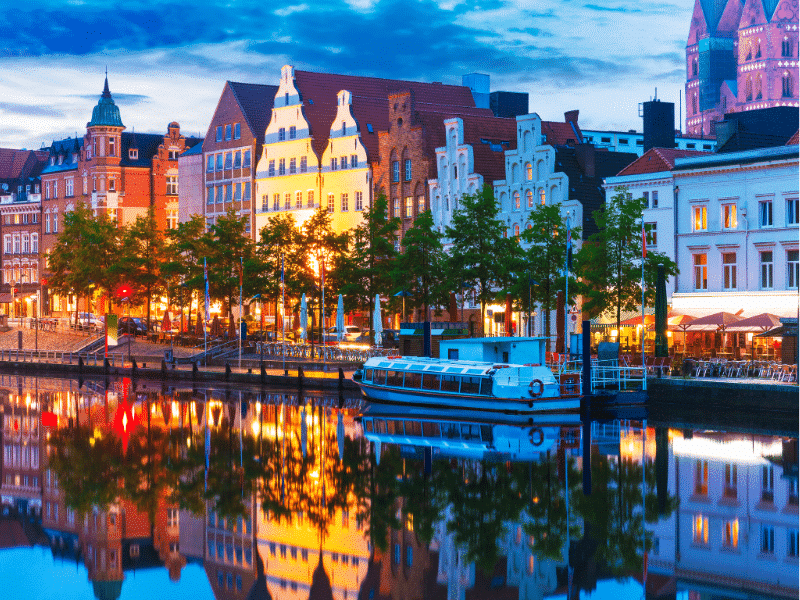
Lubecca era la città guida della Lega anseatica, la rete di mercanti che dominò per secoli i commerci intorno al Baltico, e il suo profilo di sette campanili in mattoni mostra ancora quanto diventò ricca. Il centro storico sorge su un’isola circondata dal fiume Trave e dai suoi canali, e nel 1987 fu il primo centro storico intero del Nord Europa iscritto nel Patrimonio mondiale dell’UNESCO. Ecco i fatti e le storie che la raccontano.
10 curiosità su Lubecca
- Regina dell’Hansa: Lubecca ospitò la maggior parte degli Hansetage, le assemblee della Lega anseatica, dal XIV secolo fino all’ultima, riunita qui nel 1669.
- Una porta che sprofonda: la Porta di Holsten, o Holstentor, fu costruita tra il 1464 e il 1478 su un terreno paludoso, e le sue torri si sono abbassate e pendono visibilmente. L’iscrizione latina sul lato della città, Concordia domi foris pax, significa concordia dentro, pace fuori.
- A gate in your wallet: the Holsten Gate was printed on the old 50 Deutsche Mark note, and in 2006 it appeared on Germany's first 2-euro coin in its series on the federal states.
- A record-breaking brick vault: the nave of St Mary's Church rises to 38.5 metres, often called the highest brick vault in the world. The church became a model for brick Gothic churches all around the Baltic.
- Bells that still lie where they fell: during the RAF raid on the night of Palm Sunday 1942, St Mary's burned and its bells crashed to the floor of the south tower. Their shattered remains have been left there as a memorial.
- Un municipio con i buchi: la costruzione iniziò nel XIII secolo e proseguì per circa trecento anni. Le grandi aperture rotonde nella facciata di rappresentanza in mattoni servono a far passare il vento.
- Tre premi Nobel: Thomas Mann nacque qui nel 1875 e ambientò I Buddenbrook nella sua città natale, Willy Brandt vi nacque nel 1913 e Günter Grass visse nei dintorni per decenni.
- La capitale del marzapane: Johann Georg Niederegger aprì la sua pasticceria di fronte al municipio nel 1806, e il nome Lübecker Marzipan è tutelato nell’UE come indicazione geografica.
- White gold by the river: the row of brick Salzspeicher beside the Holsten Gate once stored salt from Lüneburg, which Lübeck's ships carried across the Baltic to preserve herring.
- Assistenza ai poveri dal 1286: l’Ospedale dello Spirito Santo, fondato da mercanti, è una delle più antiche istituzioni sociali d’Europa ancora in piedi.
The devil and St Mary's
Legend says that when work began on St Mary's, the devil came to watch. The builders told him they were putting up a wine tavern, and the devil, who liked the idea of a place full of drinkers, helped them. When the walls rose high enough for him to see that it was a church, he flew into a rage and picked up a huge boulder to smash it. A quick-thinking builder promised him a tavern right next door, and the devil, satisfied, dropped the stone beside the church. The tavern is said to be the Ratskeller in the Town Hall cellars, and the boulder still lies by St Mary's, with a bronze devil sitting on it whose horns visitors rub for luck.
I Gänge e gli Höfe in breve
Quando la Lubecca medievale si riempì, i proprietari costruirono piccole casette nei cortili sul retro e le affittarono ad artigiani e operai. Ci si arrivava da stretti passaggi, i Gänge, che si aprono sulle strade principali con piccole porte. Alcuni diventarono cortili di ospizi, gli Höfe, come il Füchtingshof, costruito negli anni Trenta del Seicento per le vedove di mercanti e capitani. Molti sono ancora abitati, quindi attraversali in silenzio.
Cosa mangiare a Lubecca
- Lübecker Marzipan: ricco di mandorle e non troppo dolce. Prova una torta al marzapane nel caffè della casa Niederegger, di fronte al municipio.
- Rotspon: red Bordeaux wine aged in Lübeck's cellars. Legend says Napoleon's officers preferred it to the wine in France.
- Fischbrötchen: un panino con aringa marinata, sgombro affumicato o pesce fritto, da mangiare in riva al mare a Travemünde.
- Labskaus: a sailors' dish of corned beef, potato and beetroot, served with a fried egg, pickled gherkin and herring.
- Grünkohl: cavolo riccio stufato per ore e servito con salsiccia e maiale affumicato, il classico piatto invernale della Germania del Nord.
Da sapere prima di partire
- Il Museo europeo dell’Hansa, aperto nel 2015 sul fiume all’estremità nord del centro storico, è il posto migliore per capire la Lega anseatica. Calcola almeno due ore.
- For a view over the island and its spires, take the lift up the tower of St Peter's Church.
- Travemünde, Lübeck's own seaside resort on the Baltic, is about 20 minutes away by train.
- In Avvento Lubecca organizza diversi mercatini di Natale, tra cui uno di artigianato dentro l’Ospedale dello Spirito Santo.
Scopri Lubecca con World City Trail
Our Lübeck scavenger hunt turns these sights into a game you play on your phone. The route links 10 stops and takes around two hours, with about 44 minutes of walking, and includes the Holsten Gate, the Town Hall and St Mary's Church.
A ogni tappa risolvi un enigma e ascolti una breve storia, al tuo ritmo. Puoi iniziare quando vuoi.
Gioca alla caccia al tesoro di Lubecca →
Fatti verificati a ottobre 2026.