
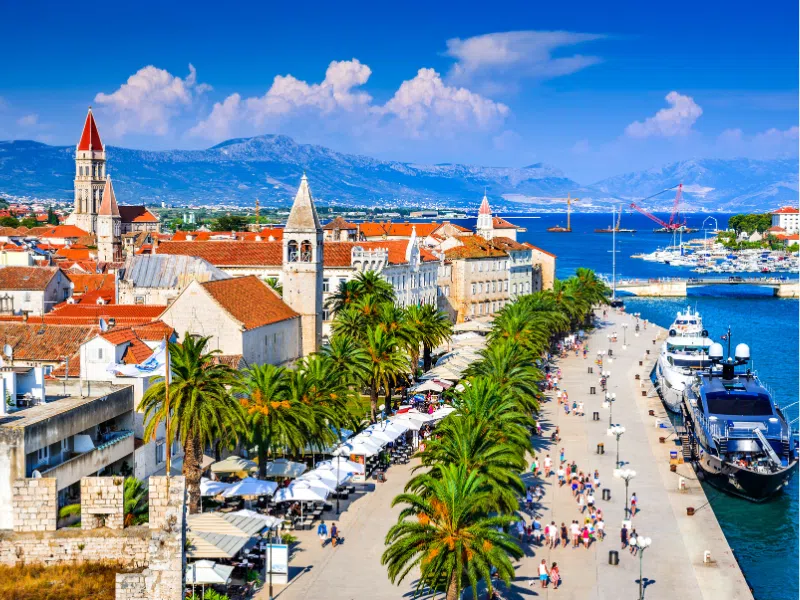
Split grew up inside a Roman emperor's retirement palace, and it never moved out. Homes, shops and cafés fill the walls Diocletian built around AD 300, and the seafront Riva runs along its southern façade. Here are the facts and stories that make the city special.
10 curiosità su Spalato
- Un palazzo per un imperatore in pensione: Diocleziano fece costruire il palazzo a partire dal 295 circa e vi si stabilì dopo aver abdicato nel 305, uno dei pochissimi imperatori romani a lasciare il potere di sua volontà.
- Ci si vive ancora: circa 3.000 persone abitano dentro le mura del palazzo, che occupano circa metà della città vecchia.
- A mausoleum turned cathedral: Diocletian's mausoleum became the Cathedral of St Domnius, named after a bishop of Salona who was martyred during Diocletian's persecution of Christians. It is one of the oldest cathedrals in the world still in use.
- On the UNESCO list since 1979: Diocletian's Palace and the historic centre of Split were among the first sites in Croatia to become World Heritage.
- A giant toe for luck: Ivan Meštrović's 8.5-metre bronze of Gregory of Nin, a 10th-century bishop who championed the Croatian language in church services, first stood in the Peristyle in 1929. Since 1954 it has stood outside the Golden Gate, and rubbing its big toe is said to bring luck.
- Girato nelle cantine: le cantine a volta sotto il palazzo, tra le sostruzioni antiche meglio conservate del loro genere, compaiono nella quarta stagione di Game of Thrones.
- Una squadra nata in una birreria di Praga: l’Hajduk Spalato fu fondato nel 1911 da studenti spalatini a U Fleků, una birreria di Praga.
- Il padre della letteratura croata: Marko Marulić completò a Spalato nel 1501 la Judita, il primo grande poema epico in croato. Una statua di Meštrović lo ricorda in Piazza della Frutta.
- Un teatro in grande: il Teatro nazionale croato aprì nel 1893 con circa 1.000 posti, allora il più grande teatro dell’Europa sud-orientale. Dopo un incendio nel 1970 fu ricostruito e riaperto nel 1980.
- Un gioco in acqua bassa: il picigin, che consiste nel tenere in aria una pallina con tuffi e schizzi nell’acqua alta fino alle caviglie, è nato sulla spiaggia di Bačvice.
Diocleziano e i suoi cavoli
Diocletian was born in Dalmatia, ruled the Roman Empire for more than twenty years and reorganised it so that four emperors could share power. Then, in 305, he did something almost unheard of: he resigned and retired to his palace by the sea. When former colleagues later urged him to take power again, he is said to have replied that if they could see the cabbages he had grown with his own hands, they would never ask. Three centuries later, when Avars and Slavs destroyed nearby Salona, its people took refuge inside the palace walls, and the emperor's retreat slowly became a town.
Il Peristilio e il Vestibolo
The Peristyle, the palace's colonnaded central square, was the formal approach to the emperor's apartments; today people sit on its steps with a coffee. Beyond it lies the Vestibule, a round hall whose dome has long since fallen in. Its acoustics suit klapa, the a cappella multipart singing of Dalmatia, which was added to UNESCO's intangible cultural heritage list in 2012, and groups often sing here for passers-by.
Cosa mangiare a Spalato
- Pašticada: manzo marinato nell’aceto e brasato a lungo con vino e prugne secche, servito con gli gnocchi, il piatto delle feste di famiglia in Dalmazia.
- Soparnik: una torta sottile ripiena di bietole, cipolla e prezzemolo, cotta sul focolare. La versione della vicina zona di Poljica è protetta dall’UE dal 2016.
- Crni rižot: risotto nero colorato e insaporito con il nero di seppia.
- Fritule: piccole frittelle profumate con scorza di agrumi e acquavite, molto diffuse nel periodo natalizio.
Da sapere prima di partire
- Traghetti e catamarani per Hvar, Brač e altre isole partono dal porto, proprio accanto alla città vecchia. D’estate conviene prenotare.
- Traù, cittadina medievale su un isolotto e Patrimonio UNESCO, è a un breve tragitto in autobus, e il Parco nazionale della Krka è un’ottima gita di un giorno.
- Climb the cathedral's bell tower for a view over the palace roofs, or walk up Marjan hill from the western end of the Riva for wide views of the sea and islands.
Scopri Spalato con World City Trail
Our Split scavenger hunt turns these sights into a game you play on your phone. The route links 10 stops and takes around two hours, with about 20 minutes of walking, and its stops include the Croatian National Theatre, the Gregory of Nin statue and the Golden Gate of Diocletian's Palace.
A ogni tappa risolvi un enigma e ascolti una breve storia, al tuo ritmo. Puoi iniziare quando vuoi.
Gioca alla caccia al tesoro di Spalato →
Fatti verificati a ottobre 2026.