
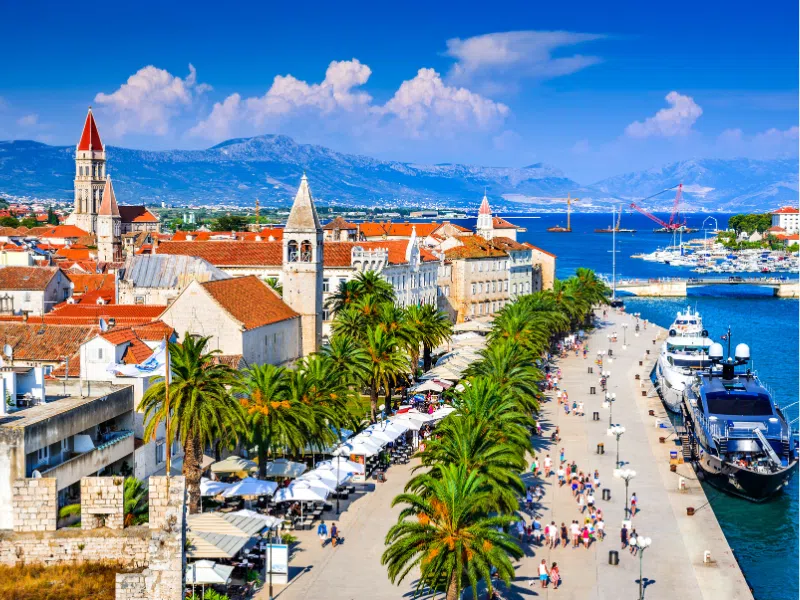
Split grew up inside a Roman emperor's retirement palace, and it never moved out. Homes, shops and cafés fill the walls Diocletian built around AD 300, and the seafront Riva runs along its southern façade. Here are the facts and stories that make the city special.
10 curiosidades sobre Split
- Un palacio para un emperador jubilado: Diocleciano mandó construir el palacio desde hacia el año 295 y se instaló en él tras abdicar en 305, uno de los poquísimos emperadores romanos que dejó el poder por voluntad propia.
- Aún se vive dentro: unas 3.000 personas viven dentro de los muros del palacio, que ocupan aproximadamente la mitad del casco antiguo.
- A mausoleum turned cathedral: Diocletian's mausoleum became the Cathedral of St Domnius, named after a bishop of Salona who was martyred during Diocletian's persecution of Christians. It is one of the oldest cathedrals in the world still in use.
- On the UNESCO list since 1979: Diocletian's Palace and the historic centre of Split were among the first sites in Croatia to become World Heritage.
- A giant toe for luck: Ivan Meštrović's 8.5-metre bronze of Gregory of Nin, a 10th-century bishop who championed the Croatian language in church services, first stood in the Peristyle in 1929. Since 1954 it has stood outside the Golden Gate, and rubbing its big toe is said to bring luck.
- Rodado en los sótanos: los sótanos abovedados bajo el palacio, entre las subestructuras antiguas mejor conservadas de su tipo, aparecen en la cuarta temporada de Juego de Tronos.
- Un club de fútbol nacido en una cervecería de Praga: el Hajduk Split lo fundaron en 1911 estudiantes de Split en U Fleků, una cervecería de Praga.
- El padre de la literatura croata: Marko Marulić terminó en Split en 1501 Judita, el primer gran poema épico en croata. Una estatua suya de Meštrović está en la Plaza de la Fruta.
- Un teatro a lo grande: el Teatro Nacional Croata se inauguró en 1893 con unas 1.000 butacas, entonces el mayor teatro del sudeste de Europa. Tras un incendio en 1970 se reconstruyó y reabrió en 1980.
- Un juego en aguas poco profundas: el picigin, que consiste en mantener una pelota pequeña en el aire con saltos y salpicaduras en agua hasta los tobillos, nació en la playa de Bačvice.
Diocleciano y sus coles
Diocletian was born in Dalmatia, ruled the Roman Empire for more than twenty years and reorganised it so that four emperors could share power. Then, in 305, he did something almost unheard of: he resigned and retired to his palace by the sea. When former colleagues later urged him to take power again, he is said to have replied that if they could see the cabbages he had grown with his own hands, they would never ask. Three centuries later, when Avars and Slavs destroyed nearby Salona, its people took refuge inside the palace walls, and the emperor's retreat slowly became a town.
El Peristilo y el Vestíbulo
The Peristyle, the palace's colonnaded central square, was the formal approach to the emperor's apartments; today people sit on its steps with a coffee. Beyond it lies the Vestibule, a round hall whose dome has long since fallen in. Its acoustics suit klapa, the a cappella multipart singing of Dalmatia, which was added to UNESCO's intangible cultural heritage list in 2012, and groups often sing here for passers-by.
Qué comer en Split
- Pašticada: ternera marinada en vinagre y estofada lentamente con vino y ciruelas pasas, servida con ñoquis, el plato de las celebraciones familiares dálmatas.
- Soparnik: una empanada fina rellena de acelgas, cebolla y perejil, cocida en un hogar abierto. La versión de la cercana región de Poljica tiene protección de la UE desde 2016.
- Crni rižot: risotto negro teñido y aromatizado con tinta de sepia.
- Fritule: buñuelos pequeños con ralladura de cítricos y aguardiente, muy típicos en Navidad.
Antes de ir
- Los ferris y catamaranes a Hvar, Brač y otras islas salen del puerto, justo al lado del casco antiguo. En verano, reserva con antelación.
- Trogir, una pequeña ciudad medieval sobre un islote declarada Patrimonio de la UNESCO, está a un corto trayecto en autobús, y el Parque Nacional de Krka es una buena excursión de un día.
- Climb the cathedral's bell tower for a view over the palace roofs, or walk up Marjan hill from the western end of the Riva for wide views of the sea and islands.
Descubre Split con World City Trail
Our Split scavenger hunt turns these sights into a game you play on your phone. The route links 10 stops and takes around two hours, with about 20 minutes of walking, and its stops include the Croatian National Theatre, the Gregory of Nin statue and the Golden Gate of Diocletian's Palace.
En cada parada resuelves un acertijo y escuchas una historia breve, a tu ritmo. Puedes empezar cuando quieras.
Juega a la búsqueda del tesoro de Split →
Datos comprobados en octubre de 2026.