
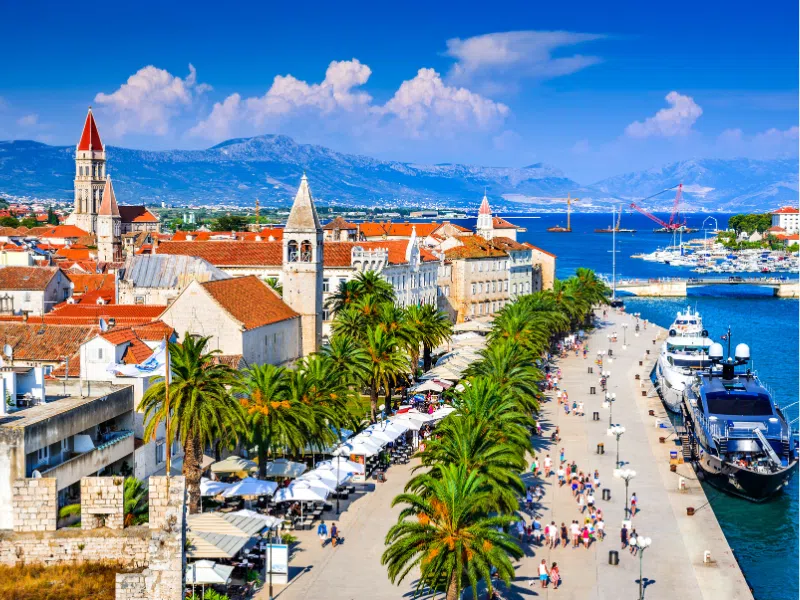
Split grew up inside a Roman emperor's retirement palace, and it never moved out. Homes, shops and cafés fill the walls Diocletian built around AD 300, and the seafront Riva runs along its southern façade. Here are the facts and stories that make the city special.
10 spannende Fakten über Split
- Ein Palast für einen Kaiser im Ruhestand: Diokletian ließ den Palast ab etwa 295 bauen und zog sich hierher zurück, nachdem er 305 abgedankt hatte, als einer der ganz wenigen römischen Kaiser, die freiwillig zurücktraten.
- Hier wird noch gewohnt: Rund 3.000 Menschen leben innerhalb der Palastmauern, die etwa die Hälfte der Altstadt einnehmen.
- A mausoleum turned cathedral: Diocletian's mausoleum became the Cathedral of St Domnius, named after a bishop of Salona who was martyred during Diocletian's persecution of Christians. It is one of the oldest cathedrals in the world still in use.
- On the UNESCO list since 1979: Diocletian's Palace and the historic centre of Split were among the first sites in Croatia to become World Heritage.
- A giant toe for luck: Ivan Meštrović's 8.5-metre bronze of Gregory of Nin, a 10th-century bishop who championed the Croatian language in church services, first stood in the Peristyle in 1929. Since 1954 it has stood outside the Golden Gate, and rubbing its big toe is said to bring luck.
- Gedreht in den Kellern: Die Gewölbekeller unter dem Palast, die zu den besterhaltenen antiken Unterbauten ihrer Art gehören, waren in der vierten Staffel von Game of Thrones zu sehen.
- Ein Fußballclub aus einer Prager Bierstube: Hajduk Split wurde 1911 von Studenten aus Split im U Fleků gegründet, einem Bierlokal in Prag.
- Der Vater der kroatischen Literatur: Marko Marulić vollendete 1501 in Split die Judita, das erste große Epos in kroatischer Sprache. Eine Statue von Meštrović erinnert an ihn auf dem Obstplatz.
- Ein Theater im großen Stil: Das Kroatische Nationaltheater wurde 1893 mit rund 1.000 Plätzen eröffnet, damals das größte Theater Südosteuropas. Nach einem Brand 1970 wurde es wieder aufgebaut und 1980 neu eröffnet.
- Ein Spiel im seichten Wasser: Picigin, bei dem man einen kleinen Ball mit Sprüngen und Spritzern im knöcheltiefen Wasser in der Luft hält, entstand am Strand Bačvice.
Diokletian und sein Kohl
Diocletian was born in Dalmatia, ruled the Roman Empire for more than twenty years and reorganised it so that four emperors could share power. Then, in 305, he did something almost unheard of: he resigned and retired to his palace by the sea. When former colleagues later urged him to take power again, he is said to have replied that if they could see the cabbages he had grown with his own hands, they would never ask. Three centuries later, when Avars and Slavs destroyed nearby Salona, its people took refuge inside the palace walls, and the emperor's retreat slowly became a town.
Peristyl und Vestibül
The Peristyle, the palace's colonnaded central square, was the formal approach to the emperor's apartments; today people sit on its steps with a coffee. Beyond it lies the Vestibule, a round hall whose dome has long since fallen in. Its acoustics suit klapa, the a cappella multipart singing of Dalmatia, which was added to UNESCO's intangible cultural heritage list in 2012, and groups often sing here for passers-by.
Was man in Split essen sollte
- Pašticada: in Essig mariniertes Rindfleisch, langsam mit Wein und Trockenpflaumen geschmort und mit Gnocchi serviert, das Festtagsgericht dalmatinischer Familien.
- Soparnik: ein dünner Fladen mit Mangold, Zwiebeln und Petersilie, auf offener Feuerstelle gebacken. Die Variante aus der nahen Region Poljica ist seit 2016 von der EU geschützt.
- Crni rižot: schwarzes Risotto, gefärbt und gewürzt mit Sepiatinte.
- Fritule: kleine frittierte Teigkugeln mit Zitrusschale und Schnaps, besonders beliebt in der Weihnachtszeit.
Gut zu wissen vor dem Besuch
- Fähren und Katamarane nach Hvar, Brač und auf andere Inseln legen im Hafen direkt neben der Altstadt ab. Im Sommer solltest du vorab buchen.
- Trogir, eine mittelalterliche Kleinstadt auf einer winzigen Insel und UNESCO-Welterbe, ist eine kurze Busfahrt entfernt, und der Nationalpark Krka ist ein lohnender Tagesausflug.
- Climb the cathedral's bell tower for a view over the palace roofs, or walk up Marjan hill from the western end of the Riva for wide views of the sea and islands.
Split mit World City Trail entdecken
Our Split scavenger hunt turns these sights into a game you play on your phone. The route links 10 stops and takes around two hours, with about 20 minutes of walking, and its stops include the Croatian National Theatre, the Gregory of Nin statue and the Golden Gate of Diocletian's Palace.
An jeder Station löst du ein Rätsel und hörst eine kurze Geschichte, in deinem eigenen Tempo. Du kannst starten, wann du willst.
Die Schnitzeljagd in Split spielen →
Fakten geprüft im Oktober 2026.