
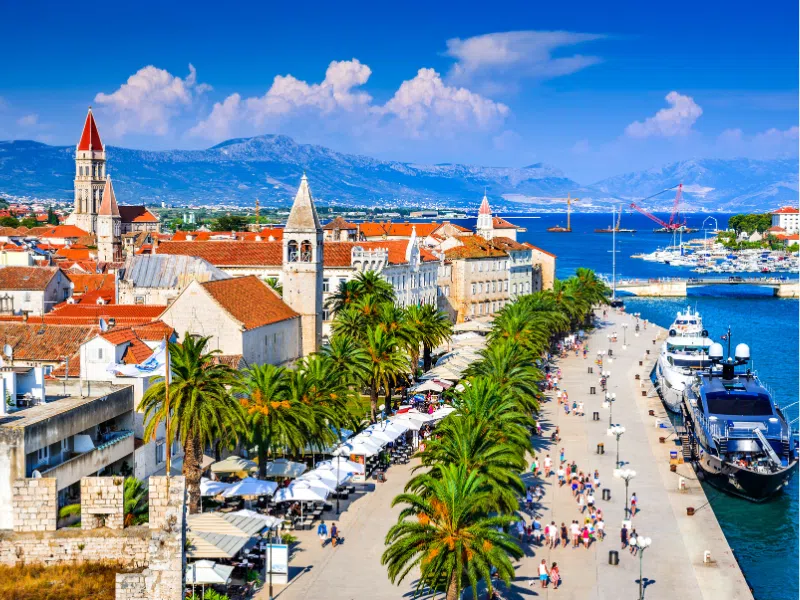
Split grew up inside a Roman emperor's retirement palace, and it never moved out. Homes, shops and cafés fill the walls Diocletian built around AD 300, and the seafront Riva runs along its southern façade. Here are the facts and stories that make the city special.
10 anecdotes sur Split
- Un palais pour un empereur à la retraite : Dioclétien fit construire le palais à partir de 295 environ et s’y installa après avoir abdiqué en 305, l’un des très rares empereurs romains à quitter le pouvoir de son plein gré.
- On y habite toujours : environ 3 000 personnes vivent à l’intérieur des murs du palais, qui occupent à peu près la moitié de la vieille ville.
- A mausoleum turned cathedral: Diocletian's mausoleum became the Cathedral of St Domnius, named after a bishop of Salona who was martyred during Diocletian's persecution of Christians. It is one of the oldest cathedrals in the world still in use.
- On the UNESCO list since 1979: Diocletian's Palace and the historic centre of Split were among the first sites in Croatia to become World Heritage.
- A giant toe for luck: Ivan Meštrović's 8.5-metre bronze of Gregory of Nin, a 10th-century bishop who championed the Croatian language in church services, first stood in the Peristyle in 1929. Since 1954 it has stood outside the Golden Gate, and rubbing its big toe is said to bring luck.
- Tourné dans les caves : les caves voûtées sous le palais, parmi les soubassements antiques les mieux conservés de leur genre, apparaissent dans la quatrième saison de Game of Thrones.
- Un club de football né dans une brasserie de Prague : l’Hajduk Split a été fondé en 1911 par des étudiants de Split à U Fleků, une brasserie de Prague.
- Le père de la littérature croate : Marko Marulić acheva Judita, le premier grand poème épique en croate, à Split en 1501. Une statue de lui par Meštrović se dresse sur la place aux Fruits.
- Un théâtre vu en grand : le Théâtre national croate a ouvert en 1893 avec environ 1 000 places, à l’époque le plus grand théâtre d’Europe du Sud-Est. Après un incendie en 1970, il a été reconstruit et a rouvert en 1980.
- Un jeu dans l’eau peu profonde : le picigin, qui consiste à garder une petite balle en l’air à coups de plongeons et d’éclaboussures dans l’eau jusqu’aux chevilles, est né sur la plage de Bačvice.
Dioclétien et ses choux
Diocletian was born in Dalmatia, ruled the Roman Empire for more than twenty years and reorganised it so that four emperors could share power. Then, in 305, he did something almost unheard of: he resigned and retired to his palace by the sea. When former colleagues later urged him to take power again, he is said to have replied that if they could see the cabbages he had grown with his own hands, they would never ask. Three centuries later, when Avars and Slavs destroyed nearby Salona, its people took refuge inside the palace walls, and the emperor's retreat slowly became a town.
Le Péristyle et le Vestibule
The Peristyle, the palace's colonnaded central square, was the formal approach to the emperor's apartments; today people sit on its steps with a coffee. Beyond it lies the Vestibule, a round hall whose dome has long since fallen in. Its acoustics suit klapa, the a cappella multipart singing of Dalmatia, which was added to UNESCO's intangible cultural heritage list in 2012, and groups often sing here for passers-by.
Que manger à Split
- Pašticada : du bœuf mariné au vinaigre puis braisé longuement avec du vin et des pruneaux, servi avec des gnocchis, le plat des fêtes de famille dalmates.
- Soparnik : une tourte fine garnie de blettes, d’oignon et de persil, cuite sur un foyer ouvert. La version de la région voisine de Poljica est protégée par l’UE depuis 2016.
- Crni rižot : un risotto noir coloré et parfumé à l’encre de seiche.
- Fritule : de petits beignets parfumés aux zestes d’agrumes et à l’eau-de-vie, surtout autour de Noël.
Bon à savoir avant de partir
- Ferries et catamarans pour Hvar, Brač et d’autres îles partent du port, juste à côté de la vieille ville. En été, réservez à l’avance.
- Trogir, petite ville médiévale sur un îlot inscrite à l’UNESCO, est à un court trajet en bus, et le parc national de Krka fait une belle excursion d’une journée.
- Climb the cathedral's bell tower for a view over the palace roofs, or walk up Marjan hill from the western end of the Riva for wide views of the sea and islands.
Découvrir Split avec World City Trail
Our Split scavenger hunt turns these sights into a game you play on your phone. The route links 10 stops and takes around two hours, with about 20 minutes of walking, and its stops include the Croatian National Theatre, the Gregory of Nin statue and the Golden Gate of Diocletian's Palace.
À chaque étape, vous résolvez une énigme et écoutez une courte histoire, à votre rythme. Vous pouvez commencer quand vous voulez.
Jouer à la chasse au trésor de Split →
Faits vérifiés en octobre 2026.