What is the Palermo self-guided walking tour?
The Palermo self-guided walking tour is a walk through Palermo that you take on your own, with audio narration on your phone instead of a guide. It takes about 3 hours in all: 34 minutes of walking over 2.8 km, and 10 stops where the narration takes over. The stops lie close together in the old centre, which leaves room for the Arab, Norman and baroque layers of the city.
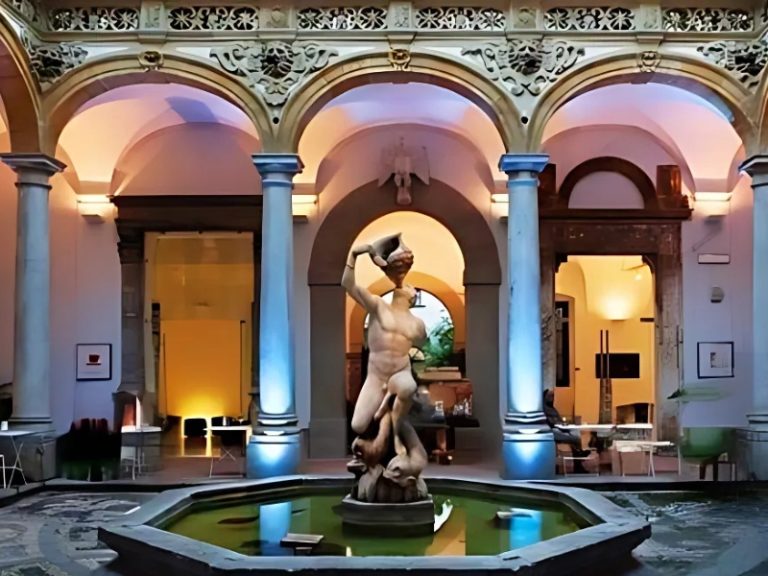
At the Porta Nuova you hear that the gate recalls Charles V's entry into Palermo in 1535, after his victory at Tunis, and why four Moors carry its upper floor. The cathedral holds the tomb of Emperor Frederick II, and La Martorana owes its nickname to a convent whose nuns, it is said, invented marzipan fruit. On Piazza Pretoria the narration explains how a fountain carved in Florence for a private villa ended up in Palermo as the Fountain of Shame. The walk closes at the Teatro Massimo, opened in 1897, where the last scene of The Godfather Part III was filmed on the steps.
- Durationabout 3 hours
- Walkingabout 34 min · 2.8 km
- Stops10
- LanguagesEnglish, German, French, Italian, Spanish, Dutch
What you do along the way
Hear the stories
Every stop has its own audio chapter with history, local legends and fun facts, read aloud or shown as text.
Find the way
Google Maps shows the way to the next stop: 2.8 km and about 34 minutes on foot in total.
Take a break
Nothing runs on a timetable. Close the app for a meal or a museum and open it again whenever you like, even the next day.
Local tips
Along the way you get tips for food and shops near the route. If another starting point suits you better, change it in the app.
See the route and attractions →
How it works
- Book online Choose the number of people. Your booking reference arrives by email straight away.
- Get the app Download the World City Trail app from the App Store or Google Play and enter your booking reference.
- Walk when you like Start whenever you are ready, walk at your own pace and pause any time. No guide, no fixed schedule.
Who the walking tour is for
First time in Palermo
One walk links the main sights of the centre and explains what you are looking at.
Travellers who skip group tours
No group to keep up with and no meeting point: stay where something interests you and move on when you are ready.
A short stay
About 3 hours covers the centre, so the rest of the day stays free.
Good to know
- Bring a charged smartphone with mobile data; a power bank helps.
- No entry tickets needed: everything happens outside the buildings. Going inside is optional and paid separately.
- Family friendly; children must be accompanied by an adult.
- Not suitable for wheelchair users and difficult with strollers.
- Groups of up to 5 work best; larger groups split up, one ticket per person.
- Every purchase helps support stray cats and dogs in Greece.
The walk stop by stop: the Norman Palace, the Cassaro, the Quattro Canti, the Teatro Massimo
10 stops · about 34 min walking · start: Norman Palace · finish: Teatro Massimo
The walk begins at the Norman Palace on the highest point of the old city, with the Porta Nuova right beside it. The old main street, the Cassaro, now Corso Vittorio Emanuele, leads down to Palermo Cathedral. Side streets then bring you to the Jesuits' Chiesa del Gesù and to La Martorana, a few steps from the fountain on Piazza Pretoria. The Quattro Canti mark the crossing of the Cassaro and Via Maqueda, and from there the route turns north to San Domenico, the Antonio Salinas Archaeological Museum and, tenth, the Teatro Massimo. Start and order can be changed in the app, and every stop is free.
Open the route map ↗
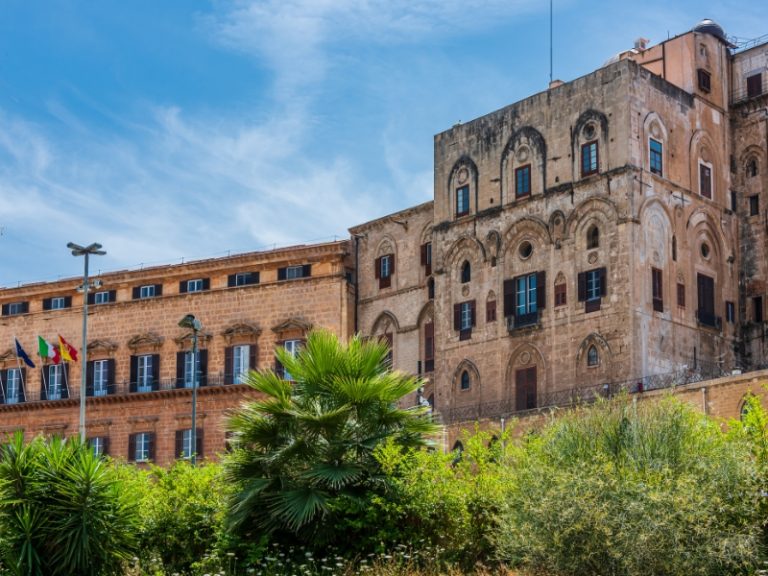
1Norman PalaceStart
The Palazzo dei Normanni, also called the Royal Palace, grew from an Arab-era fortress on the highest point of the old city and became the residence of the Norman kings in the 12th century. Today it is the seat of the Sicilian Regional Assembly. With other Arab-Norman monuments of Palermo it has been a UNESCO World Heritage Site since 2015.
Read the full story →
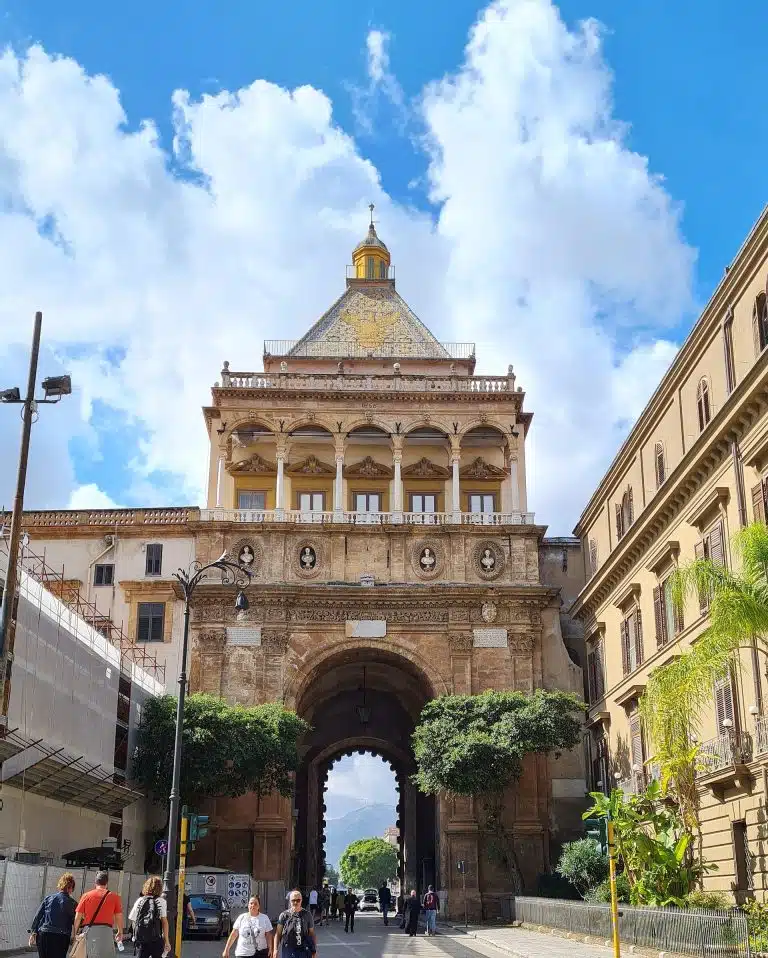
2Porta Nuova
This monumental gate stands at the top of the Cassaro, today Corso Vittorio Emanuele, right next to the Norman Palace. It was built in the 16th century to commemorate Emperor Charles V's entry into Palermo in 1535 after his victory at Tunis. On its outer side four large figures of Moors support the upper floor, which is crowned by a pyramid-shaped roof of coloured tiles.
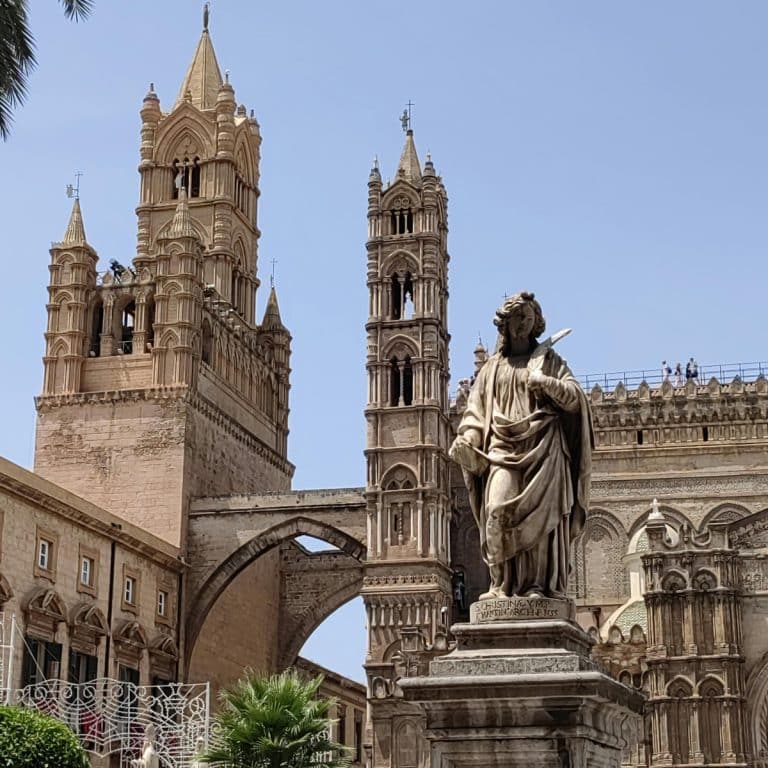
3Palermo Cathedral
Archbishop Walter Ophamil founded the cathedral in 1184 on the site of an earlier church that had served as a mosque under Arab rule. Centuries of rebuilding left Norman, Gothic, Catalan and baroque features, and the neoclassical dome was added in the late 18th century. Inside lie royal tombs, including that of Emperor Frederick II.
4Chiesa del Gesù
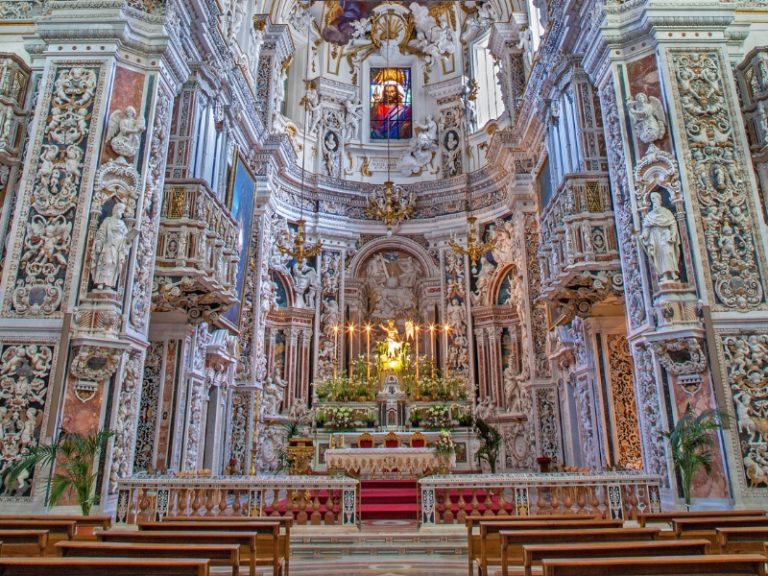
Also known as Casa Professa, this was the first church of the Jesuits in Sicily, built from the late 16th century. Its interior is covered with inlaid coloured marble and stucco, a typical Sicilian baroque technique called marmi mischi. The church was badly damaged by bombing in 1943 and later restored.
Read the full story →
5Santa Maria dell'Ammiraglio (La Martorana)
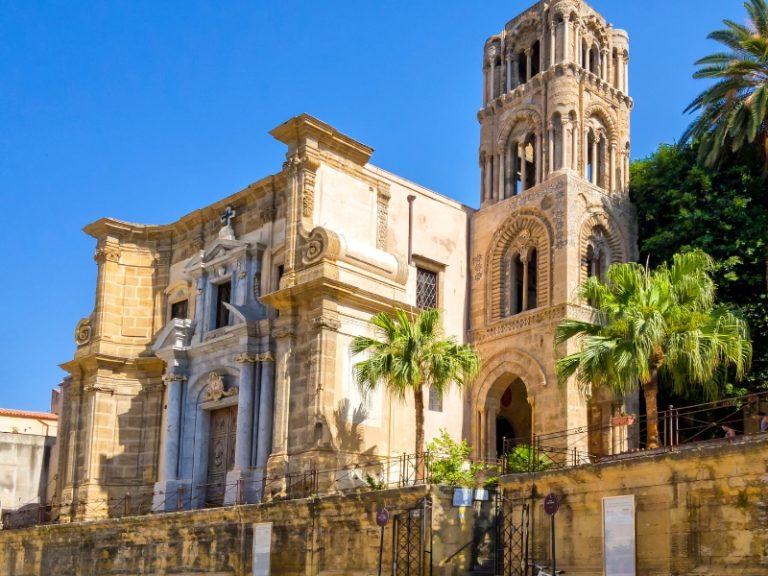
George of Antioch, admiral of King Roger II, founded this church in 1143, which is why it is named after the admiral. Its Byzantine mosaics include a scene of Christ crowning Roger II. The nickname Martorana comes from a nearby convent whose nuns, it is said, invented the marzipan fruits known as frutta martorana.
6Piazza Pretoria
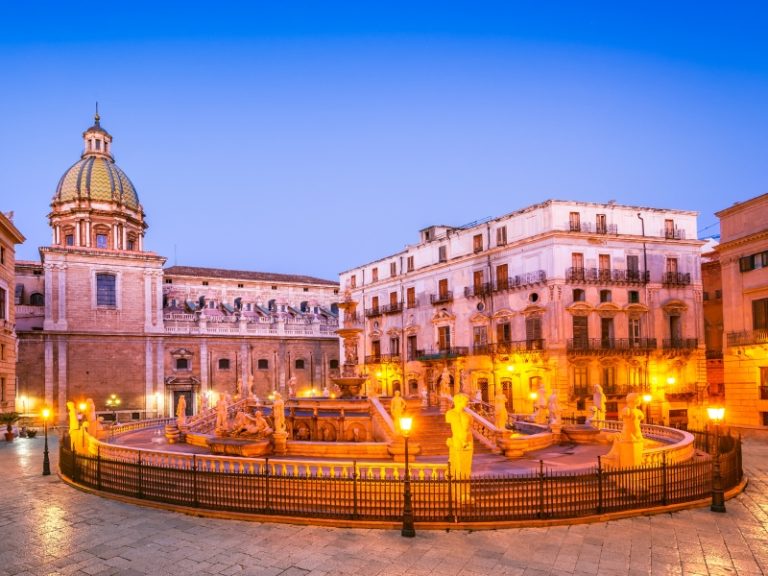
The square is filled by the Pretoria Fountain, made in Florence by Francesco Camilliani in the 16th century for a private villa and later sold to the city of Palermo. Its many nude statues earned it the nickname Fountain of Shame. Facing it stands Palazzo delle Aquile, Palermo's town hall.
Read the full story →
7Quattro Canti
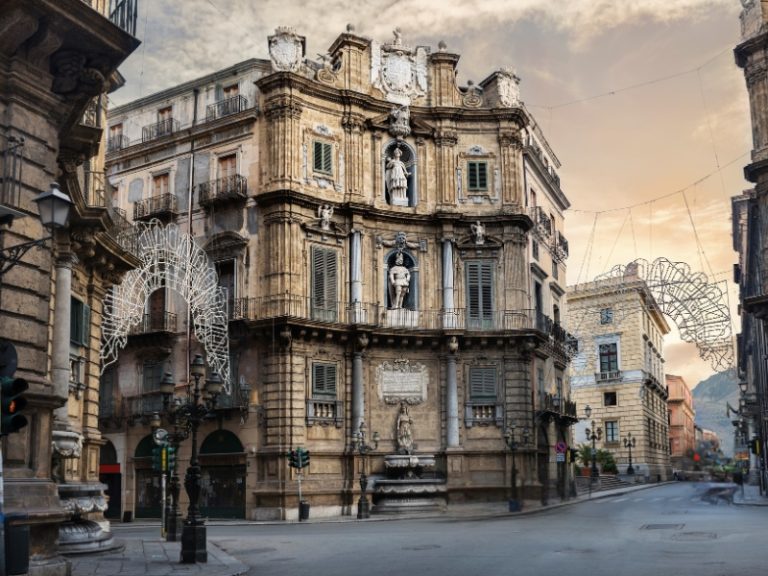
This baroque crossroads, officially Piazza Vigliena, was laid out in the early 17th century where Via Maqueda crosses the Cassaro, today Corso Vittorio Emanuele. Each of its four curved façades has a fountain and statues of a season, a Spanish king and a patron saint. It divides the historic centre into four traditional districts.
Read the full story →
8San Domenico
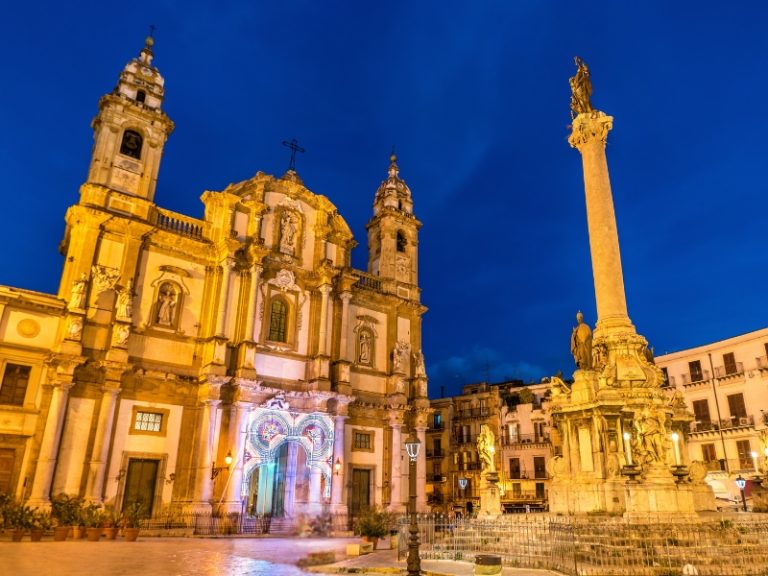
The Dominican church of San Domenico was rebuilt from the 17th century, and its baroque façade with two bell towers was completed in the 18th century. It is known as the pantheon of Palermo because many famous Sicilians are buried here, among them the anti-mafia judge Giovanni Falcone. In front of it stands a column topped by a statue of the Virgin Mary.
Read the full story →
9Antonio Salinas Regional Archaeological Museum
Sicily's main archaeological museum occupies a former monastery of the Oratorians of Saint Philip Neri, next to the church of the Olivella. It is named after Antonio Salinas, the archaeologist who directed it in the 19th century. Its collection includes the carved metopes from the Greek temples of Selinunte.
10Teatro MassimoFinish
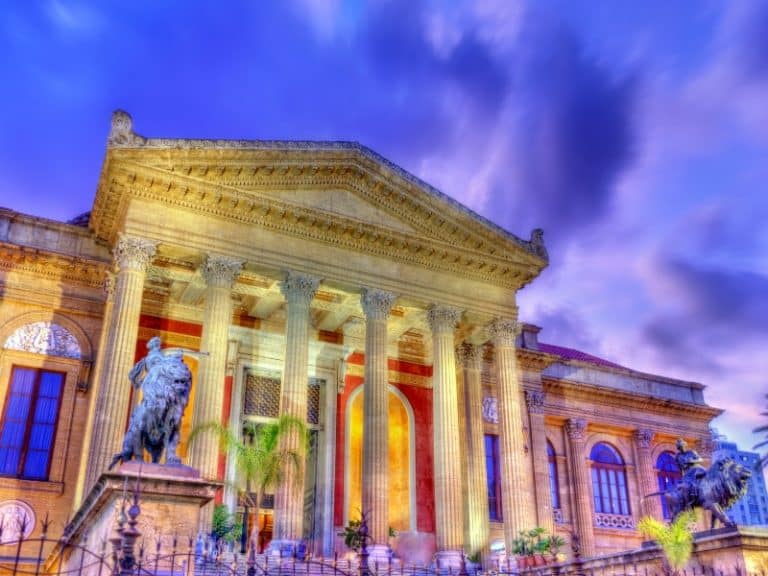
Designed by Giovan Battista Filippo Basile and completed by his son Ernesto, the Teatro Massimo opened in 1897 and is the largest opera house in Italy. Two bronze lions with allegorical figures flank its wide staircase. The final scene of The Godfather Part III was filmed on these steps.
Only logged in customers who have purchased this product may leave a review.



Mexico –
Collected on GetYourGuide
Netherlands –
Collected on GetYourGuide
Narchis– Netherlands –
Collected on GetYourGuide
Leuke manier om de stad voor een klein deel te zien
Tommi– Finland –
Collected on GetYourGuide
Sovellus toimi ihan hyvin ja ohjasi kätevästi nähtävyydeltä toiselle. Kertoi mukavasti infoa kohteista ja kaupungista.
Tommi– Finland –
Collected on GetYourGuide
Sovellus toimi ihan hyvin ja ohjasi k?tev?sti n?ht?vyydelt? toiselle. Kertoi mukavasti infoa kohteista ja kaupungista.
Thomas– Switzerland –
Collected on GetYourGuide
Hat Spass gemacht und man lernt auf eine einfache Art eine Stadt und dies in dem eigenen Tempo. Dazwischen einen Espresso oder Glass Wein endschleunigt das ganze auf eine angenehme Weise ??