
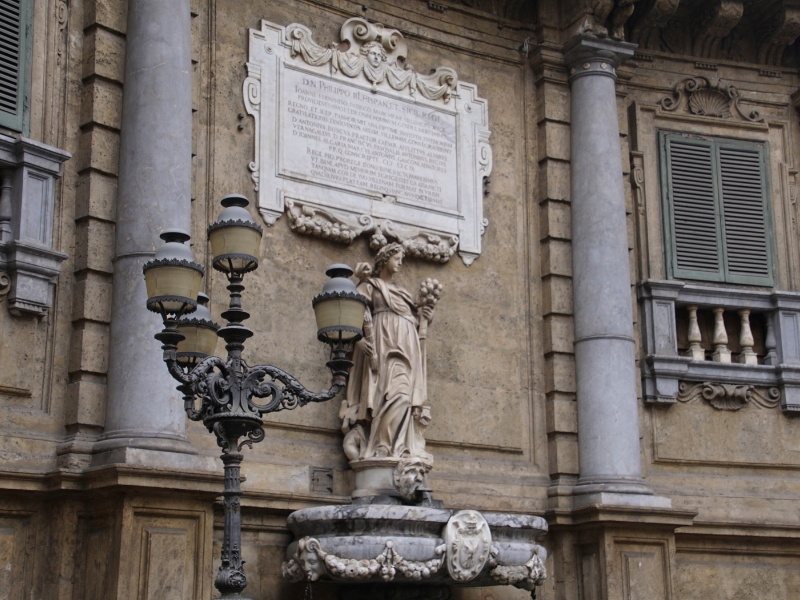
The Quattro Canti (Four Corners), officially Piazza Vigliena, is the Baroque crossroads where Via Maqueda meets Corso Vittorio Emanuele, the two main streets of old Palermo. Laid out from 1608, it is not really a square but an octagon formed by four curved corner facades. Each one is stacked like a wedding cake: a fountain with a season at the bottom, a Spanish king in the middle and one of Palermo's patron saints at the top.
The Quattro Canti at a glance
- Where: the crossing of Via Maqueda and Corso Vittorio Emanuele (the Cassaro) in the historic centre of Palermo.
- Built: from 1608, under the Spanish viceroys; the fountains were finished around 1630 and the kings' statues carved in 1661–1663.
- By: designed by the royal architect Giulio Lasso and completed by Mariano Smiriglio; sculptures by Gregorio Tedeschi, Nunzio La Mattina and Carlo D'Aprile.
- What it is today: a busy pedestrian crossroads and the natural meeting point of the old town, free to see at any hour.
- Time needed: 10–15 minutes, longer if you go into the church on the corner.
A crossroads made for a viceroy
Palermo's oldest street, the Cassaro, ran from the Royal Palace towards the sea. Around 1600 the Spanish rulers of Sicily cut a second straight street across it, Via Maqueda, named after the viceroy who ordered it. The crossing split the old city into four quarters, and in 1608 the viceroy Juan Fernández Pacheco, Marquis of Villena (Vigliena in Italian), had it turned into a stage. The royal architect Giulio Lasso designed four matching concave facades, and Mariano Smiriglio completed the work over the following years.
Each facade has three orders, Doric, Ionic and Corinthian, one above the other, and each tier has its own theme. The sculptors Gregorio Tedeschi and Nunzio La Mattina made the fountains and the seasons, finished around 1630, and Carlo D'Aprile carved the statues of the kings in 1661–1663. On top of each corner sit three coats of arms: the royal arms in the centre, flanked by those of the viceroy and of the Senate of Palermo. The square still carries the viceroy's title, Piazza Vigliena, although nobody in Palermo calls it that.
What to look for
- The four seasons on the lowest tier, each above a fountain: Spring, Summer, Autumn and Winter, shown as classical figures with flowers, crops, grapes and, for Winter, a lantern.
- The four Spanish kings in the middle niches: Charles V, Philip II, Philip III and Philip IV, who ruled Sicily from Madrid.
- The four female patron saints of Palermo at the top, one for each old quarter: Christina, Ninfa, Oliva and Agatha.
- The three coats of arms crowning each corner: the king's, the viceroy's and the city Senate's.
- The church of San Giuseppe dei Teatini on the south-west corner, whose side forms one of the four facades; inside it is lavishly decorated in Baroque marble and stucco.
The Theatre of the Sun
Palermitans also call the crossroads the Teatro del Sole, the Theatre of the Sun. Because the four facades face in different directions, at almost any time of day the sun lights at least one of them, while the others are in shade. The corners also mark the four historic quarters of the old city, which met at this crossing: Kalsa, Albergheria, Seralcadi (Capo) and Loggia (Castellammare). Each saint at the top watches over one of them.
Tips for your visit
- Stand in the middle of the crossroads only when traffic allows; better views come from each corner looking diagonally across at the facade opposite.
- Visit in the morning and again in the afternoon to see different corners in sunlight, which is the whole idea of the Theatre of the Sun.
- Combine it with Piazza Pretoria and Piazza Bellini, both a minute or two away, for a short walk through three of Palermo's best squares.
Nearby
- Fontana Pretoria: the Renaissance fountain crowded with marble nudes, a minute's walk away next to the town hall.
- La Martorana and San Cataldo: the Norman churches on Piazza Bellini, one with Byzantine mosaics and one with three red domes, a couple of minutes' walk away.
- Palermo Cathedral: the vast cathedral on the Cassaro, a walk of around ten minutes towards the Royal Palace.
- Teatro Massimo: Italy's largest opera house, at the northern end of Via Maqueda, a walk of around ten to fifteen minutes.
See Palermo with World City Trail
Our Palermo scavenger hunt turns the old town into a game you play on your phone. The route links 10 stops and takes around 2 hours, with about 34 minutes of walking. It includes the Norman Palace with the Palatine Chapel and Palermo Cathedral, both along the Cassaro from the Quattro Canti.
If you prefer a different format, there is also a self-guided walking tour and an outdoor escape game in Palermo.
Play the Palermo scavenger hunt →
Take the self-guided walking tour of Palermo →
Play the outdoor escape game in Palermo →
Facts checked in October 2026.