
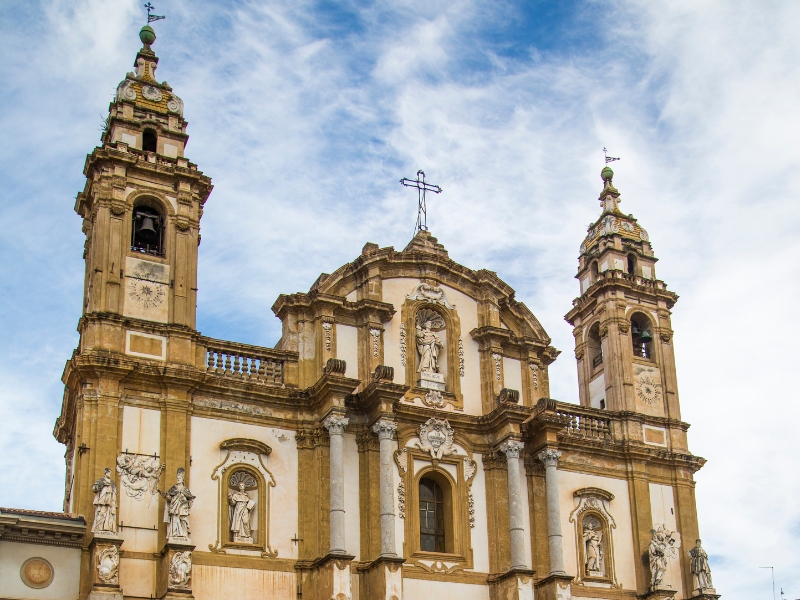
San Domenico is the large Baroque church of the Dominican friars on Piazza San Domenico, just off Via Roma in Palermo's old La Loggia quarter. After the cathedral it is the city's most important church, and since 1853 it has served as the pantheon of illustrious Sicilians. Among the people buried here is Giovanni Falcone, the anti-Mafia judge murdered in 1992.
San Domenico at a glance
- Where: Piazza San Domenico, between Via Roma and the alleys of the Vucciria market, in the La Loggia quarter.
- Built: the present church was begun in 1640; the facade was completed in 1726.
- By: the Dominican architect Andrea Cirrincione designed the church.
- What it is today: a working Dominican church and burial place of famous Sicilians, with a medieval cloister beside it.
- Time needed: 30–45 minutes for the church, longer if you also visit the cloister.
Three churches on one site
The Dominicans arrived in Palermo in the early 13th century, while their founder Saint Dominic was still alive. Between 1280 and 1285 they built their first church here, in the Norman-Gothic style, with a convent and a cloister beside it. As the congregation grew, the friars rebuilt it in the 15th century with help from Pope Martin V and Palermo's noble families, in a Renaissance style. That too became too small, and in 1640 work began on the vast church you see today, designed by the friar Andrea Cirrincione. The facade took until 1726 to finish.
The church has also been a stage for Sicilian history. On 25 March 1848, during the revolution against the Bourbons, the new Sicilian Parliament opened here. From 1853 famous Sicilians were buried inside, and the opening of Via Roma later brought the piazza onto one of the city's main streets. In May 1992 Cardinal Salvatore Pappalardo celebrated the state funeral of Giovanni Falcone, his wife Francesca Morvillo and three police officers of their escort here; in 2015 Falcone's remains were moved into the church.
What to look for
- The facade: two tiers of paired columns, flanked by two bell towers, with stucco statues of Dominican saints and popes set in niches.
- The interior: a huge, plain Latin-cross nave in grey Billiemi stone, lined with side chapels full of altarpieces and funerary monuments.
- Giovanni Falcone's tomb: visitors often leave notes, flowers and letters to the judge beside it.
- The tombs of the pantheon: look for the names of the painter Pietro Novelli, the poet Giovanni Meli, the folklorist Giuseppe Pitrè and the statesman Francesco Crispi.
- The Column of the Immaculate Conception: in the piazza outside, a grey marble column of the 1720s topped by a bronze Virgin by Giovan Battista Ragusa.
The cloister
North of the church lies the cloister of the old convent, founded around 1300 and paid for by the powerful Chiaramonte family. It is a quiet Gothic courtyard of slender columns and pointed arches, and some of its capitals and columns were reused from the first 13th-century building. The convent around it is still the home of the Dominican community, and the cloister can be reached from the church's north aisle.
Tips for your visit
- This is a working church: dress modestly, keep your voice down and avoid walking around during Mass.
- Step back across Via Roma for the best view of the whole facade with the column in front of it.
- Combine it with a walk through the Vucciria market, which starts right behind the piazza, and with the nearby oratories decorated by the stucco sculptor Giacomo Serpotta.
Nearby
- Oratory of the Rosary of San Domenico: a small oratory behind the church with stucco work by the Serpotta school and an altarpiece by Anthony van Dyck.
- Vucciria: Palermo's old market quarter of narrow lanes and stalls, beginning just south of the piazza.
- Oratory of Santa Cita: a few minutes' walk away, famous for Giacomo Serpotta's white stucco reliefs and figures.
See Palermo with World City Trail
Our Palermo scavenger hunt turns the old town into a game you play on your phone. The route links 10 stops and takes around two hours, with about 34 minutes of walking. It includes Palermo Cathedral and the Norman Palace with the Palatine Chapel.
If you prefer a different format, there is also a self-guided walking tour and an outdoor escape game in Palermo.
Play the Palermo scavenger hunt →
Take the self-guided walking tour of Palermo →
Play the outdoor escape game in Palermo →
Facts checked in October 2026.