
In the Middle Ages, Ghent grew rich on cloth and became one of the largest cities in northern Europe. The towers, guild houses and castle from that time still stand along its canals, but this is also a busy university city, so the streets feel lived in rather than preserved. Here are the facts and stories that make the city special.
10 fun facts about Ghent
- A dragon on the roof: the Belfry is 91 metres tall, and a gilded dragon has watched over the city from its spire for centuries. It is part of the UNESCO World Heritage listing of the belfries of Belgium and France.
- A castle in the middle of town: the Gravensteen, the Castle of the Counts, was built in 1180 by Count Philip of Alsace. In 1949 students occupied it in protest against a rise in the price of beer.
- An emperor's birthplace: Charles V, ruler of an empire on which it was said the sun never set, was born in Ghent in 1500.
- Built on cloth: Ghent's medieval wealth came from weaving English wool into fine cloth, and its guilds and merchants built the step-gabled houses you still see today.
- A medieval harbour: the Graslei and the Korenlei, facing each other across the Leie, were the city's port. The guild houses along them span several centuries, from a Romanesque grain warehouse to Baroque façades.
- A giant cannon: the Dulle Griet, a huge red wrought-iron cannon from the 15th century, stands next to the Vrijdagmarkt, the Friday Market square.
- A daring sculpture: above the door of the former city jail next to the Belfry, the Mammelokker relief shows a woman breastfeeding her starving father in prison, an ancient story known as Roman Charity.
- Thursday is veggie day: in 2009 Ghent became one of the first cities in the world to promote an official weekly meat-free day, Donderdag Veggiedag.
- A street made for graffiti: in the Werregarenstraat, a narrow alley in the centre, spraying the walls is allowed, so the art changes almost every week.
- Ten days of party: the Gentse Feesten, a free street festival of music and theatre, takes over the centre for ten days every July and goes back to 1843.
The noose bearers of Ghent
In 1539 Ghent rebelled against its most famous son. The city refused to pay taxes that Charles V demanded for his wars, and the emperor came in person to restore order. In 1540 he took a humiliating revenge: the city lost its privileges, and its leading citizens had to walk before him barefoot, dressed in shirts, with a noose around their necks, and beg for forgiveness on their knees. The people of Ghent turned the shame into pride. They still call themselves stroppendragers, noose bearers, and during the Gentse Feesten you will see people wearing a noose as a badge of the city's stubbornness.
The Ghent Altarpiece, explained
In St Bavo's Cathedral hangs the Adoration of the Mystic Lamb, a polyptych begun by Hubert van Eyck and completed by his brother Jan in 1432. It is often called one of the most stolen artworks in history. Napoleon's troops carried its central panels to Paris, some wings were sold and ended up in Berlin, and the Nazis hid it in an Austrian salt mine, where the Allies recovered it in 1945. One panel, the Just Judges, was stolen in 1934 and has never been found. The one you see today is a copy.
What to eat in Ghent
- Gentse waterzooi: a creamy stew of chicken or fish with vegetables, the city's signature dish.
- Stoverij: beef slowly braised in dark beer, often served with fries.
- Cuberdons: cone-shaped purple sweets with a soft raspberry centre. In Ghent they are called neuzekes, little noses, and are sold from carts on the Groentenmarkt.
- Tierenteyn mustard: a strong, freshly made mustard sold from wooden barrels in a historic shop on the Groentenmarkt.
- Local beer: Ghent has its own breweries, including one that brews with gruit, the mix of herbs used before hops became standard.
Good to know before you go
- Boat trips leave from the Graslei and the Korenlei and show the medieval harbour from the water.
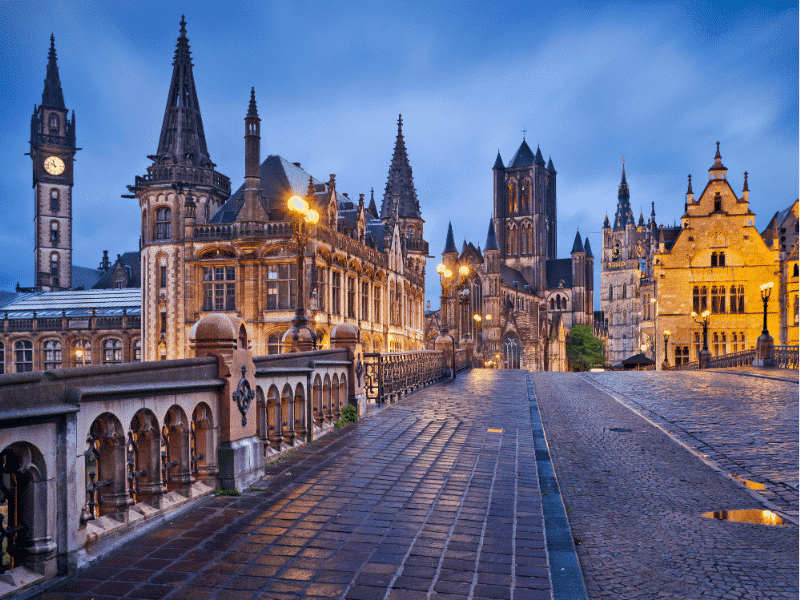
- Stand on St Michael's Bridge for the classic view of Ghent's three towers lined up: St Nicholas' Church, the Belfry and St Bavo's Cathedral.
- Stay after dark: Ghent lights its main buildings, bridges and quays at night as part of a citywide lighting plan.
- Bruges is a short train ride away, so the two cities combine easily, but Ghent is quieter in the evening once the day-trippers leave.
Explore Ghent with World City Trail
Our Ghent scavenger hunt turns these sights into a game you play on your phone. The route links 11 stops and takes around three hours, with about 30 minutes of walking, and leads you past St Michael's Church, St Michael's Bridge, the Belfry and St Bavo's Cathedral, among other sights.
At each stop you solve a puzzle and hear a short story, at your own pace. You can start whenever you like.
Play the Ghent scavenger hunt →
Facts checked in October 2026.