
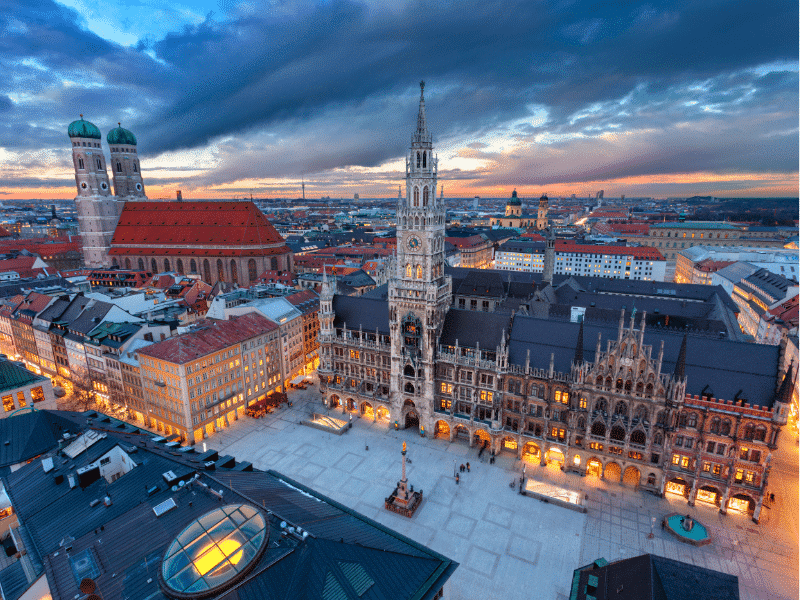
Munich was the capital of the Wittelsbach dukes and kings of Bavaria for more than 700 years, and they left it a palace, grand avenues and a royal brewery. Today the Bavarian capital mixes beer halls and baroque churches with world-class museums and a river you can surf on. Here are the facts and stories that make the city special.
10 fun facts about Munich
- A city named after monks: Munich takes its name from the monks, Munichen in Old High German, who lived here before Duke Henry the Lion founded the town in 1158. A small monk, the Münchner Kindl, still appears on the city's coat of arms.
- A clock that tells two stories: the Glockenspiel in the tower of the New Town Hall on Marienplatz has 43 bells and 32 life-size figures and was installed in 1908. It re-enacts a royal wedding of 1568 with a joust, and the coopers' dance that marked the end of a plague in 1517.
- Twin towers that define the skyline: the Frauenkirche was built of brick between 1468 and 1488, and its two towers, just under 99 metres high, received their onion-shaped domes around 1525.
- No skyscrapers above the cathedral: in a referendum in 2004, Munich voted that new buildings inside the middle ring road should not rise higher than the towers of the Frauenkirche.
- A wedding party that never ended: the first Oktoberfest was held in October 1810 to celebrate the marriage of Crown Prince Ludwig and Princess Therese. The meadow where it still takes place, the Theresienwiese, is named after the bride.
- A royal brewery: the Hofbräuhaus was founded in 1589 by Duke Wilhelm V as the court brewery, because the dukes were tired of importing expensive beer.
- Germany's largest inner-city palace: the Residenz grew over more than 400 years from a 14th-century castle into a vast complex. Its vast vaulted Antiquarium was finished in 1571.
- Lions for luck: four bronze lions guard the entrances of the Residenz on Residenzstraße. Passers-by rub their noses for luck, which is why they shine.
- A park bigger than Central Park: the English Garden, laid out from 1789, is one of the largest city parks in the world. At its southern end, surfers ride a standing wave on the Eisbach, which reopened to surfing in May 2026 after a long break.
- Sausages before noon: tradition says that a Weißwurst, the white veal sausage, should not hear the noon bells, a rule from the days before refrigeration.
The legend of the Devil's Footprint
In the entrance hall of the Frauenkirche, a dark footprint is pressed into the floor. Legend says the master builder made a deal with the devil, who agreed to help build the church on condition that it would have no visible windows. When the devil came to inspect the finished building, he stood in the entrance and, because the pillars hide the tall windows from that spot, saw none at all. Delighted, he stamped his foot and left his mark. One step further, he saw the windows, realised he had been tricked, and turned into a furious wind to bring the church down. Locals say the wind still blows around the church.
Marienplatz, explained
Marienplatz has been the heart of Munich since the city's founding. In the middle stands the Mariensäule, a column with a golden statue of the Virgin Mary, put up in 1638 in thanks that the city had been spared destruction during the Thirty Years' War. On one side rises the neo-Gothic New Town Hall. On the other side stands the Old Town Hall, and the Viktualienmarkt, the city's food market, is a few steps away.
What to eat in Munich
- Weißwurst: white veal sausage, eaten in the morning with sweet mustard and a pretzel. Locals suck the meat out of the skin.
- Schweinshaxe: a roast pork knuckle with crackling, served with potato dumplings in every traditional beer hall.
- Obatzda: a spicy spread of ripe Camembert, butter, paprika and onions, the classic beer garden snack with a pretzel.
- Leberkäse: a smooth meat loaf, served in thick warm slices in a bread roll with mustard. Despite the name, the Munich version contains neither liver nor cheese.
- Apfelstrudel: thin pastry filled with apples and raisins, served warm with vanilla sauce.
Good to know before you go
- Oktoberfest starts in September and ends in early October. Book hotels well in advance.
- The south tower of the Frauenkirche is open to visitors again, with a lift for most of the way. The tower of St Peter's, Alter Peter, is another classic viewpoint over Marienplatz.
- The Glockenspiel plays several times a day. Check the times before you go.
- Popular day trips include Neuschwanstein Castle, which needs a timed ticket, and the Dachau Concentration Camp Memorial Site.
Explore Munich with World City Trail
Our Munich scavenger hunt turns these sights into a game you play on your phone. The route links 10 stops and takes around three hours, with about 55 minutes of walking, including Marienplatz, the Frauenkirche and the Residenz.
At each stop you solve a puzzle and hear a short story, at your own pace. You can start whenever you like and play in English, German, French, Italian, Spanish, Dutch or Polish.
Play the Munich scavenger hunt →
Facts checked in October 2026.