
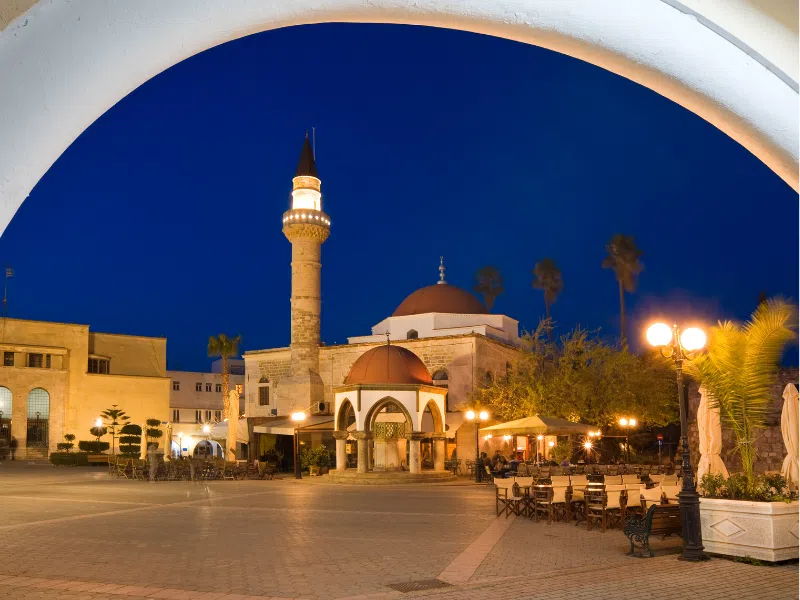
Kos is the island where Hippocrates, the father of medicine, was born, and its main town wears its long history openly: ancient ruins lie between the streets, a castle of the Knights of St John guards the harbour, and Italian-era buildings line the waterfront. Here are the facts and stories that make the island special.
10 fun facts about Kos
- The father of medicine was born here: Hippocrates was born on Kos around 460 BC. The Hippocratic Oath, still echoed in doctors' pledges today, carries his name.
- A tree with a famous name: the Plane Tree of Hippocrates in the centre of Kos Town is said to stand where he taught. The present tree is thought to be around 500 years old, probably a descendant of an older one.
- A healing sanctuary on three terraces: the Asklepieion, dedicated to Asclepius, god of healing, was built from the 4th century BC onwards. It was rediscovered in 1902 by the German archaeologist Rudolf Herzog and the local historian Iakovos Zarraftis.
- A castle named after bitter oranges: the Knights Hospitaller built Nerantzia Castle between 1436 and 1514, reusing stones from ancient Kos. Its name comes from the bitter orange trees, nerantzia, that once covered the island.
- A lettuce named after the island: cos lettuce, the long-leaved romaine, takes its English name from Kos.
- Famous for silk: in Roman times Kos was known for Coan silk, a fine, almost transparent fabric mentioned by Roman writers.
- A royal birthplace: Ptolemy II Philadelphus, the Egyptian king who built up the Library of Alexandria, was born on Kos in 309 BC.
- An earthquake that uncovered the past: after a strong earthquake in 1933, Italian archaeologists excavated the ruined areas and exposed the ancient agora and harbour quarter in the heart of town.
- Italian for three decades: Kos was under Italian rule from 1912 to 1943, then under German occupation, and joined Greece with the rest of the Dodecanese in 1948.
- Closer to Turkey than to Athens: Kos lies just off Turkey's Bodrum peninsula, and ferries link the two.
Hippocrates and the plane tree
Before Hippocrates, illness was often explained by the will of the gods. He and his followers on Kos argued that disease has natural causes, and that a doctor should observe the patient, record the symptoms and support the body's own ability to heal. Tradition says he taught his students in the shade of a great plane tree in the town centre. The tree you see today, its heavy branches propped up on metal supports, stands beside an Ottoman-era fountain, and cuttings and seeds from it have been planted at medical schools and hospitals around the world.
Kos Town's open-air history
In Kos Town, history is not kept behind museum glass. The Ancient Agora, the harbour quarter and the Western Excavations, with Roman mosaics, columns and a stretch of ancient paved road, lie open between modern streets. The Casa Romana, a Roman house restored by the Italians, shows how wealthy families lived. And the Italian buildings of the 1920s and 1930s, from the former governor's palace on the harbour to the market hall, give the town a look unlike most Greek islands.
What to eat in Kos
- Krasotyri: a local goat's or sheep's cheese matured in red wine lees, which give it a reddish rind and a slightly sweet, tangy taste.
- Pitaridia: handmade pasta cut into rough squares, cooked in meat broth and served with cheese, a dish of village celebrations.
- Katimeria: small fried pastries filled with soft mizithra cheese and drizzled with honey.
- Thyme honey: the island's aromatic honey, sold in village shops and at local festivals.
- Kanelada: a sweet cinnamon syrup mixed with cold water, a traditional summer drink.
Good to know before you go
- Parts of Nerantzia Castle were damaged in the 2017 earthquake and have been closed for repairs at times, so check what is open before you go.
- The Asklepieion is a short bike or bus ride from town. In summer go early or late, as the site has little shade.
- Kos Town is flat and has many cycle paths, so a rented bike is an easy way to get around.
- Ferries run to Bodrum in Turkey (bring your passport), boat trips go to the volcano of Nisyros, and for sunset you can head up to the mountain village of Zia.
Explore Kos with World City Trail
Our Kos scavenger hunt turns these sights into a game you play on your phone. The route takes around two hours, with about 33 minutes of walking, including Nerantzia Castle and the Plane Tree of Hippocrates.
At each stop you solve a puzzle and hear a short story, at your own pace. You can start whenever you like and play in English, German, French, Italian, Dutch or Greek.
Facts checked in October 2026.