
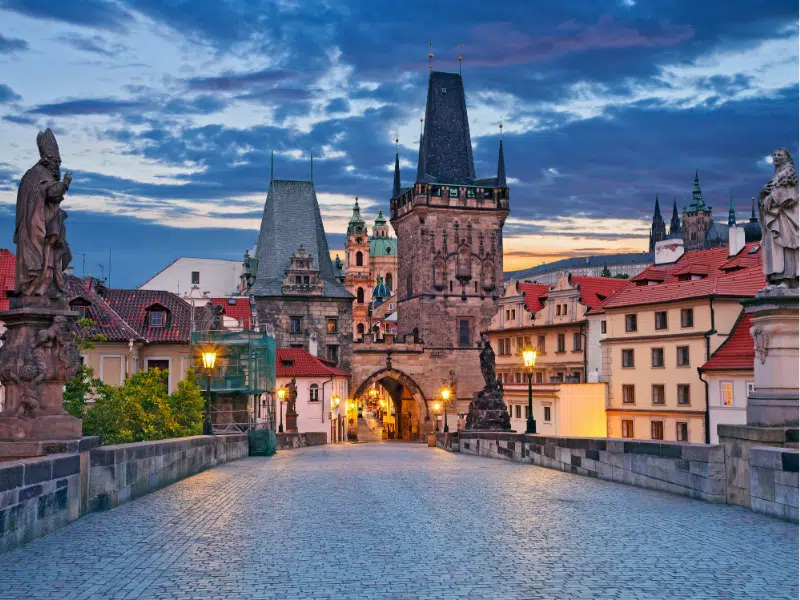
Prague has been the seat of Czech princes, kings and presidents for more than a thousand years, and its historic centre came through the 20th century largely intact. Gothic towers, Baroque palaces and Art Nouveau façades stand within a few minutes' walk of each other. Here are the facts and stories that make the city special.
10 fun facts about Prague
- A clock from 1410: the Astronomical Clock on the Old Town Hall was installed in 1410 and is the oldest astronomical clock still working. Every hour the Twelve Apostles parade past two small windows above the dial.
- Adam and Eve: the two Gothic towers of the Church of Our Lady before Týn rise about 80 metres over the Old Town Square. They are not identical, and Prague tradition calls the broader one Adam and the slimmer one Eve.
- An astronomer's grave: Tycho Brahe, the Danish astronomer who worked for Emperor Rudolf II in Prague, died in the city in 1601 and is buried in the Týn Church.
- The tallest belfry in town: at about 66 metres, the Henry Tower is Prague's tallest free-standing bell tower. Of the bells that once hung there, only one survives, Maria, cast in 1518.
- A bridge with a lucky number: Charles Bridge was begun in 1357 under Charles IV. A popular story says the foundation stone was laid at 5.31 am on 9 July, giving the palindrome 1357 9 7 5 31.
- A saint thrown from the bridge: John of Nepomuk was thrown into the Vltava from the bridge in 1393 on the orders of King Wenceslas IV. Touching the bronze relief at the foot of his statue is said to bring luck.
- A record-sized castle: Guinness World Records lists Prague Castle as the largest ancient castle complex in the world, covering about 70,000 square metres.
- Out of the window: Prague has had two famous defenestrations. In 1618 two royal governors and their secretary were thrown from a window of Prague Castle and survived, an event that helped start the Thirty Years' War.
- The oldest university in Central Europe: Charles IV founded Charles University in 1348, making it the oldest university north of the Alps and east of Paris.
- A nation of beer drinkers: for about three decades Czechs have drunk more beer per person than any other nation, and the golden pilsner style was born in nearby Plzeň in 1842.
The legend of the Golem
Prague's most famous legend belongs to its Jewish Town. In the late 16th century, the story goes, Rabbi Judah Loew ben Bezalel, a real and highly respected scholar, shaped a man out of clay from the banks of the Vltava and brought him to life by placing a slip with the name of God in his mouth. The Golem did heavy work and protected the community from attacks. One Friday the rabbi forgot to remove the slip before the Sabbath, and the Golem went on a rampage until the rabbi pulled it out and the clay figure collapsed. Legend says its remains still lie in the attic of the Old-New Synagogue, which dates from the 13th century and is the oldest active synagogue in Europe.
The Astronomical Clock, explained
The upper dial of the clock shows the positions of the sun and the moon in the sky, the signs of the zodiac and several ways of telling the time, including Old Czech time, which counts the hours from sunset. Next to the dials stand moving figures: a skeleton representing Death rings a bell, while Vanity admires himself in a mirror and a Miser shakes his money bag. Legend says the councillors had the clockmaker, Master Hanuš, blinded so he could never build a finer clock elsewhere, and that he took revenge by stopping it. In fact, the clock was built by the clockmaker Mikuláš of Kadaň with the astronomer Jan Šindel.
What to eat in Prague
- Svíčková: braised beef in a creamy root-vegetable sauce, served with bread dumplings, cranberries and a spoon of whipped cream.
- Vepřo knedlo zelo: roast pork with dumplings and sauerkraut, the classic Czech Sunday lunch.
- Smažený sýr: a thick slice of breaded, fried cheese with tartar sauce, a favourite in pubs.
- Czech beer: order a draught lager in a traditional pub, where it is often served with a thick head of foam.
- Trdelník: the sugar-coated chimney cake sold all over the old town is a recent arrival for tourists, not an old Czech tradition.
Good to know before you go
- The square in front of the Astronomical Clock gets packed on the hour. For a view over the whole square, climb the Old Town Hall tower, which also has a lift.
- Cross Charles Bridge early in the morning to see the statues without the crowds.
- The courtyards of Prague Castle are free to walk through, but most interiors, including the main part of St Vitus Cathedral, need a ticket.
- Kutná Hora, about an hour away by train, is a UNESCO-listed silver-mining town with the Gothic St Barbara's Church and the Sedlec Ossuary, decorated with human bones.
Explore Prague with World City Trail
Our Prague scavenger hunt turns these sights into a game you play on your phone. The route links 10 stops and takes around two hours, with about 53 minutes of walking, and its stops include the Henry Tower, the Astronomical Clock and the Church of Our Lady before Týn.
At each stop you solve a puzzle and hear a short story, at your own pace. You can start whenever you like.
Play the Prague scavenger hunt →
Facts checked in October 2026.