
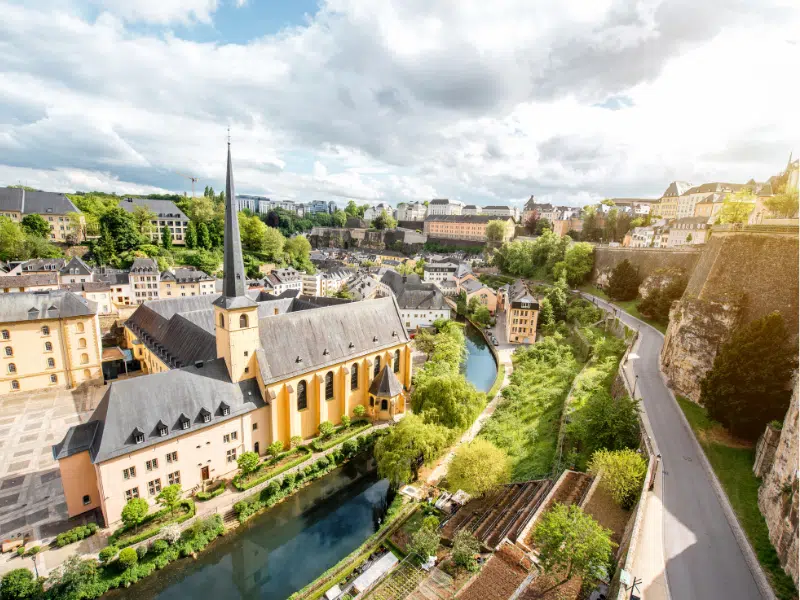
Luxembourg City stands on a rocky plateau above two deep river valleys, and for centuries that position made it one of the most fought-over fortresses in Europe. Today it is the capital of the world's only grand duchy and one of the seats of the European Union, yet its old quarters, bridges and tunnels still tell the fortress story. Here are the facts and stories that make the city special.
10 fun facts about Luxembourg
- A city born on a rock: in 963 Count Siegfried acquired the Bock promontory above the Alzette from the abbey of St Maximin in Trier and built a castle there. The town that grew around it became Luxembourg.
- The Gibraltar of the North: Spanish, French, Austrian and Prussian garrisons strengthened the fortress so often that it earned this nickname. After the Treaty of London in 1867, most of it was taken down and Luxembourg was declared neutral.
- A city underground: the Spanish began digging the Bock Casemates in 1644. During the Second World War the tunnels sheltered up to 35,000 people during air raids.
- World Heritage since 1994: the old quarters and fortifications of Luxembourg City were added to UNESCO's World Heritage List in 1994.
- The world's only grand duchy: Luxembourg is the last sovereign grand duchy, and the Grand Ducal Palace in the old town is the Grand Duke's official residence in the capital.
- Three official languages: Luxembourgish, French and German are all official. Laws are written in French, newspapers are often in German, and Luxembourgish is the language people speak at home.
- Free transport for everyone: in 2020 Luxembourg became the first country to make all its buses, trams and trains free to use nationwide, apart from first class on trains.
- A record-breaking bridge: when the Adolphe Bridge opened in 1903, its arch over the Pétrusse valley was the largest stone arch in the world. Since 2018 a bridge for cyclists and pedestrians has hung beneath its deck.
- A golden lady: the Gëlle Fra, a gilded figure on a tall obelisk on Place de la Constitution, honours Luxembourgers who died in the First World War. The Nazis pulled it down in 1940; the statue was found decades later and returned to its column in 1985.
- A fair since 1340: the Schueberfouer, the city's big funfair held every late summer, was founded in 1340 by John the Blind, Count of Luxembourg and King of Bohemia.
The legend of Melusina
Luxembourg's best-known legend says that Count Siegfried fell in love with Melusina, a beautiful woman he met by the Alzette. She agreed to marry him on one condition: one day every week she must be left completely alone. For years he kept his promise, until curiosity won. He looked through the keyhole and saw her in her bath with the tail of a fish. Discovered, Melusina sank into the rock of the Bock and was never seen again. Legend says she is still inside, knitting one stitch a year, and that if she finishes before someone sets her free, the whole city will disappear into the rock with her.
The Knuedler, Place d'Armes and the national poets
Place Guillaume II is known to locals as the Knuedler, from the knotted cord worn by the Franciscan friars whose monastery once stood here. The horseman in the middle is William II, King of the Netherlands and Grand Duke of Luxembourg, and the City Hall lines one side. A short walk away, Place d'Armes, once the parade ground of the garrison, is the city's open-air living room. Nearby stands the monument to Dicks and Lentz, the two 19th-century poets who helped make Luxembourgish a written language. Michel Lentz wrote the words of the national anthem, Ons Heemecht, and the monument carries the national motto from another of his songs: Mir wëlle bleiwe wat mir sinn, we want to remain what we are.
What to eat in Luxembourg
- Judd mat Gaardebounen: smoked pork collar with broad beans in a creamy sauce, the national dish, best in summer when the beans are fresh.
- Gromperekichelcher: crisp potato fritters with onion and parsley, sold at markets and at the Schueberfouer.
- Bouneschlupp: a hearty green bean soup with potatoes, bacon and often sausage.
- Kachkéis: a soft, runny cooked cheese spread on bread, often with a little mustard.
- Crémant and Moselle wine: sparkling Crémant de Luxembourg and white wines such as Riesling and Pinot gris come from the vineyards along the Moselle.
Good to know before you go
- Public transport is free, and so are the panoramic lift from the upper town down to Pfaffenthal and the funicular up to Kirchberg, the district of the European institutions.
- Walk the Chemin de la Corniche, which the writer Batty Weber called the most beautiful balcony in Europe, for views over the Grund and the Alzette valley.
- The Bock Casemates usually open from spring to autumn. Check before you go, as they can close for maintenance.
- Vianden Castle in the north and the wine villages of the Moselle make easy day trips by bus or train.
Explore Luxembourg with World City Trail
Our Luxembourg scavenger hunt turns these sights into a game you play on your phone. The route links 10 stops and takes around two hours, with about 30 minutes of walking, and its stops include the Monument to Dicks and Lentz, Place d'Armes and Place Guillaume II.
At each stop you solve a puzzle and hear a short story, at your own pace. You can start whenever you like.
Play the Luxembourg scavenger hunt →
Facts checked in October 2026.