
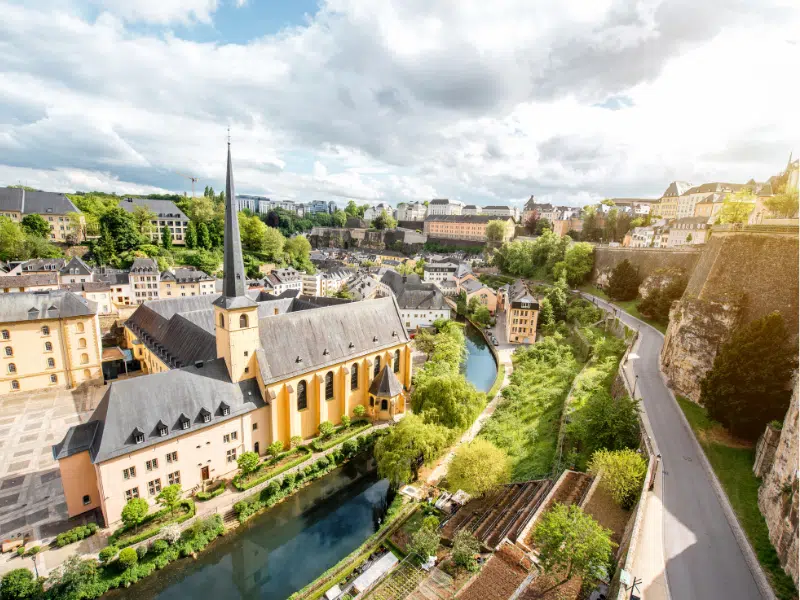
Luxembourg City stands on a rocky plateau above two deep river valleys, and for centuries that position made it one of the most fought-over fortresses in Europe. Today it is the capital of the world's only grand duchy and one of the seats of the European Union, yet its old quarters, bridges and tunnels still tell the fortress story. Here are the facts and stories that make the city special.
10 spannende Fakten über Luxemburg
- Eine Stadt, geboren auf einem Felsen: 963 erwarb Graf Siegfried den Bockfelsen über der Alzette von der Abtei St. Maximin in Trier und baute dort eine Burg. Aus der Siedlung um sie herum wurde Luxemburg.
- Das Gibraltar des Nordens: Spanische, französische, österreichische und preußische Garnisonen bauten die Festung so oft aus, dass sie diesen Beinamen bekam. Nach dem Londoner Vertrag von 1867 wurde sie größtenteils geschleift und Luxemburg für neutral erklärt.
- Eine Stadt unter der Erde: Die Spanier begannen 1644, die Bock-Kasematten zu graben. Im Zweiten Weltkrieg boten die Tunnel bei Luftangriffen bis zu 35.000 Menschen Schutz.
- World Heritage since 1994: the old quarters and fortifications of Luxembourg City were added to UNESCO's World Heritage List in 1994.
- The world's only grand duchy: Luxembourg is the last sovereign grand duchy, and the Grand Ducal Palace in the old town is the Grand Duke's official residence in the capital.
- Drei Amtssprachen: Luxemburgisch, Französisch und Deutsch sind alle Amtssprachen. Gesetze werden auf Französisch verfasst, Zeitungen erscheinen oft auf Deutsch, und Luxemburgisch ist die Sprache, die man zu Hause spricht.
- Gratis unterwegs: 2020 wurde Luxemburg das erste Land, in dem alle Busse, Straßenbahnen und Züge landesweit kostenlos sind, mit Ausnahme der ersten Klasse im Zug.
- Eine Rekordbrücke: Als die Adolphe-Brücke 1903 eröffnet wurde, war ihr Bogen über das Petrusstal der größte Steinbogen der Welt. Seit 2018 hängt unter ihrer Fahrbahn eine Brücke für Radfahrer und Fußgänger.
- Eine goldene Dame: Die Gëlle Fra, eine vergoldete Figur auf einem hohen Obelisken an der Place de la Constitution, ehrt die Luxemburger, die im Ersten Weltkrieg starben. Die Nazis rissen das Denkmal 1940 ab; die Statue wurde Jahrzehnte später wiedergefunden und 1985 zurück auf ihre Säule gestellt.
- A fair since 1340: the Schueberfouer, the city's big funfair held every late summer, was founded in 1340 by John the Blind, Count of Luxembourg and King of Bohemia.
Die Sage von Melusina
Luxembourg's best-known legend says that Count Siegfried fell in love with Melusina, a beautiful woman he met by the Alzette. She agreed to marry him on one condition: one day every week she must be left completely alone. For years he kept his promise, until curiosity won. He looked through the keyhole and saw her in her bath with the tail of a fish. Discovered, Melusina sank into the rock of the Bock and was never seen again. Legend says she is still inside, knitting one stitch a year, and that if she finishes before someone sets her free, the whole city will disappear into the rock with her.
The Knuedler, Place d'Armes and the national poets
Place Guillaume II is known to locals as the Knuedler, from the knotted cord worn by the Franciscan friars whose monastery once stood here. The horseman in the middle is William II, King of the Netherlands and Grand Duke of Luxembourg, and the City Hall lines one side. A short walk away, Place d'Armes, once the parade ground of the garrison, is the city's open-air living room. Nearby stands the monument to Dicks and Lentz, the two 19th-century poets who helped make Luxembourgish a written language. Michel Lentz wrote the words of the national anthem, Ons Heemecht, and the monument carries the national motto from another of his songs: Mir wëlle bleiwe wat mir sinn, we want to remain what we are.
Was man in Luxemburg essen sollte
- Judd mat Gaardebounen: geräucherter Schweinenacken mit dicken Bohnen in cremiger Soße, das Nationalgericht, am besten im Sommer, wenn die Bohnen frisch sind.
- Gromperekichelcher: knusprige Kartoffelpuffer mit Zwiebeln und Petersilie, verkauft auf Märkten und auf der Schueberfouer.
- Bouneschlupp: eine kräftige Suppe aus grünen Bohnen mit Kartoffeln, Speck und oft Wurst.
- Kachkéis: ein weicher, fließender Kochkäse, aufs Brot gestrichen, oft mit etwas Senf.
- Crémant und Moselwein: Der prickelnde Crémant de Luxembourg und Weißweine wie Riesling und Pinot gris kommen von den Weinbergen an der Mosel.
Gut zu wissen vor dem Besuch
- Der öffentliche Verkehr ist kostenlos, genauso wie der Panoramaaufzug von der Oberstadt hinunter nach Pfaffenthal und die Standseilbahn hinauf nach Kirchberg, dem Viertel der europäischen Institutionen.
- Spaziere über den Chemin de la Corniche, den der Schriftsteller Batty Weber den schönsten Balkon Europas nannte, mit Blick auf den Grund und das Alzettetal.
- Die Bock-Kasematten sind meist von Frühling bis Herbst geöffnet. Informiere dich vorher, denn sie können wegen Wartungsarbeiten geschlossen sein.
- Die Burg Vianden im Norden und die Weindörfer an der Mosel sind einfache Tagesausflüge mit Bus oder Bahn.
Luxemburg mit World City Trail entdecken
Our Luxembourg scavenger hunt turns these sights into a game you play on your phone. The route links 10 stops and takes around two hours, with about 30 minutes of walking, and its stops include the Monument to Dicks and Lentz, Place d'Armes and Place Guillaume II.
An jeder Station löst du ein Rätsel und hörst eine kurze Geschichte, in deinem eigenen Tempo. Du kannst starten, wann du willst.
Die Schnitzeljagd in Luxemburg spielen →
Fakten geprüft im Oktober 2026.