
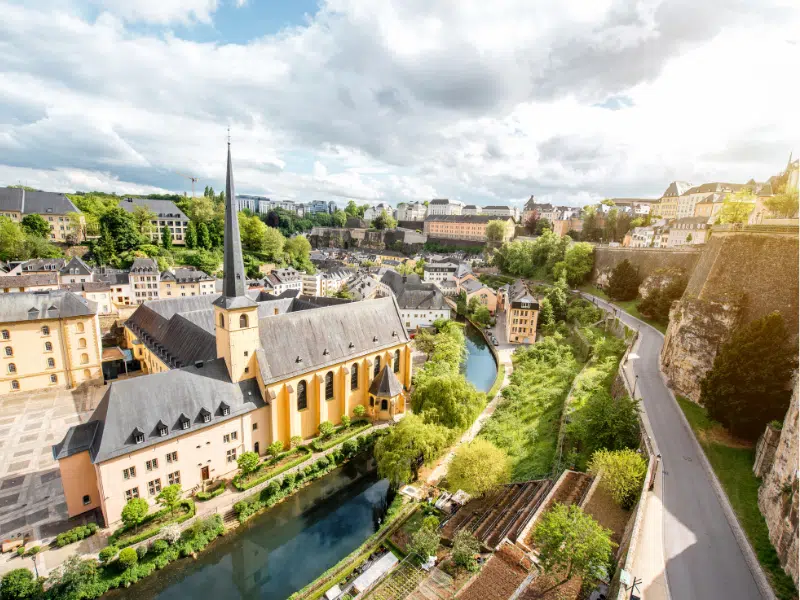
Luxembourg City stands on a rocky plateau above two deep river valleys, and for centuries that position made it one of the most fought-over fortresses in Europe. Today it is the capital of the world's only grand duchy and one of the seats of the European Union, yet its old quarters, bridges and tunnels still tell the fortress story. Here are the facts and stories that make the city special.
10 curiosità su Lussemburgo
- Una città nata su una roccia: nel 963 il conte Sigfrido acquistò il promontorio del Bock, sopra l’Alzette, dall’abbazia di San Massimino di Treviri e vi costruì un castello. Il borgo cresciuto intorno divenne Lussemburgo.
- La Gibilterra del Nord: guarnigioni spagnole, francesi, austriache e prussiane rafforzarono la fortezza così tante volte da farle guadagnare questo soprannome. Dopo il Trattato di Londra del 1867 fu in gran parte smantellata e il Lussemburgo fu dichiarato neutrale.
- Una città sotterranea: gli spagnoli iniziarono a scavare le casematte del Bock nel 1644. Durante la Seconda guerra mondiale le gallerie ospitarono fino a 35.000 persone durante i bombardamenti.
- World Heritage since 1994: the old quarters and fortifications of Luxembourg City were added to UNESCO's World Heritage List in 1994.
- The world's only grand duchy: Luxembourg is the last sovereign grand duchy, and the Grand Ducal Palace in the old town is the Grand Duke's official residence in the capital.
- Tre lingue ufficiali: lussemburghese, francese e tedesco sono tutte lingue ufficiali. Le leggi si scrivono in francese, i giornali spesso in tedesco, e il lussemburghese è la lingua che si parla in casa.
- Trasporti gratis per tutti: nel 2020 il Lussemburgo è diventato il primo paese a rendere gratuiti tutti i suoi autobus, tram e treni su tutto il territorio, esclusa la prima classe in treno.
- Un ponte da record: quando il Ponte Adolfo fu inaugurato nel 1903, il suo arco sulla valle della Pétrusse era il più grande arco in pietra del mondo. Dal 2018 sotto la carreggiata è sospesa una passerella per ciclisti e pedoni.
- Una signora d’oro: la Gëlle Fra, una figura dorata in cima a un alto obelisco in Place de la Constitution, ricorda i lussemburghesi morti nella Prima guerra mondiale. I nazisti la abbatterono nel 1940; la statua fu ritrovata decenni dopo e rimessa sulla sua colonna nel 1985.
- A fair since 1340: the Schueberfouer, the city's big funfair held every late summer, was founded in 1340 by John the Blind, Count of Luxembourg and King of Bohemia.
La leggenda di Melusina
Luxembourg's best-known legend says that Count Siegfried fell in love with Melusina, a beautiful woman he met by the Alzette. She agreed to marry him on one condition: one day every week she must be left completely alone. For years he kept his promise, until curiosity won. He looked through the keyhole and saw her in her bath with the tail of a fish. Discovered, Melusina sank into the rock of the Bock and was never seen again. Legend says she is still inside, knitting one stitch a year, and that if she finishes before someone sets her free, the whole city will disappear into the rock with her.
The Knuedler, Place d'Armes and the national poets
Place Guillaume II is known to locals as the Knuedler, from the knotted cord worn by the Franciscan friars whose monastery once stood here. The horseman in the middle is William II, King of the Netherlands and Grand Duke of Luxembourg, and the City Hall lines one side. A short walk away, Place d'Armes, once the parade ground of the garrison, is the city's open-air living room. Nearby stands the monument to Dicks and Lentz, the two 19th-century poets who helped make Luxembourgish a written language. Michel Lentz wrote the words of the national anthem, Ons Heemecht, and the monument carries the national motto from another of his songs: Mir wëlle bleiwe wat mir sinn, we want to remain what we are.
Cosa mangiare a Lussemburgo
- Judd mat Gaardebounen: collo di maiale affumicato con fave in salsa cremosa, il piatto nazionale, migliore d’estate quando le fave sono fresche.
- Gromperekichelcher: frittelle di patate croccanti con cipolla e prezzemolo, vendute ai mercati e alla Schueberfouer.
- Bouneschlupp: una zuppa sostanziosa di fagiolini con patate, pancetta e spesso salsiccia.
- Kachkéis: un formaggio cotto, morbido e cremoso, da spalmare sul pane, spesso con un po’ di senape.
- Crémant e vini della Mosella: il frizzante Crémant de Luxembourg e vini bianchi come Riesling e Pinot grigio vengono dai vigneti lungo la Mosella.
Da sapere prima di partire
- I trasporti pubblici sono gratuiti, come anche l’ascensore panoramico che scende dalla città alta al Pfaffenthal e la funicolare che sale al Kirchberg, il quartiere delle istituzioni europee.
- Percorri il Chemin de la Corniche, che lo scrittore Batty Weber chiamò il balcone più bello d’Europa, per la vista sul Grund e sulla valle dell’Alzette.
- Le casematte del Bock di solito aprono dalla primavera all’autunno. Informati prima di andare, perché possono chiudere per manutenzione.
- Il castello di Vianden a nord e i villaggi del vino lungo la Mosella sono facili gite in autobus o in treno.
Scopri Lussemburgo con World City Trail
Our Luxembourg scavenger hunt turns these sights into a game you play on your phone. The route links 10 stops and takes around two hours, with about 30 minutes of walking, and its stops include the Monument to Dicks and Lentz, Place d'Armes and Place Guillaume II.
A ogni tappa risolvi un enigma e ascolti una breve storia, al tuo ritmo. Puoi iniziare quando vuoi.
Gioca alla caccia al tesoro di Lussemburgo →
Fatti verificati a ottobre 2026.