
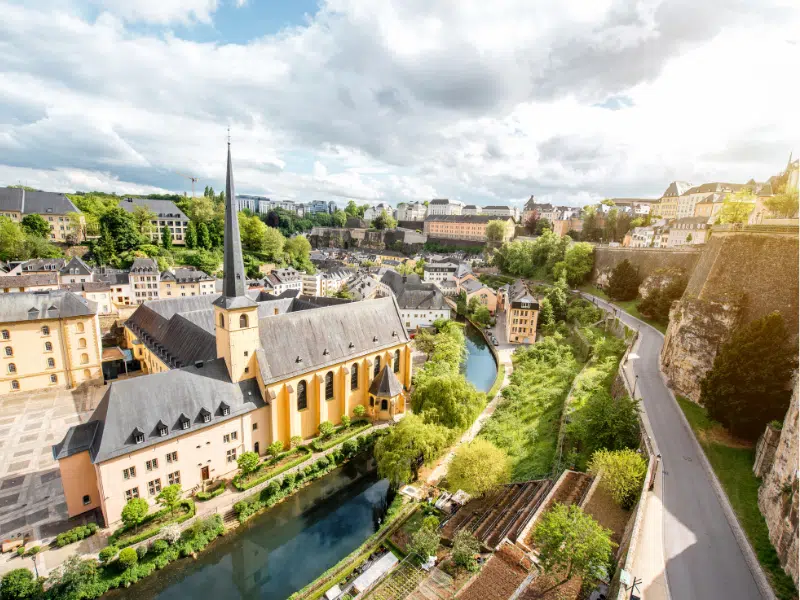
Luxembourg City stands on a rocky plateau above two deep river valleys, and for centuries that position made it one of the most fought-over fortresses in Europe. Today it is the capital of the world's only grand duchy and one of the seats of the European Union, yet its old quarters, bridges and tunnels still tell the fortress story. Here are the facts and stories that make the city special.
10 curiosidades sobre o Luxemburgo
- Uma cidade nascida numa rocha: em 963, o conde Sigefredo adquiriu o promontório do Bock, sobre o Alzette, à abadia de São Maximino de Tréveris e construiu ali um castelo. A povoação que cresceu à sua volta tornou-se o Luxemburgo.
- O Gibraltar do Norte: guarnições espanholas, francesas, austríacas e prussianas reforçaram a fortaleza tantas vezes que ela ganhou esta alcunha. Depois do Tratado de Londres de 1867, foi em grande parte desmantelada e o Luxemburgo foi declarado neutro.
- Uma cidade debaixo da terra: os espanhóis começaram a escavar as casamatas do Bock em 1644. Na Segunda Guerra Mundial, os túneis abrigaram até 35 000 pessoas durante os bombardeamentos.
- World Heritage since 1994: the old quarters and fortifications of Luxembourg City were added to UNESCO's World Heritage List in 1994.
- The world's only grand duchy: Luxembourg is the last sovereign grand duchy, and the Grand Ducal Palace in the old town is the Grand Duke's official residence in the capital.
- Três línguas oficiais: luxemburguês, francês e alemão são todas oficiais. As leis são escritas em francês, os jornais muitas vezes em alemão, e o luxemburguês é a língua que se fala em casa.
- Transportes grátis para todos: em 2020, o Luxemburgo tornou-se o primeiro país a tornar gratuitos todos os autocarros, elétricos e comboios em todo o território, exceto a primeira classe nos comboios.
- Uma ponte recorde: quando a Ponte Adolfo abriu em 1903, o seu arco sobre o vale do Pétrusse era o maior arco de pedra do mundo. Desde 2018 há uma ponte para ciclistas e peões suspensa por baixo do tabuleiro.
- Uma senhora dourada: a Gëlle Fra, uma figura dourada no topo de um alto obelisco na Place de la Constitution, homenageia os luxemburgueses mortos na Primeira Guerra Mundial. Os nazis derrubaram-na em 1940; a estátua foi encontrada décadas depois e voltou à coluna em 1985.
- A fair since 1340: the Schueberfouer, the city's big funfair held every late summer, was founded in 1340 by John the Blind, Count of Luxembourg and King of Bohemia.
A lenda de Melusina
Luxembourg's best-known legend says that Count Siegfried fell in love with Melusina, a beautiful woman he met by the Alzette. She agreed to marry him on one condition: one day every week she must be left completely alone. For years he kept his promise, until curiosity won. He looked through the keyhole and saw her in her bath with the tail of a fish. Discovered, Melusina sank into the rock of the Bock and was never seen again. Legend says she is still inside, knitting one stitch a year, and that if she finishes before someone sets her free, the whole city will disappear into the rock with her.
The Knuedler, Place d'Armes and the national poets
Place Guillaume II is known to locals as the Knuedler, from the knotted cord worn by the Franciscan friars whose monastery once stood here. The horseman in the middle is William II, King of the Netherlands and Grand Duke of Luxembourg, and the City Hall lines one side. A short walk away, Place d'Armes, once the parade ground of the garrison, is the city's open-air living room. Nearby stands the monument to Dicks and Lentz, the two 19th-century poets who helped make Luxembourgish a written language. Michel Lentz wrote the words of the national anthem, Ons Heemecht, and the monument carries the national motto from another of his songs: Mir wëlle bleiwe wat mir sinn, we want to remain what we are.
O que comer no Luxemburgo
- Judd mat Gaardebounen: cachaço de porco fumado com favas em molho cremoso, o prato nacional, melhor no verão, quando as favas estão frescas.
- Gromperekichelcher: pastéis de batata estaladiços com cebola e salsa, vendidos nos mercados e na Schueberfouer.
- Bouneschlupp: uma sopa reconfortante de feijão-verde com batata, toucinho e muitas vezes salsicha.
- Kachkéis: um queijo cozido, mole e cremoso, para barrar no pão, muitas vezes com um pouco de mostarda.
- Crémant e vinhos do Mosela: o espumante Crémant de Luxembourg e brancos como o riesling e o pinot gris vêm das vinhas ao longo do Mosela.
Antes de ires
- Os transportes públicos são gratuitos, tal como o elevador panorâmico que desce da cidade alta a Pfaffenthal e o funicular que sobe a Kirchberg, o bairro das instituições europeias.
- Percorre o Chemin de la Corniche, a que o escritor Batty Weber chamou a varanda mais bonita da Europa, pelas vistas sobre o Grund e o vale do Alzette.
- As casamatas do Bock costumam abrir da primavera ao outono. Confirma antes de ires, porque podem fechar para manutenção.
- O castelo de Vianden, a norte, e as aldeias vinícolas do Mosela são passeios de um dia fáceis de autocarro ou comboio.
Descobre o Luxemburgo com a World City Trail
Our Luxembourg scavenger hunt turns these sights into a game you play on your phone. The route links 10 stops and takes around two hours, with about 30 minutes of walking, and its stops include the Monument to Dicks and Lentz, Place d'Armes and Place Guillaume II.
Em cada paragem resolves um enigma e ouves uma pequena história, ao teu ritmo. Podes começar quando quiseres.
Jogar a caça ao tesouro do Luxemburgo →
Factos verificados em outubro de 2026.