
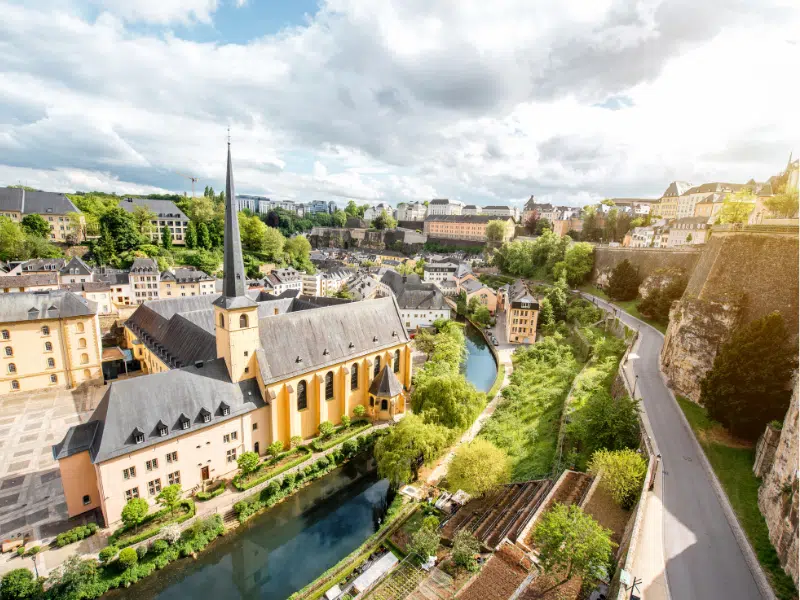
Luxembourg City stands on a rocky plateau above two deep river valleys, and for centuries that position made it one of the most fought-over fortresses in Europe. Today it is the capital of the world's only grand duchy and one of the seats of the European Union, yet its old quarters, bridges and tunnels still tell the fortress story. Here are the facts and stories that make the city special.
10 leuke weetjes over Luxemburg
- Een stad geboren op een rots: in 963 verwierf graaf Siegfried de Bockrots boven de Alzette van de abdij van Sint-Maximinus in Trier en bouwde er een burcht. Het stadje dat eromheen groeide, werd Luxemburg.
- Het Gibraltar van het Noorden: Spaanse, Franse, Oostenrijkse en Pruisische garnizoenen versterkten de vesting zo vaak dat ze deze bijnaam kreeg. Na het Verdrag van Londen van 1867 werd ze grotendeels ontmanteld en werd Luxemburg neutraal verklaard.
- Een stad onder de grond: de Spanjaarden begonnen in 1644 met het uithakken van de Bock-kazematten. In de Tweede Wereldoorlog boden de tunnels tijdens luchtaanvallen onderdak aan tot 35.000 mensen.
- World Heritage since 1994: the old quarters and fortifications of Luxembourg City were added to UNESCO's World Heritage List in 1994.
- The world's only grand duchy: Luxembourg is the last sovereign grand duchy, and the Grand Ducal Palace in the old town is the Grand Duke's official residence in the capital.
- Drie officiële talen: Luxemburgs, Frans en Duits zijn alle drie officieel. Wetten worden in het Frans geschreven, kranten vaak in het Duits, en Luxemburgs is de taal die mensen thuis spreken.
- Gratis vervoer voor iedereen: in 2020 werd Luxemburg het eerste land waar alle bussen, trams en treinen in het hele land gratis zijn, behalve de eerste klas in de trein.
- Een recordbrug: toen de Adolfbrug in 1903 openging, was haar boog over het Pétrussedal de grootste stenen boog ter wereld. Sinds 2018 hangt onder het brugdek een brug voor fietsers en voetgangers.
- Een gouden dame: de Gëlle Fra, een vergulde figuur op een hoge obelisk aan de Place de la Constitution, eert de Luxemburgers die in de Eerste Wereldoorlog stierven. De nazi’s haalden haar in 1940 neer; het beeld werd decennia later teruggevonden en in 1985 weer op de zuil gezet.
- A fair since 1340: the Schueberfouer, the city's big funfair held every late summer, was founded in 1340 by John the Blind, Count of Luxembourg and King of Bohemia.
De legende van Melusina
Luxembourg's best-known legend says that Count Siegfried fell in love with Melusina, a beautiful woman he met by the Alzette. She agreed to marry him on one condition: one day every week she must be left completely alone. For years he kept his promise, until curiosity won. He looked through the keyhole and saw her in her bath with the tail of a fish. Discovered, Melusina sank into the rock of the Bock and was never seen again. Legend says she is still inside, knitting one stitch a year, and that if she finishes before someone sets her free, the whole city will disappear into the rock with her.
The Knuedler, Place d'Armes and the national poets
Place Guillaume II is known to locals as the Knuedler, from the knotted cord worn by the Franciscan friars whose monastery once stood here. The horseman in the middle is William II, King of the Netherlands and Grand Duke of Luxembourg, and the City Hall lines one side. A short walk away, Place d'Armes, once the parade ground of the garrison, is the city's open-air living room. Nearby stands the monument to Dicks and Lentz, the two 19th-century poets who helped make Luxembourgish a written language. Michel Lentz wrote the words of the national anthem, Ons Heemecht, and the monument carries the national motto from another of his songs: Mir wëlle bleiwe wat mir sinn, we want to remain what we are.
Wat je moet eten in Luxemburg
- Judd mat Gaardebounen: gerookte varkensnek met tuinbonen in een romige saus, het nationale gerecht, op zijn best in de zomer als de bonen vers zijn.
- Gromperekichelcher: knapperige aardappelkoekjes met ui en peterselie, te koop op markten en op de Schueberfouer.
- Bouneschlupp: een stevige soep van sperziebonen met aardappel, spek en vaak worst.
- Kachkéis: een zachte, smeuïge gekookte kaas om op brood te smeren, vaak met een beetje mosterd.
- Crémant en moezelwijn: de mousserende Crémant de Luxembourg en witte wijnen als riesling en pinot gris komen van de wijngaarden langs de Moezel.
Goed om te weten voor je gaat
- Het openbaar vervoer is gratis, net als de panoramalift van de bovenstad naar Pfaffenthal en de kabelspoorweg omhoog naar Kirchberg, de wijk van de Europese instellingen.
- Wandel over de Chemin de la Corniche, die schrijver Batty Weber het mooiste balkon van Europa noemde, voor uitzicht op de Grund en het Alzettedal.
- De Bock-kazematten zijn meestal open van het voorjaar tot de herfst. Kijk vooraf even, want ze kunnen dicht zijn voor onderhoud.
- Het kasteel van Vianden in het noorden en de wijndorpen aan de Moezel zijn makkelijke dagtochten met bus of trein.
Ontdek Luxemburg met World City Trail
Our Luxembourg scavenger hunt turns these sights into a game you play on your phone. The route links 10 stops and takes around two hours, with about 30 minutes of walking, and its stops include the Monument to Dicks and Lentz, Place d'Armes and Place Guillaume II.
Bij elke stop los je een puzzel op en hoor je een kort verhaal, in je eigen tempo. Je kunt beginnen wanneer je wilt.
Speel de schattenjacht in Luxemburg →
Feiten gecontroleerd in oktober 2026.