
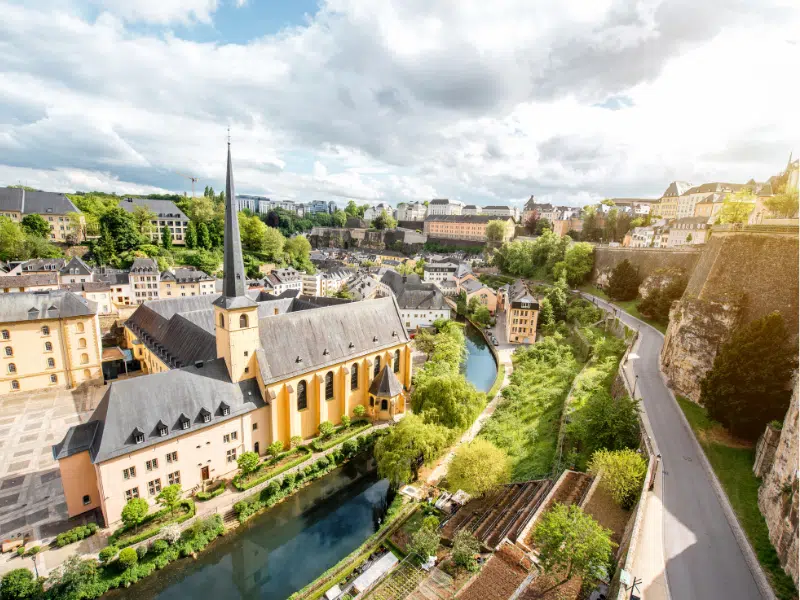
Luxembourg City stands on a rocky plateau above two deep river valleys, and for centuries that position made it one of the most fought-over fortresses in Europe. Today it is the capital of the world's only grand duchy and one of the seats of the European Union, yet its old quarters, bridges and tunnels still tell the fortress story. Here are the facts and stories that make the city special.
10 curiosidades sobre Luxemburgo
- Una ciudad nacida sobre una roca: en 963 el conde Sigfrido adquirió el promontorio del Bock, sobre el Alzette, a la abadía de San Maximino de Tréveris y construyó allí un castillo. El pueblo que creció a su alrededor se convirtió en Luxemburgo.
- El Gibraltar del Norte: las guarniciones españolas, francesas, austriacas y prusianas reforzaron tantas veces la fortaleza que se ganó este apodo. Tras el Tratado de Londres de 1867, fue desmantelada en gran parte y Luxemburgo fue declarado neutral.
- Una ciudad bajo tierra: los españoles empezaron a excavar las casamatas del Bock en 1644. Durante la Segunda Guerra Mundial, los túneles dieron refugio a hasta 35.000 personas durante los bombardeos.
- World Heritage since 1994: the old quarters and fortifications of Luxembourg City were added to UNESCO's World Heritage List in 1994.
- The world's only grand duchy: Luxembourg is the last sovereign grand duchy, and the Grand Ducal Palace in the old town is the Grand Duke's official residence in the capital.
- Tres lenguas oficiales: luxemburgués, francés y alemán son oficiales. Las leyes se redactan en francés, los periódicos suelen estar en alemán y el luxemburgués es la lengua que se habla en casa.
- Transporte gratis para todos: en 2020 Luxemburgo se convirtió en el primer país en hacer gratuitos todos sus autobuses, tranvías y trenes en todo el territorio, salvo la primera clase en tren.
- Un puente de récord: cuando se inauguró el puente Adolfo en 1903, su arco sobre el valle del Pétrusse era el mayor arco de piedra del mundo. Desde 2018 cuelga bajo su tablero una pasarela para ciclistas y peatones.
- Una dama dorada: la Gëlle Fra, una figura dorada sobre un alto obelisco en la Place de la Constitution, recuerda a los luxemburgueses muertos en la Primera Guerra Mundial. Los nazis la derribaron en 1940; la estatua se encontró décadas después y volvió a su columna en 1985.
- A fair since 1340: the Schueberfouer, the city's big funfair held every late summer, was founded in 1340 by John the Blind, Count of Luxembourg and King of Bohemia.
La leyenda de Melusina
Luxembourg's best-known legend says that Count Siegfried fell in love with Melusina, a beautiful woman he met by the Alzette. She agreed to marry him on one condition: one day every week she must be left completely alone. For years he kept his promise, until curiosity won. He looked through the keyhole and saw her in her bath with the tail of a fish. Discovered, Melusina sank into the rock of the Bock and was never seen again. Legend says she is still inside, knitting one stitch a year, and that if she finishes before someone sets her free, the whole city will disappear into the rock with her.
The Knuedler, Place d'Armes and the national poets
Place Guillaume II is known to locals as the Knuedler, from the knotted cord worn by the Franciscan friars whose monastery once stood here. The horseman in the middle is William II, King of the Netherlands and Grand Duke of Luxembourg, and the City Hall lines one side. A short walk away, Place d'Armes, once the parade ground of the garrison, is the city's open-air living room. Nearby stands the monument to Dicks and Lentz, the two 19th-century poets who helped make Luxembourgish a written language. Michel Lentz wrote the words of the national anthem, Ons Heemecht, and the monument carries the national motto from another of his songs: Mir wëlle bleiwe wat mir sinn, we want to remain what we are.
Qué comer en Luxemburgo
- Judd mat Gaardebounen: cuello de cerdo ahumado con habas en salsa cremosa, el plato nacional, mejor en verano, cuando las habas están frescas.
- Gromperekichelcher: buñuelos crujientes de patata con cebolla y perejil, que se venden en mercados y en la Schueberfouer.
- Bouneschlupp: una sopa contundente de judías verdes con patatas, tocino y a menudo salchicha.
- Kachkéis: un queso cocido, blando y fluido, para untar en pan, a menudo con un poco de mostaza.
- Crémant y vinos del Mosela: el espumoso Crémant de Luxembourg y blancos como el riesling y el pinot gris salen de los viñedos del Mosela.
Antes de ir
- El transporte público es gratuito, igual que el ascensor panorámico que baja de la ciudad alta a Pfaffenthal y el funicular que sube a Kirchberg, el barrio de las instituciones europeas.
- Recorre el Chemin de la Corniche, que el escritor Batty Weber llamó el balcón más bonito de Europa, por sus vistas sobre el Grund y el valle del Alzette.
- Las casamatas del Bock suelen abrir de primavera a otoño. Infórmate antes de ir, porque pueden cerrar por mantenimiento.
- El castillo de Vianden, al norte, y los pueblos vinícolas del Mosela son excursiones fáciles en autobús o tren.
Descubre Luxemburgo con World City Trail
Our Luxembourg scavenger hunt turns these sights into a game you play on your phone. The route links 10 stops and takes around two hours, with about 30 minutes of walking, and its stops include the Monument to Dicks and Lentz, Place d'Armes and Place Guillaume II.
En cada parada resuelves un acertijo y escuchas una historia breve, a tu ritmo. Puedes empezar cuando quieras.
Juega a la búsqueda del tesoro de Luxemburgo →
Datos comprobados en octubre de 2026.