
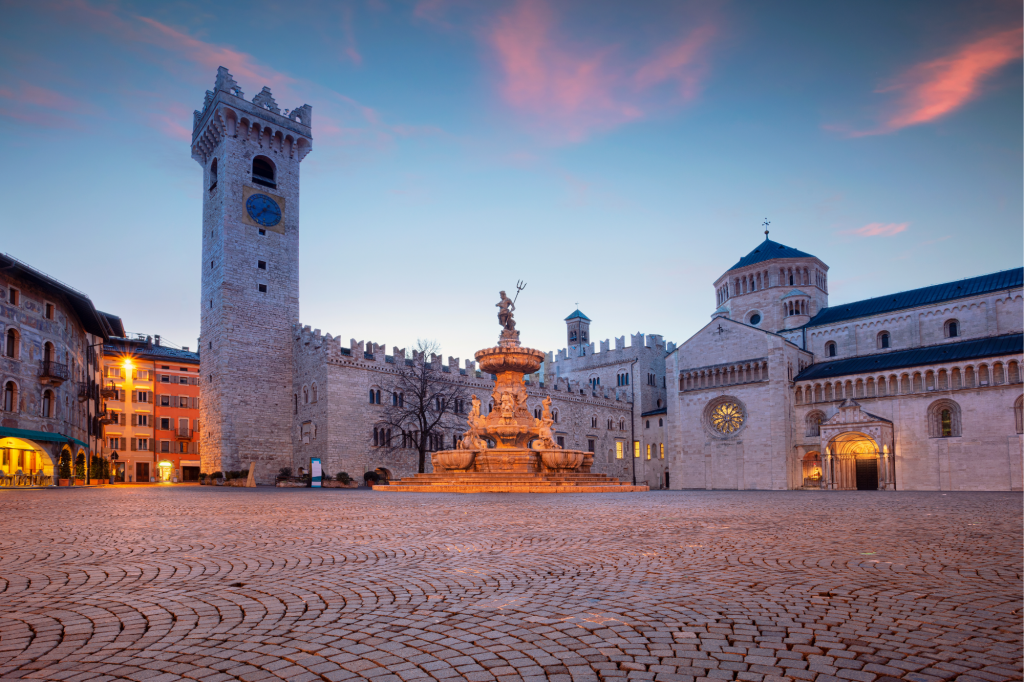
Trento lies in the Adige valley with mountains on every side, an Italian city that belonged to Austria until the First World War and still shows it. For almost eight centuries it was ruled by prince-bishops, and in the 16th century it hosted one of the most important meetings in the history of the Catholic Church. Here are the facts and stories that make it special.
10 fun facts about Trento
- A Roman trident: the Romans called the town Tridentum, a name often linked to the three hills around it, and the Neptune on the fountain in Piazza Duomo still holds a trident.
- Ruled by bishops for almost 800 years: in 1027 the emperor Conrad II gave the bishops of Trento power over the territory, and the prince-bishopric lasted until 1803.
- The Council of Trent: between 1545 and 1563, bishops and theologians met here in 25 sessions to respond to the Protestant Reformation. Their decisions shaped the Catholic Church for centuries.
- A castle with a calendar: in the Torre Aquila of the Castello del Buonconsiglio, frescoes from around 1400 show the months of the year, including one of the earliest painted snowball fights in European art.
- A Roman town underground: beneath Piazza Cesare Battisti, the S.A.S.S. archaeological site lets you walk on a stretch of Roman street, past remains of houses and the walls of Tridentum.
- Austrian until 1918: Trento was part of the Habsburg Empire for most of the 19th century and only became Italian after the First World War.
- A patriot's last stand: Cesare Battisti, a Trento-born socialist who had sat in the Austrian parliament, fought for Italy in the First World War, was captured and was executed at the Castello del Buonconsiglio in 1916.
- Dante in an Austrian city: the Dante monument in the square in front of the station was unveiled in 1896, while Trento was still Austrian, as a statement of the city's Italian identity.
- A museum shaped like mountains: MUSE, the science museum designed by Renzo Piano and opened in 2013, has a jagged roofline that echoes the peaks around the city.
- Sparkling wine with a famous name: in 1902 Giulio Ferrari began making sparkling wine in Trento by the classic method. Today the area's traditional-method sparkling wines are sold as Trentodoc.
The Council of Trent
Why Trento? The city lay on the main road between Italy and the German lands, inside the Holy Roman Empire but south of the Alps, so both the pope and the emperor Charles V could accept it. The council opened in the Cathedral of San Vigilio in December 1545, moved to Bologna for a time, was suspended twice and only closed in December 1563. Its decrees defined Catholic teaching on the sacraments, the Bible and salvation, called for seminaries to train priests and set the tone of Catholic art and worship for the next centuries. Many of the later meetings were held in the church of Santa Maria Maggiore, a few minutes' walk from the cathedral.
Piazza Duomo and the painted houses
Piazza Duomo is Trento's main square, framed by the Romanesque Cathedral of San Vigilio, the battlemented Palazzo Pretorio with its civic tower and the 18th-century Neptune Fountain. On the corner with Via Belenzani, the Case Cazuffi-Rella are covered with 16th-century frescoes, and Via Belenzani itself is lined with Renaissance palaces, some of which also keep painted façades. In December the city's Christmas market fills nearby Piazza Fiera and Piazza Cesare Battisti.
What to eat in Trento
- Canederli: large bread dumplings with speck or cheese, served in broth or with melted butter.
- Strangolapreti: spinach and bread gnocchi with butter and sage. The name means priest-stranglers, and there are several stories about why.
- Polenta: a mountain staple, served with mushrooms, cheese or slow-cooked meat.
- Apple strudel: Trentino is one of Italy's main apple-growing regions, and strudel shows the Austrian side of the local kitchen.
- Trentodoc and Teroldego: try the local sparkling wine as an aperitivo, or Teroldego Rotaliano, a deep red grown just north of the city.
Good to know before you go
- A small cable car rises from near the river to the village of Sardagna, with a wide view over the city and the valley.
- The Torre Aquila frescoes can usually only be seen on a guided visit, so ask when you buy your castle ticket.
- Lake Garda and the Dolomites are both within easy reach for a day trip.
- MUSE makes a good plan for a rainy day, especially with children.
Explore Trento with World City Trail
Our Trento scavenger hunt turns these sights into a game you play on your phone. The route leads through the main sights of the old town and takes around two hours, with about 46 minutes of walking.
At each stop you solve a puzzle and hear a short story, at your own pace. You can start whenever you like.
Play the Trento scavenger hunt →
Facts checked in October 2026.