
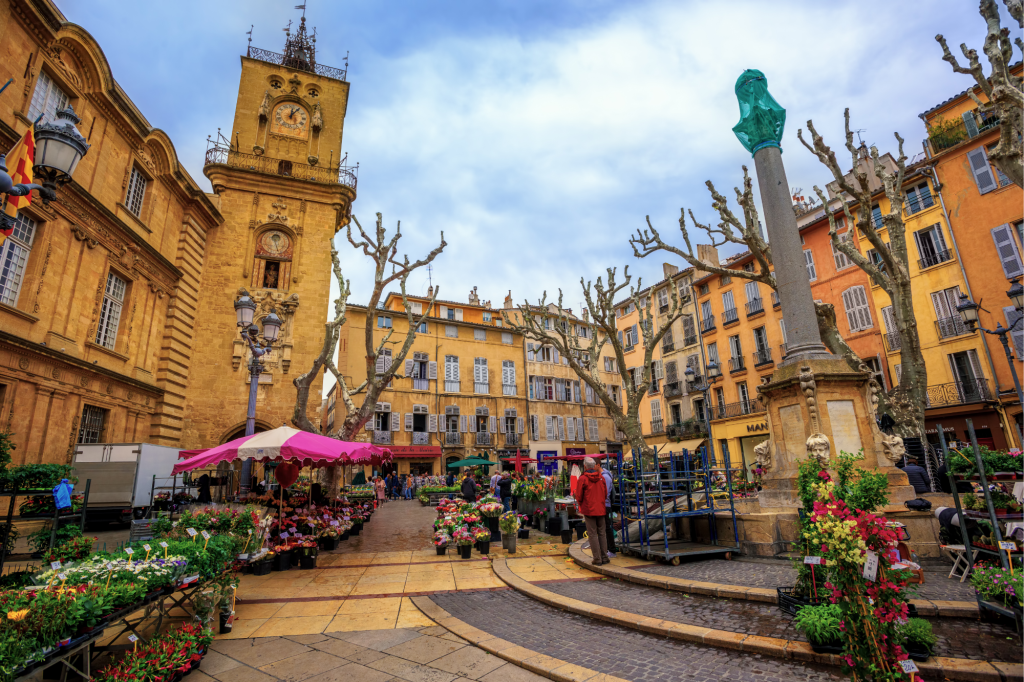
Aix-en-Provence began as a Roman spa town, grew into the capital of Provence and became the home of Paul Cézanne. Its old town is a grid of honey-coloured mansions, shaded squares and fountains, with Mont Sainte-Victoire rising to the east. Here are the facts and stories that make the city special.
10 fun facts about Aix-en-Provence
- Named after a Roman and his springs: Aix was founded in 122 BC by the Roman consul Gaius Sextius Calvinus as Aquae Sextiae, the Waters of Sextius, after the warm springs that still flow under the town.
- A battle and a mountain: in 102 BC the Roman general Marius defeated the Teutones near Aix. Tradition links the name of Mont Sainte-Victoire, the Mountain of Holy Victory, to that battle.
- A boulevard built on old walls: the Cours Mirabeau was laid out in 1650, on the line of the old town ramparts, as a broad avenue for carriages. Today it is lined with plane trees, cafés and 17th- and 18th-century mansions.
- Three statues, three directions: the great fountain at the end of the Cours, La Rotonde, was designed in 1860 and stands 12 metres high. Its three statues face three ways: Justice towards the Cours Mirabeau, Agriculture towards Marseille and Fine Arts towards Avignon.
- A king with a bunch of grapes: on the Fontaine du Roi René, a statue of 'Good King René' by David d'Angers holds muscat grapes, which René is credited with bringing to Provence.
- A new town for the rich: in 1646 Michel Mazarin, Archbishop of Aix and brother of Cardinal Mazarin, began a planned district south of the Cours. The Quartier Mazarin's straight streets filled with mansions for the city's wealthy families.
- Cézanne's mountain: Paul Cézanne was born in Aix in 1839 and painted Mont Sainte-Victoire around eighty times, in oils and watercolours. In 1902 he built a studio on the hill of Les Lauves, north of the centre.
- A sweet with its own blessing: calissons, diamond-shaped almond sweets, are linked to a vow made during the plague of 1630, when the town promised to hand them out if it was spared. Calissons are still blessed in a church ceremony every September.
- An old university town: the University of Aix was founded in 1409 by Louis II of Anjou, Count of Provence, and students still give the town much of its life.
- A summer of opera: the Festival d'Aix-en-Provence, founded in 1948, is one of Europe's leading opera festivals and fills the town's courtyards and theatres every July.
Cézanne and Zola: two boys from Aix
In the 1850s, at the Collège Bourbon in Aix, a bullied new boy named Émile Zola found a protector in an older classmate, Paul Cézanne. The two became inseparable, swimming in the River Arc and walking for hours in the hills around Mont Sainte-Victoire, dreaming of art and literature. Zola left for Paris first and urged his friend to follow. For years they supported each other, but their friendship cooled after Zola published his novel L'Œuvre in 1886, whose tormented, failed painter many readers saw as a portrait of Cézanne. Zola became famous in Paris, while Cézanne spent most of his later life in Aix, painting the same landscapes again and again.
The Cours Mirabeau, explained
The Cours Mirabeau divides old Aix in two. To the north lies the medieval town, with its winding lanes, markets and the Cathédrale Saint-Sauveur; to the south lies the orderly Quartier Mazarin. Along the Cours, look for the moss-covered Fontaine Moussue, fed by warm spring water, and the café terraces that have been the town's meeting place for generations.
What to eat in Aix-en-Provence
- Calissons: almond paste blended with candied melon, set on a wafer and topped with white icing. Buy them from one of the town's calissonniers.
- Rosé: the vineyards around Aix produce the Coteaux d'Aix-en-Provence wines, mostly dry, pale rosé that is made for a café terrace.
- Tapenade: a paste of black olives, capers and anchovies, spread on bread with an aperitif.
- Daube provençale: beef slowly braised in red wine with herbs and orange peel, a dish for cooler days.
- Pastis: the anise aperitif of Provence, diluted with cold water until it turns cloudy.
Good to know before you go
- Aix is a market town: the produce market on Place Richelme sets up most mornings, and the bigger markets fill the old town on Tuesdays, Thursdays and Saturdays.
- For the classic view of Mont Sainte-Victoire, walk up to the Terrain des Peintres near Cézanne's studio at Les Lauves.
- Book accommodation early for July, when the opera festival brings large crowds.
- The Aix TGV station lies well outside the town and is linked to the centre by shuttle bus. Marseille is a short bus ride away for a day trip.
Explore Aix-en-Provence with World City Trail
Our Aix-en-Provence scavenger hunt turns these sights into a game you play on your phone. The route takes around two hours, with about 43 minutes of walking, and leads you through the main sights of the old town.
At each stop you solve a puzzle and hear a short story, at your own pace. You can start whenever you like.
Play the Aix-en-Provence scavenger hunt →
Facts checked in October 2026.