
Hamburg is a port city that lives with the tides of the Elbe, a city-state with its own parliament, and the place where the Beatles learned their trade. Merchants, not kings, built it, and you can still see that in its warehouses, counting houses and grand town hall. Here are the facts and stories that make the city special.
10 fun facts about Hamburg
- A city that is also a state: Hamburg's official name is the Free and Hanseatic City of Hamburg. It is one of Germany's 16 federal states and, with about 1.9 million people, the country's second-largest city.
- More bridges than any other city in Europe: Hamburg counts about 2,500 bridges, far more than Venice or Amsterdam.
- The world's largest warehouse district: the Speicherstadt was built between 1883 and 1927 on oak piles driven into the mud. Since 2015 it has been a UNESCO World Heritage Site, together with the Kontorhaus district and its ship-shaped Chilehaus.
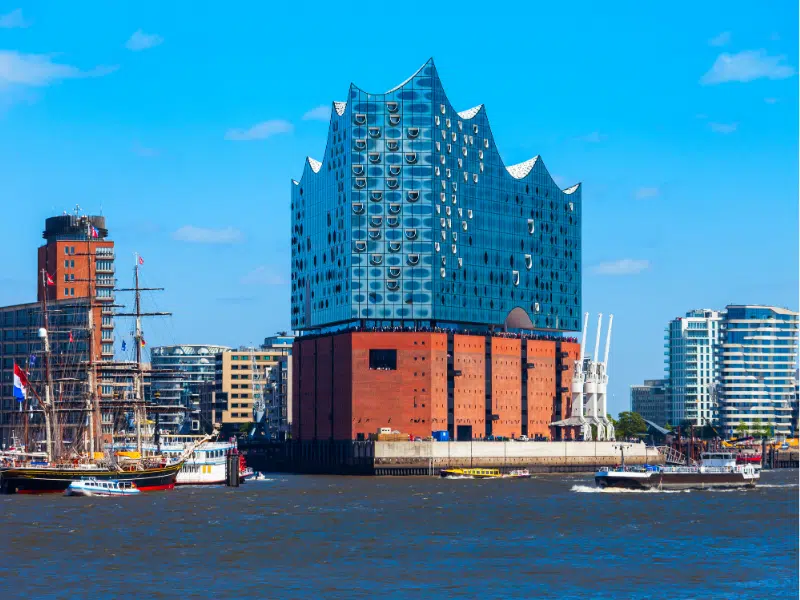
- A concert hall on top of a warehouse: the Elbphilharmonie, designed by Herzog & de Meuron, rises from the brick base of a former cocoa, tea and tobacco warehouse, Kaispeicher A. It opened in January 2017 and is about 110 metres tall.
- A town hall with 647 rooms: the neo-Renaissance Rathaus was inaugurated in 1897, and its tower is 112 metres high. Despite a popular claim, that is still fewer rooms than Buckingham Palace.
- A birthday based on a forgery: every May the city celebrates the Hafengeburtstag, the port's birthday, dated to a charter of Emperor Frederick Barbarossa from 7 May 1189. The charter is in fact a forgery made in the 13th century.
- The Beatles' training ground: from 1960 to 1962 the young Beatles played long nights in clubs on and around the Reeperbahn in St. Pauli. Beatles-Platz, at the corner of the Reeperbahn and Große Freiheit, remembers them.
- A tunnel with lifts for cars: the St. Pauli Elbe Tunnel opened in 1911 and runs 426 metres under the river, 24 metres below the surface. Huge lifts carried horses, carts and later cars down to the tubes; today it is used by people on foot and on bikes.
- The Michel's clock: the tower of St Michael's Church is 132 metres high and carries the largest church tower clock in Germany. Every day a tower trumpeter plays a chorale from the top, once in each direction.
- A fire that reshaped the city: the Great Fire of May 1842 burned for three days, destroyed about a third of the old town and left some 20,000 people homeless. The ruined tower of St. Nikolai, damaged again in the Second World War, is now a memorial.
Störtebeker, the pirate who walked
Klaus Störtebeker was the best known of the Victual Brothers, pirates who raided merchant ships in the North Sea and the Baltic around 1400. Hamburg's fleet captured him, and he was beheaded with his crew on the Grasbrook by the harbour, traditionally on 20 October 1401, although recent research points to 1400. Legend says he made a last deal with the mayor: every man he could walk past after his head was cut off would be spared. His headless body walked past eleven of his men before the executioner tripped it, and the city executed them anyway.
The Speicherstadt, explained
When Hamburg joined the German customs union in the 1880s, it kept a free port where goods could be stored without duty. To build it, the city cleared the old Kehrwieder and Wandrahm quarters and moved more than 20,000 people. The red-brick warehouses, with their gables, turrets and winches, stored coffee, tea, spices and carpets.
What to eat in Hamburg
- Fischbrötchen: a bread roll with pickled herring, fried fish or North Sea shrimp. Eat one on the piers at the Landungsbrücken.
- Franzbrötchen: a flattened, buttery cinnamon pastry that you will find in every Hamburg bakery.
- Labskaus: a sailors' dish of corned beef, potato and beetroot mashed together, served with a fried egg, gherkin and rollmops.
- Rote Grütze: a red berry pudding served with vanilla sauce or cream.
Good to know before you go
- The Fischmarkt in Altona has been held on Sunday mornings since 1703. It starts very early and is over by mid-morning.
- Regular public transport tickets are valid on the harbour ferries, so a ride from the Landungsbrücken is an easy way to see the port from the water.
- To go up to the Plaza, the public viewing level of the Elbphilharmonie, you need a timed ticket. At busy times, book ahead.
- Walk through the Old Elbe Tunnel to the south bank for one of the best views of the Landungsbrücken and the Michel.
Explore Hamburg with World City Trail
Our Hamburg scavenger hunt turns these sights into a game you play on your phone. The route links 10 stops and takes around three hours, with about 64 minutes of walking. Stops include the Town Hall, the Elbphilharmonie and St Michael's Church.
At each stop you solve a puzzle and hear a short story, at your own pace. You can start whenever you like and play in English, German, French, Italian, Spanish, Dutch or Polish.
Play the Hamburg scavenger hunt →
Facts checked in October 2026.