
Amburgo è una città portuale che vive al ritmo delle maree dell’Elba, una città-stato con un proprio parlamento e il luogo dove i Beatles impararono il mestiere. L’hanno costruita i mercanti, non i re, e lo si vede ancora nei magazzini, nei palazzi per uffici e nel grandioso municipio. Ecco i fatti e le storie che rendono speciale la città.
10 curiosità su Amburgo
- A city that is also a state: Hamburg's official name is the Free and Hanseatic City of Hamburg. It is one of Germany's 16 federal states and, with about 1.9 million people, the country's second-largest city.
- Più ponti di qualsiasi altra città d’Europa: Amburgo conta circa 2.500 ponti, molti più di Venezia o Amsterdam.
- The world's largest warehouse district: the Speicherstadt was built between 1883 and 1927 on oak piles driven into the mud. Since 2015 it has been a UNESCO World Heritage Site, together with the Kontorhaus district and its ship-shaped Chilehaus.
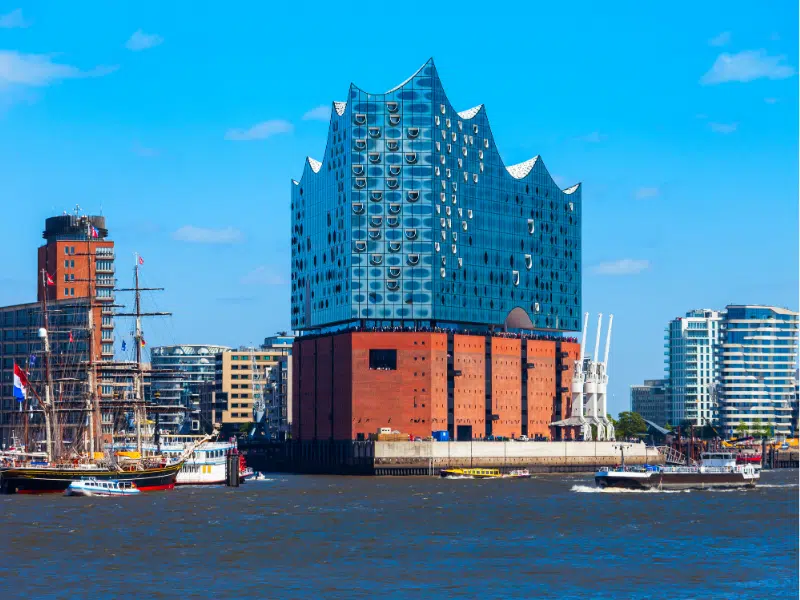
- A concert hall on top of a warehouse: the Elbphilharmonie, designed by Herzog & de Meuron, rises from the brick base of a former cocoa, tea and tobacco warehouse, Kaispeicher A. It opened in January 2017 and is about 110 metres tall.
- Un municipio con 647 stanze: il Rathaus neorinascimentale fu inaugurato nel 1897 e la sua torre è alta 112 metri. Contrariamente a una leggenda diffusa, sono comunque meno stanze di Buckingham Palace.
- A birthday based on a forgery: every May the city celebrates the Hafengeburtstag, the port's birthday, dated to a charter of Emperor Frederick Barbarossa from 7 May 1189. The charter is in fact a forgery made in the 13th century.
- The Beatles' training ground: from 1960 to 1962 the young Beatles played long nights in clubs on and around the Reeperbahn in St. Pauli. Beatles-Platz, at the corner of the Reeperbahn and Große Freiheit, remembers them.
- Un tunnel con ascensori per le auto: il tunnel dell’Elba di St. Pauli fu aperto nel 1911 e corre per 426 metri sotto il fiume, a 24 metri di profondità. Enormi ascensori portavano giù cavalli, carri e poi automobili; oggi lo usano pedoni e ciclisti.
- The Michel's clock: the tower of St Michael's Church is 132 metres high and carries the largest church tower clock in Germany. Every day a tower trumpeter plays a chorale from the top, once in each direction.
- Un incendio che cambiò la città: il Grande Incendio del maggio 1842 durò tre giorni, distrusse circa un terzo della città vecchia e lasciò senza casa circa 20.000 persone. La torre in rovina di San Nicola, colpita di nuovo nella Seconda guerra mondiale, oggi è un memoriale.
Störtebeker, il pirata che camminava
Klaus Störtebeker was the best known of the Victual Brothers, pirates who raided merchant ships in the North Sea and the Baltic around 1400. Hamburg's fleet captured him, and he was beheaded with his crew on the Grasbrook by the harbour, traditionally on 20 October 1401, although recent research points to 1400. Legend says he made a last deal with the mayor: every man he could walk past after his head was cut off would be spared. His headless body walked past eleven of his men before the executioner tripped it, and the city executed them anyway.
La Speicherstadt in breve
Quando negli anni Ottanta dell’Ottocento Amburgo entrò nell’unione doganale tedesca, mantenne un porto franco dove le merci potevano essere depositate senza dazi. Per costruirlo la città demolì i vecchi quartieri di Kehrwieder e Wandrahm e trasferì più di 20.000 persone. I magazzini in mattoni rossi, con frontoni, torrette e argani, custodivano caffè, tè, spezie e tappeti.
Cosa mangiare ad Amburgo
- Fischbrötchen: un panino con aringa marinata, pesce fritto o gamberetti del Mare del Nord. Da mangiare sui pontili dei Landungsbrücken.
- Franzbrötchen: una pasta schiacciata, burrosa e alla cannella, che trovi in ogni panetteria di Amburgo.
- Labskaus: a sailors' dish of corned beef, potato and beetroot mashed together, served with a fried egg, gherkin and rollmops.
- Rote Grütze: un budino di frutti rossi servito con salsa alla vaniglia o panna.
Da sapere prima di partire
- Il Fischmarkt di Altona si tiene la domenica mattina dal 1703. Inizia molto presto e finisce a metà mattina.
- I normali biglietti dei mezzi pubblici valgono anche sui traghetti del porto: una corsa dai Landungsbrücken è un modo semplice per vedere il porto dall’acqua.
- Per salire sulla Plaza, la terrazza panoramica pubblica dell’Elbphilharmonie, serve un biglietto a fascia oraria. Nei periodi più affollati prenota in anticipo.
- Attraversa a piedi il vecchio tunnel dell’Elba fino alla riva sud per una delle viste migliori sui Landungsbrücken e sul Michel.
Scopri Amburgo con World City Trail
Our Hamburg scavenger hunt turns these sights into a game you play on your phone. The route links 10 stops and takes around three hours, with about 64 minutes of walking. Stops include the Town Hall, the Elbphilharmonie and St Michael's Church.
A ogni tappa risolvi un enigma e ascolti una breve storia, al tuo ritmo. Puoi iniziare quando vuoi e giocare in italiano, inglese, tedesco, francese, spagnolo, olandese o polacco.
Gioca alla caccia al tesoro di Amburgo →
Fatti verificati a ottobre 2026.