
Dortmund is a city of beer, coal, steel and football, and it wears that history openly. Behind the post-war shopping streets lies a medieval Hanseatic town with Romanesque churches, and around it old breweries and pits have become museums, lakes and art spaces. Here are the facts and stories that make the city special.
10 fun facts about Dortmund
- More than 1,100 years on record: Dortmund is first mentioned around 882, as Throtmanni, in the records of Werden Abbey.
- A free city of the Hanseatic League: in the Middle Ages Dortmund was a leading Hanseatic trading town and a free imperial city, answerable only to the emperor, until 1803.
- One of Europe's first brewing rights: Dortmund received an official right to brew in 1293. Centuries later it gave its name to a beer style, Dortmunder Export, a strong pale lager made for the thirsty miners and steelworkers.
- Germany's largest stadium: Signal Iduna Park, opened in 1974 as the Westfalenstadion, holds 81,365 fans for league matches. Its south stand, the Yellow Wall, has room for about 25,000 standing fans and is the largest terrace of its kind in Europe.
- A club born at Borsigplatz: Borussia Dortmund was founded in December 1909 near Borsigplatz, north of the city centre. In 1997 it won the Champions League.
- A Christmas tree made of trees: at the Christmas market, a giant tree more than 45 metres tall is built every year from 1,700 spruces from the Sauerland. The market itself goes back to 1878.
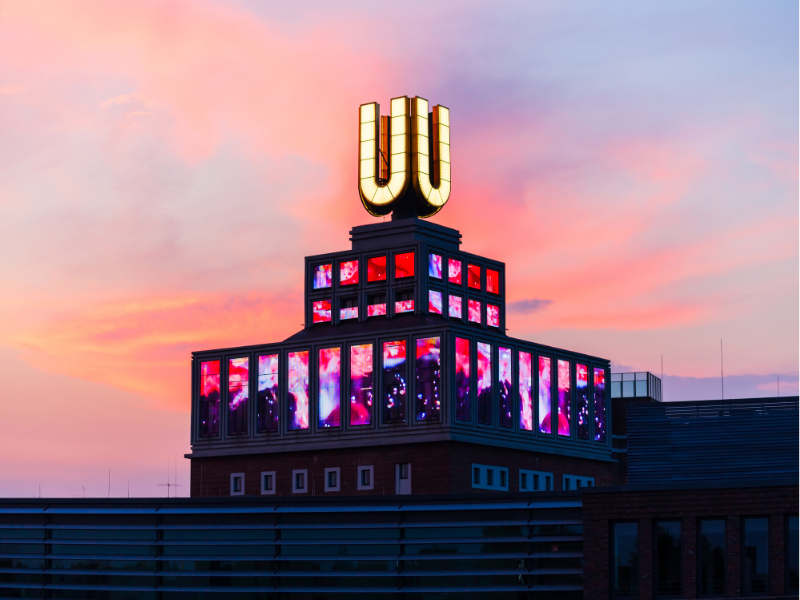
- A golden U on the skyline: the tower of the former Union brewery has carried a huge illuminated U on its roof since 1968. Since 2010 the building, the Dortmunder U, has been a centre for art and creativity.
- The end of coal: the last colliery in Dortmund, Minister Stein, closed in 1987, ending more than 150 years of coal mining in the city.
- A lake where a steelworks stood: the Phoenix See was dug on the site of the former Phoenix-Ost steelworks and filled with water in 2010 and 2011. Its shores are now lined with homes, cafés and paths.
- Europe's largest canal port: Dortmund lies at the end of the Dortmund-Ems Canal, opened in 1899, and its port is the largest canal port in Europe.
St Reinold, the city's patron
Dortmund's main church is dedicated to Reinold, a knight of medieval legend. The story goes that he gave up fighting, became a stonemason in Cologne and was murdered by jealous fellow workers. When his body was placed on a cart, the cart is said to have rolled all the way to Dortmund by itself, and the city took him as its patron. St Reinold's Church was built between 1250 and 1270. Its tower, finished in 1454 at about 112 metres, was so tall it was called the Wonder of Westphalia. Weakened by earthquakes, it collapsed in 1661 and was rebuilt by 1701. Badly damaged in the Second World War, the church was restored, and its tower stands at 104 metres today.
The Vehmic courts, explained
In the late Middle Ages Dortmund was an important seat of the Vehmic courts, the Femegerichte of Westphalia. These tribunals of sworn free judges met in the open air and could try serious crimes from far beyond the city at a time when ordinary courts often failed. In Dortmund they sat on a square between two lime trees, one of them known as the Femlinde. Their members swore to keep the court's business secret, which gave the Vehme a fearsome reputation that later writers and legends happily exaggerated.
What to eat in Dortmund
- Pfefferpotthast: Dortmund's own dish, a beef stew with plenty of onions and black pepper, served with boiled potatoes and pickles.
- Dortmunder Export: the local pale lager, best ordered by name in a traditional pub.
- Currywurst and fries: the Ruhr's favourite snack, found at stands all over the city centre.
- Pumpernickel: the dark, dense Westphalian rye bread, baked slowly for many hours.
- Westphalian ham: dry-cured and smoked, often served thinly sliced on rye bread.
Good to know before you go
- The German Football Museum, opened in 2015, is right opposite the main station.
- On Borussia home matchdays, trains and trams around the stadium are packed. Check the fixture list if you would rather avoid the crowds.
- The Christmas market runs from late November until shortly before New Year, with the giant tree on Hansaplatz.
- For industrial heritage, the former Zollern colliery in the west of the city is now a museum, with a striking Art Nouveau machine hall.
Explore Dortmund with World City Trail
Our Dortmund scavenger hunt turns these sights into a game you play on your phone. The route links 10 stops and takes around two hours, with about 42 minutes of walking, past landmarks including St Reinold's Church and the square of the Old Town Hall.
At each stop you solve a puzzle and hear a short story, at your own pace. You can start whenever you like.
Play the Dortmund scavenger hunt →
Facts checked in October 2026.