
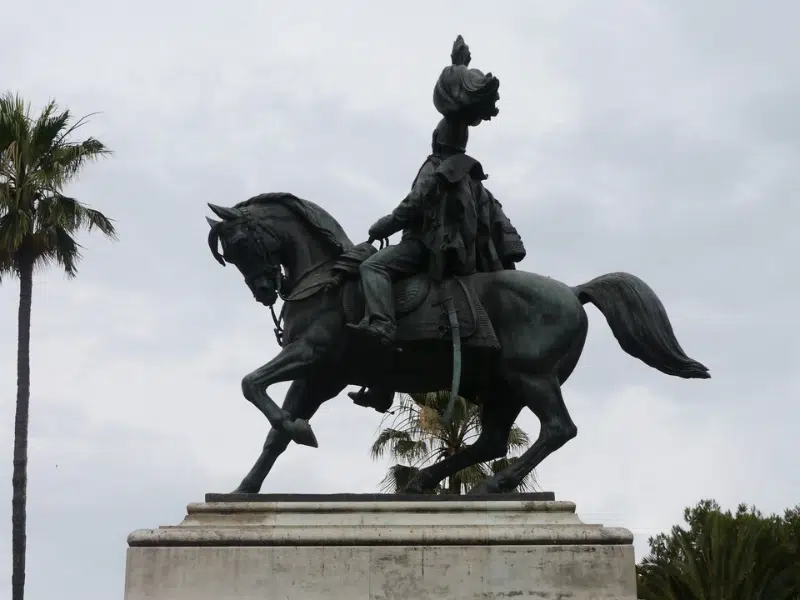
The gardens of Piazza Umberto I fill Bari's largest square, in the 19th-century Murattiano district between the central station and the shopping streets. Palms and holm oaks shade paths around a bronze King Umberto I on horseback, and at one end stands the fountain where the water of the Apulian Aqueduct first reached the city in 1915.
Piazza Umberto gardens at a glance
- Where: in the Murattiano district of central Bari, in front of the Palazzo Ateneo, the historic seat of the University of Bari, a few minutes' walk from Bari Centrale station.
- Created: the first garden was laid out in 1866 as a setting for the Palazzo Ateneo; the second was added later around the statue of Umberto I.
- By: the first garden was designed by the Neapolitan architect Giovanni Castelli; the equestrian statue is by Francesco Cifariello from Molfetta.
- What it is today: an open public park owned by the city, pedestrian since the 1980s, and one of the places where Bari meets, sits and chats.
- Time needed: 15 to 30 minutes for a stroll, longer if you sit on a bench in the shade.
From university garden to city square
In the 19th century Bari grew far beyond its old town on the peninsula. The new Murattiano district was laid out on a regular grid, and its largest open space became Piazza Umberto I. The Palazzo Ateneo was built on the square to house schools and university institutions, and in 1866 Giovanni Castelli designed a garden in front of it. In 1905 the city put up a bronze equestrian statue of King Umberto I, who had been assassinated in 1900, and a second garden was created around it. The two were later joined into the single park you walk through today.
The most celebrated day in the square's history came on 24 April 1915, when water from the newly built Apulian Aqueduct reached Bari and gushed from the monumental fountain here. For a region that had always struggled with drought, it was a turning point. In the 1980s the square was closed to traffic and became one of Bari's first large pedestrian areas.
What to look for
- The bronze equestrian statue of Umberto I by Francesco Cifariello, the focus of the second garden.
- The monumental fountain, a memorial to the arrival of the aqueduct's water in 1915.
- The variety of palms: Mexican and Californian fan palms, Canary Island date palms, date palms, dwarf fan palms and Chinese windmill palms.
- The other trees that give the gardens their shade: holm oaks, Aleppo and stone pines, a cedar of Lebanon and tall columnar cypresses.
- The long façade of the Palazzo Ateneo along the square, still used by the University of Bari.
The milk drop house
A small building in the square has a touching history. From 1922 it housed the Goccia di latte, the milk drop, an institution that supported Bari's poorest families by providing wet nurses for their babies. It ran for about fifty years and closed in 1977. Later the building was used by a blood donors' association.
Tips for your visit
- Come in the late afternoon or early evening, when the heat eases and Bari's families and students fill the benches.
- In summer, choose the paths under the holm oaks and pines for real shade.
- Use the square as a starting point: walk north along Via Sparano to reach the shops, the theatres and the old town.
- Keep an eye on your belongings at quieter times, as in any busy city park near a station.
Nearby
- Via Sparano: Bari's main shopping street, a pedestrian street that runs north from the square.
- Teatro Petruzzelli: the grand opera house on Corso Cavour, rebuilt after a fire in 1991.
- Bari Vecchia: the maze of lanes in the old town, with the Basilica of San Nicola and the Cathedral of San Sabino.
- The seafront: the long Lungomare promenade along the Adriatic, a short walk from the city centre.
See Bari with World City Trail
Our Bari scavenger hunt turns the old town into a game you play on your phone. The route links 10 stops and takes around 2 hours, with about 35 minutes of walking. It leads you through the lanes of Bari Vecchia to the Basilica di San Nicola.
If you prefer a different format, there is also a self-guided walking tour and an outdoor escape game in Bari.
Play the Bari scavenger hunt →
Take the self-guided walking tour of Bari →
Play the outdoor escape game in Bari →
Facts checked in October 2026.