
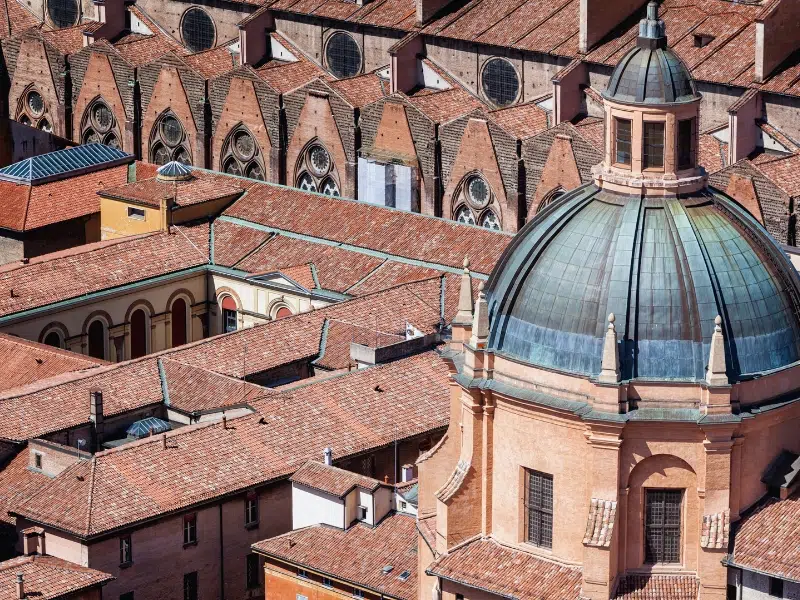
Santa Maria della Vita is a Baroque sanctuary on Via Clavature, in the old market streets just off Piazza Maggiore in Bologna. Behind its plain entrance stands one of the most startling sculptures of the Italian Renaissance: Niccolò dell'Arca's Lamentation over the Dead Christ, a group of life-size terracotta mourners who cry out over Christ's body.
Santa Maria della Vita at a glance
- Where: Via Clavature, in the Quadrilatero, the medieval market district just east of Piazza Maggiore.
- Built: the present church 1687–1690, with the dome completed in 1787 and the façade added in 1905; the Lamentation is dated between about 1463 and 1490.
- By: the architect Giovanni Battista Bergonzoni (church) and Giuseppe Tubertini (dome); sculptures by Niccolò dell'Arca and Alfonso Lombardi.
- What it is today: a church and museum complex run as part of the Genus Bononiae museum network, with a former confraternity oratory upstairs.
- Time needed: 30–45 minutes for the church and the oratory.
From a flagellants' hospital to a Baroque sanctuary
In the 13th century a lay confraternity of flagellants, the Battuti, organised itself in Bologna and ran a hospital on this site for the sick and for pilgrims. The church grew up beside the hospital, and the confraternity paid for much of the art you see today. Niccolò dell'Arca, a sculptor from southern Italy who took his nickname from his work on the Arca, the marble tomb of Saint Dominic in Bologna, made the Lamentation for the sanctuary in the second half of the 15th century. Scholars still disagree on whether it dates from the 1460s or the 1480s.
The medieval church was replaced at the end of the 17th century. Giovanni Battista Bergonzoni began the new building in 1687 on an elliptical plan, Giuseppe Tubertini's dome was completed a century later in 1787, and the façade was only added in 1905. Upstairs, the confraternity's oratory was built between 1604 and 1617 to designs by Floriano Ambrosini. It holds a second great terracotta group: Alfonso Lombardi's Death of the Virgin, 14 figures completed in 1522.
What to look for
- Mary Magdalene: the figure rushing in with her robes blown back and her mouth wide open, the most famous image of grief in Bolognese art.
- The faces of the other mourners: each shows a different kind of pain, from quiet weeping to open howling. Look at the creased foreheads, the clenched hands and the twisted mouths at eye level.
- The body of Christ lying at the centre, calm and still in contrast to the despair around him.
- The elliptical nave under Tubertini's dome, a bright Baroque space that is a surprise after the narrow market street outside.
- Upstairs in the oratory: Lombardi's 14 figures gathered around the Virgin's deathbed, and statues of the Bolognese saints Proculus and Petronius by Alessandro Algardi.
A scream turned to stone
The poet Gabriele D'Annunzio described the Lamentation as a cry turned to stone, and the phrase has stuck to it ever since. It is often said that the kneeling man who looks out of the scene, towards the viewer, is a self-portrait of Niccolò dell'Arca, but no document proves it. The figures have also been moved around over the centuries, so the arrangement you see today may not be the original one.
Tips for your visit
- The Lamentation stands in the chapel to the right of the high altar. Stand in front of it at eye level and take your time: the details only appear slowly.
- Combine your visit with a food stop in the Quadrilatero: Via Clavature, Via Drapperie and Via Pescherie Vecchie are lined with delis, market stalls and small bars.
- It is a place of worship: keep your voice down, and avoid walking around during Mass.
Nearby
- Piazza Maggiore: Bologna's main square, with the Basilica of San Petronio and the Neptune Fountain, a short walk away.
- Archiginnasio: the 16th-century seat of the university, with courtyards covered in coats of arms and a wooden anatomical theatre.
- Two Towers: the Asinelli and the leaning Garisenda, the symbols of Bologna. Both have been closed to visitors since 2023 during safety work on the Garisenda; check before you go.
- Biblioteca Salaborsa: the public library in Palazzo d'Accursio, where a glass floor lets you look down onto Roman and medieval remains.
See Bologna with World City Trail
Our Bologna scavenger hunt turns the old town into a game you play on your phone. The route links 10 stops and takes around 2 hours, with about 33 minutes of walking. Santa Maria della Vita is not one of the stops, but the route includes the Two Towers and the Biblioteca Salaborsa, both a short walk from here.
If you prefer a different format, there is also a self-guided walking tour and an outdoor escape game in Bologna.
Play the Bologna scavenger hunt →
Take the self-guided walking tour of Bologna →
Play the outdoor escape game in Bologna →
Facts checked in October 2026.