
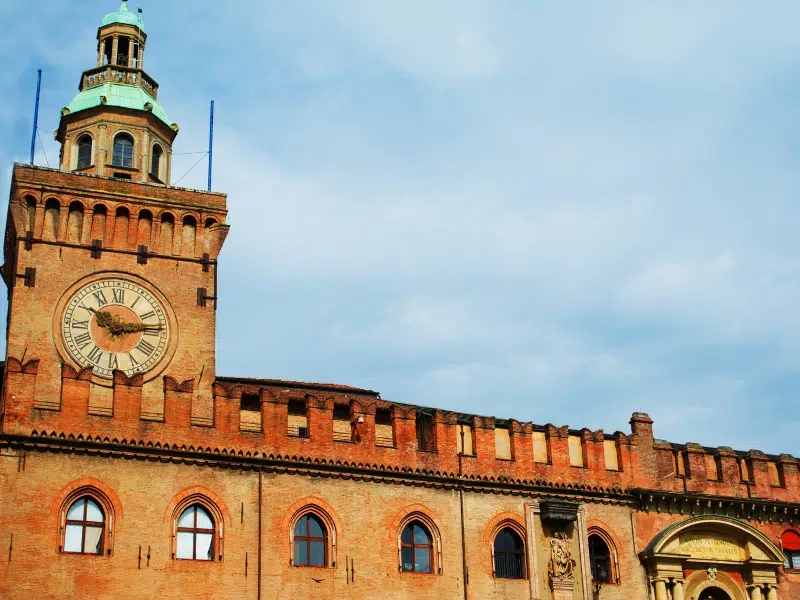
Palazzo d'Accursio is Bologna's town hall, the long, fortress-like palace that fills the west side of Piazza Maggiore. It has been the seat of the city government since the 14th century, and inside is a broad, gently sloping staircase, attributed to Bramante, that was designed so that dignitaries could ride up it on horseback.
Palazzo d'Accursio at a glance
- Where: on the west side of Piazza Maggiore, with a second front on Piazza del Nettuno.
- Built: in stages from the late 13th to the 16th century, around the house of the jurist Accursio.
- What it is today: Bologna's city hall, with the Municipal Art Collections on the upper floor and the Salaborsa library in its former courtyard.
- Also inside: the clock tower, which can be climbed on guided tours.
- Time needed: 15 minutes for the courtyard and staircase, one to two hours with the art collections and tower.
From a lawyer's house to a fortified town hall
The palace is named after Accursio, a famous 13th-century teacher of law at Bologna's university. In 1287 his son sold the family house to the city, and the commune gradually bought up the whole block around it, at first using the building as a public grain store. In 1336 it became the seat of the Anziani, the elders who governed the city, and from then on Bologna's rulers lived and worked here. When the city came under papal control, the palace was walled in and given towers like a castle, to protect the papal legates who governed in the pope's name.
After a fire in 1425 the architect Fioravante Fioravanti added a new wing, and in 1444 the old Accursio tower was raised; a public clock followed in 1451. In 1530 Emperor Charles V was crowned King of Italy with the Iron Crown in one of the palace's halls, before his imperial coronation in San Petronio across the square. In the 16th century Galeazzo Alessi designed the main portal, and in 1580 a bronze statue of Pope Gregory XIII, who was born in Bologna, was placed above it. On 21 November 1920 the palace was the scene of a massacre, when fascist squads attacked the crowd celebrating a new socialist city council, an event now seen as a turning point in the rise of fascism.
What to look for
- The bronze Pope Gregory XIII above the main portal, raising his hand in blessing.
- The terracotta Madonna and Child by Niccolò dell'Arca from 1478, high up on the façade facing the square.
- The clock tower and its bell of 1493, which strikes the hour and then repeats the strokes about a minute later.
- The great ramp-like staircase inside, attributed to Bramante, with low, wide steps meant for horses.
- On the Piazza del Nettuno side, the wall of photographs remembering the partisans who died in the Resistance during the Second World War.
The pope who became a saint for a while
The statue of Gregory XIII nearly did not survive. In 1796, when French troops arrived and papal symbols were being destroyed, the city council saved it by turning the pope into Saint Petronius, Bologna's patron: a bishop's mitre replaced the papal tiara, a crozier was added, and a new inscription named the figure as the city's protector and father. The disguise stayed for about a century, and in 1895 the statue was given back its original look.
Tips for your visit
- Walk into the courtyard and up the Bramante staircase: it is part of the public building and gives a good feel of the palace.
- Book a guided tour if you want to climb the clock tower; the view over Piazza Maggiore and the red roofs is one of the best in the city.
- Come back in the evening, when Piazza Maggiore fills with people and the palace façade is lit.
- Combine the palace with Salaborsa next door, where a glass floor shows Roman and medieval remains under the library.
Nearby
- Fountain of Neptune: Giambologna's bronze sea god on Piazza del Nettuno, right at the corner of the palace.
- Basilica of San Petronio: the huge church on the south side of Piazza Maggiore, with its unfinished façade, a minute away.
- Palazzo del Podestà and Palazzo Re Enzo: the medieval government palaces opposite, with a vault under the arches where a voice carries from one corner to the opposite one.
- The Two Towers: the leaning Asinelli and Garisenda towers, a few minutes' walk east along Via Rizzoli.
See Bologna with World City Trail
Our Bologna scavenger hunt turns the old town into a game you play on your phone. The route links 10 stops and takes around 2 hours, with about 33 minutes of walking. It includes the Two Towers and the Biblioteca Salaborsa, which occupies the palace's former courtyard, and at each stop you solve a puzzle and hear a story about the city.
If you prefer a different format, there is also a self-guided walking tour of Bologna and an outdoor escape game.
Play the Bologna scavenger hunt →
Take the self-guided walking tour of Bologna →
Play the outdoor escape game in Bologna →
Facts checked in October 2026.