
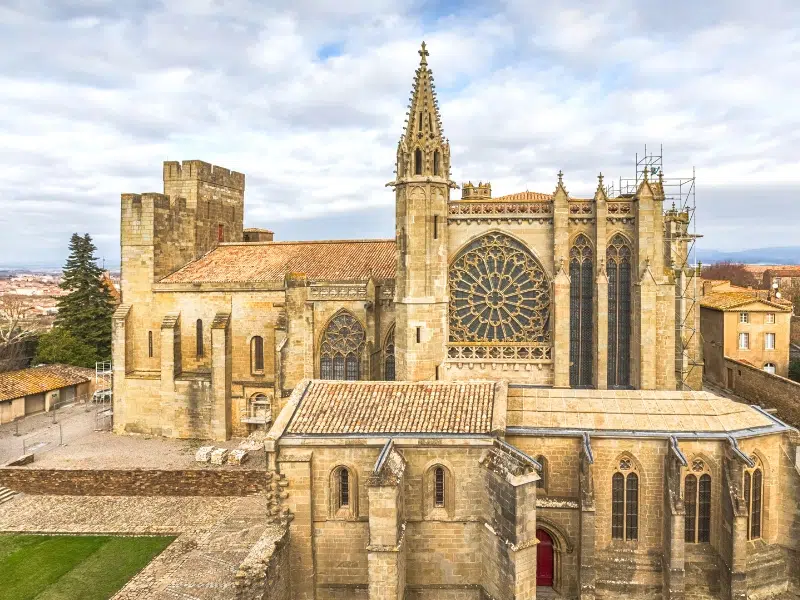
The Basilica of Saints Nazarius and Celsus, usually just called Saint-Nazaire, is the church inside La Cité, the walled medieval citadel of Carcassonne. It was the city's cathedral until 1803, and it is two buildings in one: a dark Romanesque nave and a Gothic choir that seems made of glass. The central choir window, from around 1280, is one of the oldest stained glass windows in the south of France.
Saint-Nazaire at a glance
- Where: inside La Cité, the fortified upper town, a short walk from the Château Comtal.
- Built: the Romanesque nave from the late 11th and 12th centuries; the Gothic choir and transept from about 1270 to the 1320s.
- Restored by: Eugène Viollet-le-Duc, who led the restoration from 1845 to 1867.
- What it is today: a Catholic church, raised to the rank of minor basilica in 1898. The cathedral title moved to Saint-Michel in the lower town in 1803.
- Time needed: 20–30 minutes; longer if you want to read the windows scene by scene.
A Romanesque church with a Gothic crown
On 12 June 1096 Pope Urban II came to Carcassonne and blessed the materials for a new cathedral. The nave built in the following decades is the oldest part you can see today: thick walls, round arches and little light. In 1269 the king authorised an extension, and from around 1270 the eastern end was rebuilt in the new Gothic style of northern France, with tall windows filling almost all the wall. The work was finished under Bishop Pierre Rodier in the 1320s.
After the French Revolution the church lost its role: in 1803 the bishop's seat moved to Saint-Michel in the Bastide, the lower town. It became a historic monument in 1840, and Viollet-le-Duc, who was also restoring the walls of La Cité, took charge from 1845. He removed 18th-century stalls and paintings, demolished a 16th-century bell tower on the west side and rebuilt the west front to look like part of the fortifications. His workshop also restored the stained glass between 1851 and 1861, and some scenes, including much of the Tree of Life window, are 19th-century work.
What to look for
- The contrast between the dim, heavy Romanesque nave and the bright Gothic choir and transept.
- The axial window behind the altar, from around 1280: the childhood and Passion of Christ told in 16 medallions.
- The two rose windows in the transept: the north rose dominated by deep blue, the south rose in yellow-greens and wine reds.
- The Tree of Jesse and the Tree of Life windows in the transept chapels, from the early 14th century.
- The tomb of Bishop Guillaume Radulphe, who died in 1266, set into the wall of his chapel with his effigy standing upright.
- Outside, on the stair turret of the south transept: Viollet-le-Duc's playful gargoyles, including a snail and a priest.
The siege stone
On the west wall of the south transept is a carved relief known as the 'siege stone'. It shows a city under attack with siege engines, and an angel carrying a dead man's soul. Tradition links it to the siege of Toulouse in 1218, where Simon de Montfort was killed. Montfort led the crusade against the Cathars and had become lord of Carcassonne after the crusaders took it in 1209. He was killed by a stone from a siege engine, and one source claims the machine was worked by the women of Toulouse. The link between the relief and that siege is not certain. What is documented is that Montfort was first buried in this church; one of his sons later moved his body to Montfort-l'Amaury, near Paris, and a tombstone in the south transept still bears his name.
Tips for your visit
- Come in the morning, when the sun lights the choir windows and La Cité is still quiet.
- Bring binoculars or use your phone's zoom: the medallions in the windows are small and high.
- It is a working church; keep your voice down and avoid visiting during Mass.
Nearby
- Château Comtal: the castle inside La Cité, with a walk along part of the ramparts.
- The lices: the open strip between the inner and outer walls, the best place to understand the double ring of fortifications.
- Porte Narbonnaise: the main gate of La Cité, with twin towers and a drawbridge.
- Pont Vieux: the medieval bridge over the Aude to the Bastide Saint-Louis, with the classic view back to La Cité.
See Carcassonne with World City Trail
Our Carcassonne scavenger hunt turns the old town into a game you play on your phone. The route links 10 stops and takes around 2 hours, with about 46 minutes of walking. The Basilica of Saint-Nazaire is one of the stops, along with La Cité and its ramparts.
If you prefer a different format, there is also a self-guided walking tour and an outdoor escape game in Carcassonne.
Play the Carcassonne scavenger hunt →
Take the self-guided walking tour of Carcassonne →
Play the outdoor escape game in Carcassonne →
Facts checked in October 2026.