
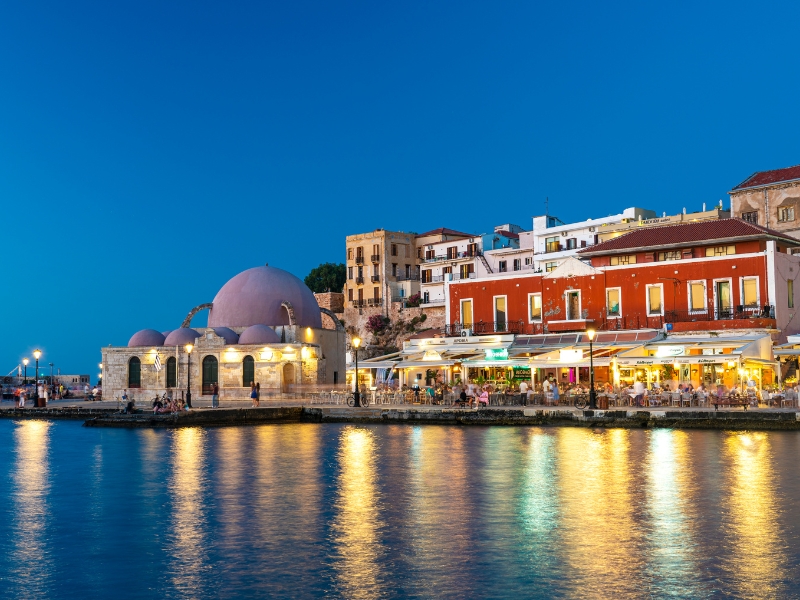
The Küçük Hasan Mosque is the low domed building right on the waterfront of Chania's Venetian harbour, and for most visitors it is the first landmark they notice when they reach the sea. It was built by the Ottomans soon after they captured the city in 1645, and it is the best-preserved Ottoman mosque in Chania. Its roofline of one large dome and six small ones makes it easy to pick out from anywhere around the harbour.
Küçük Hasan Mosque at a glance
- Where: on the harbour front of Chania's old town, at the foot of Kastelli hill, between the waterfront cafés and the Venetian arsenals.
- Built: in the second half of the 17th century, after the Ottoman conquest of Chania in 1645.
- By: an Armenian architect whose name is not recorded; he is also credited with a similar mosque at Spaniakos in south-west Crete.
- What it is today: an exhibition and events hall; it has not been used for worship since 1923.
- Time needed: 10–15 minutes from the outside, longer if an exhibition is on.
From harbour mosque to exhibition hall
The Ottomans took Chania from Venice in the summer of 1645, making it their first major city on Crete. The new mosque went up on the harbour soon afterwards and was dedicated to Küçük Hasan Pasha, the first Ottoman commander of the city's garrison. Locals came to call it the Yalı Camii, the mosque of the shore. It is said to stand on the site of an earlier church, and its courtyard, shaded by palm trees, once held the graves of pashas and janissaries.
After the population exchange between Greece and Turkey in 1923, Chania's Muslim community left and the mosque closed. Its minaret was demolished in 1939. During the Second World War the building housed the Archaeological Museum of Chania, and in the decades that followed it served as a storehouse, a folk museum and a tourist information office. Today it has been restored and is used for exhibitions and cultural events.
What to look for
- The main dome: a wide hemisphere that sits directly on the cube-shaped prayer hall without a drum, carried inside on four stone arches.
- The six small domes along the north and west sides, which cover the portico and give the building its unusual bubbly outline.
- The arched openings of the portico: it was originally open, and the arches that close it today were added in the late 19th century.
- The missing minaret: the building looks low and squat because the slender tower that once rose beside it was pulled down in 1939.
- The setting: the mosque stands almost on the quay, with the harbour on one side and the lanes of the old town climbing behind it.
A mosque from the start of a long war
The mosque dates from the beginning of the Ottoman conquest of Crete, which took far longer than its quick start suggested. Chania fell in 1645 after a siege of about two months, but Candia, today's Heraklion, held out against the Ottomans until 1669, one of the longest sieges in history. The mosque on Chania's harbour was built while that war was still going on, and it remained in use for more than two and a half centuries.
Tips for your visit
- Come early in the morning or around sunset: the harbour front is quiet in the morning, and in the evening the domes catch the low light.
- For the classic photo, look across the water from the western side of the harbour near the Maritime Museum, or from the breakwater on the way to the lighthouse.
- Check whether an exhibition is on: the hall is only open when something is being shown, and the programme changes through the year.
- Combine it with a slow walk around the whole harbour, from the Firkas Fortress past the mosque to the arsenals and out to the lighthouse.
Nearby
- Venetian Lighthouse: at the end of the long breakwater; the walk out gives the best view back over the harbour and the old town.
- Maritime Museum of Crete: in the Firkas Fortress at the western end of the harbour, with models and relics from Crete's long seafaring history.
- Venetian Arsenals (Neoria): the great vaulted shipyards a short walk east along the quay, built by Venice in the 16th century.
- Kastelli hill: the oldest part of Chania and the site of ancient Kydonia, just behind the mosque, with excavations visible between the houses.
See Chania with World City Trail
Our Chania scavenger hunt turns the old town into a game you play on your phone. The route links 10 stops and takes around 2 hours, with about 42 minutes of walking. It takes you through the alleys of the old town and to the Venetian harbour, where the mosque stands. You can play in English, German, French, Italian, Dutch and Greek.
If you prefer a different format, there is also a self-guided walking tour and an outdoor escape game in Chania.
Play the Chania scavenger hunt →
Take the self-guided walking tour of Chania →
Play the outdoor escape game in Chania →
Facts checked in October 2026.