
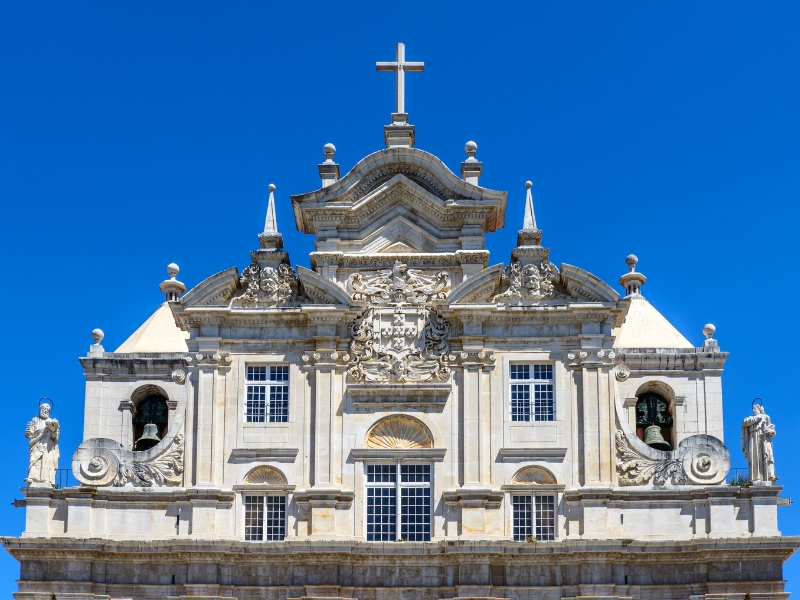
The New Cathedral, or Sé Nova, stands at the top of Coimbra's upper town, on the Largo da Feira dos Estudantes close to the university. It was not built as a cathedral at all: it began in 1598 as the church of the Jesuit college, and only became the seat of the bishop in 1772, after the Marquis of Pombal had expelled the Jesuits from Portugal. Four Jesuit saints still stand in the niches of its façade.
The New Cathedral at a glance
- Where: Largo da Feira dos Estudantes, in the Alta (upper town), a few minutes' walk from the University of Coimbra.
- Built: foundation stone laid in 1598; the church opened in 1640, and work and decoration continued for decades afterwards.
- By: the original design is attributed to the architect Baltazar Álvares.
- What it is today: the cathedral of the Diocese of Coimbra and a working parish church.
- Time needed: 20–30 minutes.
From Jesuit college church to cathedral
The Jesuits settled in Coimbra in 1541, only a year after their order was approved by the Pope, and built a large college in the upper town, the Colégio das Onze Mil Virgens (College of the Eleven Thousand Virgins). The foundation stone of its church was laid in 1598, to a design attributed to Baltazar Álvares and modelled on the church of São Vicente de Fora in Lisbon. Work went slowly: the church opened in 1640, and its façade and interior were completed in stages over the following decades, which is why the lower and upper parts of the front look so different.
In 1759 the Marquis of Pombal expelled the Jesuits from Portugal, and the college was left empty. Down the hill, the cathedral chapter was cramped in the medieval Romanesque cathedral, the Sé Velha. In 1772, the same year Pombal reformed the University of Coimbra, the bishop's seat moved into the former Jesuit church, which has been the Sé Nova ever since. The chapter brought some furnishings from the old cathedral with it, and they are still inside.
What to look for
- The lower façade: four niches with statues of Jesuit saints, Ignatius of Loyola, Francis Xavier, Francis Borgia and Aloysius Gonzaga, a clear statement of who built the church.
- The upper façade: the later, Baroque top of the front, with large statues of Saint Peter and Saint Paul.
- The gilded woodwork (talha dourada) of the chancel, from the late 17th century, with niches holding images of Jesuit saints, among them Stanislaus Kostka.
- The single, wide vaulted nave in pale stone, lined with side chapels.
- Two pieces from the Sé Velha: the 17th-century choir stalls and an early 16th-century baptismal font, both brought here when the cathedral moved.
Students and the Sé Nova
The square in front takes its name from the students: Largo da Feira dos Estudantes, the Students' Fair Square. Coimbra's student life still passes through it. During the Queima das Fitas, the university's big student festival in May, final-year students come to the Sé Nova for the Bênção das Pastas, a Mass at which the bishop blesses the briefcases (pastas) of those about to graduate, with families and friends crowding in to watch.
Tips for your visit
- Step back to the far side of the square to see the whole façade at once, from the Jesuit saints up to Peter and Paul.
- It is a working church: dress modestly and avoid walking around during Mass.
- In May, during the Queima das Fitas, the square and the church can be packed with students in black capes; come early or choose another day for a quiet visit.
Nearby
- Machado de Castro National Museum: Coimbra's main art museum, a couple of minutes away, built over the vaulted Roman cryptoporticus of ancient Aeminium, which you can walk through.
- University of Coimbra: the Paço das Escolas courtyard and the Joanina Library, a few minutes' walk up the hill.
- Sé Velha: the 12th-century Romanesque old cathedral, a few minutes downhill, worth seeing to compare the two cathedrals.
- Porta Férrea: the 17th-century gateway into the university's main courtyard, decorated with figures representing its faculties.
See Coimbra with World City Trail
Our Coimbra scavenger hunt turns the old town into a game you play on your phone. The route links 10 stops and takes around 2 hours, with about 37 minutes of walking. It includes the Santa Cruz Church and the Praça do Comércio in the lower town. You can play in English, German, French, Italian, Spanish, Dutch or Portuguese.
If you prefer a different format, there is also a self-guided walking tour and an outdoor escape game in Coimbra.
Play the Coimbra scavenger hunt →
Take the self-guided walking tour of Coimbra →
Play the outdoor escape game in Coimbra →
Facts checked in October 2026.