
The Church of Santa Cruz (Holy Cross) is the church of a great Augustinian monastery founded in 1131 in the lower town of Coimbra, on Praça 8 de Maio. It holds the tombs of Portugal's first two kings, Afonso Henriques and his son Sancho I, and since 2003 it has been one of the country's National Pantheons. Its carved Manueline portal, from the early 1500s, faces straight onto one of the busiest squares in the city.
Santa Cruz Church at a glance
- Where: Praça 8 de Maio, in Coimbra's Baixa (lower town), next to the City Hall and at the bottom of Rua Visconde da Luz.
- Built: founded in 1131; the church as you see it today was largely rebuilt between about 1507 and the 1530s under King Manuel I and King João III.
- By: Diogo de Boytac, Marcos Pires and Diogo de Castilho for the Manueline rebuilding, with sculpture by the French-born Nicolau Chanterene and Jean de Rouen (João de Ruão).
- What it is today: a working church and National Pantheon, with the royal tombs, the Cloister of Silence and the sacristy open to visitors.
- Time needed: 30–45 minutes for the church, the tombs and the cloister.
The monastery of Portugal's first king
The first stone was laid on 28 June 1131 by a group of twelve founders, among them the archdeacon Telo and João Peculiar, and the community of Augustinian canons began its life in February 1132 under its first prior, Teotónio, later canonised. Afonso Henriques, who had made Coimbra his capital, kept his archives here and chose it as his burial place. The monastery became one of the great centres of learning of medieval Portugal: the young Fernando de Bulhões, later known as St Anthony of Padua (or of Lisbon), studied here as an Augustinian canon before he joined the Franciscans.
In the early 16th century King Manuel I had the Romanesque church and cloister pulled down and rebuilt in the new Manueline style, and he gave the first two kings new tombs. Under João III the monastery added colleges, a library and new cloisters, and when the university moved permanently to Coimbra in 1537 some of its faculties first met here. Religious orders were abolished in 1834, the monastery's buildings were split among different owners, and part of the complex was demolished to open a new avenue. The church was declared a National Monument in 1907 and a National Pantheon in 2003.
What to look for
- The main portal: a richly carved Manueline-Renaissance doorway framed by statues in niches. The triumphal arch in front of the façade is a 19th-century addition.
- The royal tombs on either side of the main chapel: Afonso Henriques on one side and Sancho I on the other, in tombs made in 1518–1522 by Diogo de Castilho, with recumbent figures by Nicolau Chanterene.
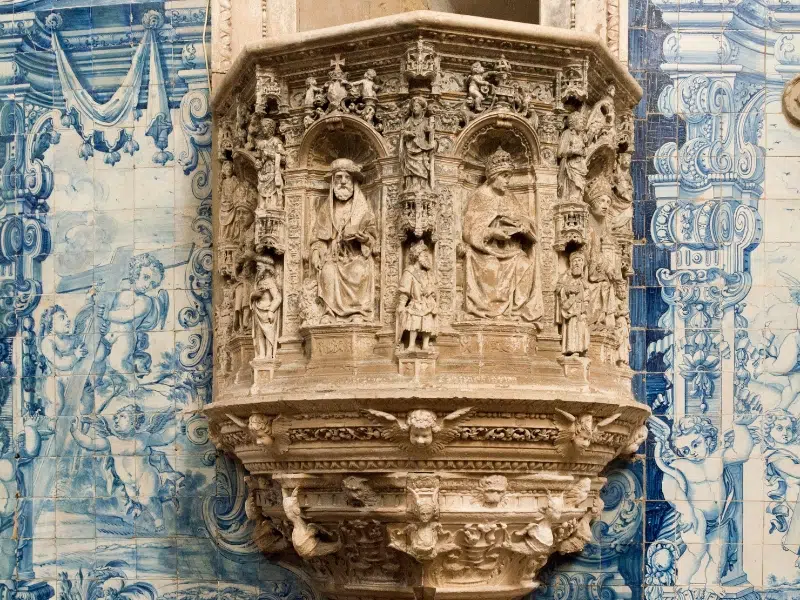
- The pulpit in the nave: a delicate Renaissance work, also by Chanterene, often called one of the finest of its kind in Portugal.
- The blue-and-white azulejos lining the nave walls, added in the 18th century, and the large Baroque organ above them.
- The Cloister of Silence: built by Marcos Pires in 1517–1525, with four reliefs of the Passion of Christ by Chanterene.
Café Santa Cruz next door
Right beside the church, behind tall Gothic windows, is Café Santa Cruz. The space was once a small church built for the ordinary people of the town, so they could worship without disturbing the monks. After it lost its religious use it became a café, opened in 1923, and it has been a meeting place for writers, students and artists ever since. The ribbed stone vault and stained glass are still there, and it is one of the best places in Coimbra to hear an evening of fado.
Tips for your visit
- The tombs, the cloister and the sacristy are a separate visit, entered from inside the church. Go early or late in the day to avoid the tour groups.
- It is a place of worship: dress modestly, keep your voice down and avoid visiting during Mass.
- Step back across Praça 8 de Maio to photograph the whole portal; the square was redesigned by the architect Fernando Távora in the 1990s.
Nearby
- Café Santa Cruz: the historic café in the former church of the people, next door, for a coffee and a pastel de nata under Gothic vaults.
- Jardim da Manga: the unusual Renaissance fountain behind the church, with a central dome and four small chapels, attributed to Jean de Rouen.
- Praça do Comércio: the elongated square of the lower town, a few minutes' walk away, lined with old houses and the churches of São Tiago and São Bartolomeu.
- Arco de Almedina: the old city gate at the top of Rua Ferreira Borges, where the steep climb to the Sé Velha and the university begins.
See Coimbra with World City Trail
Our Coimbra scavenger hunt turns the old town into a game you play on your phone. The route links 10 stops and takes around 2 hours, with about 37 minutes of walking. Santa Cruz Church is one of the stops, along with Praça do Comércio. You can play in English, German, French, Italian, Spanish, Dutch and Portuguese.
If you prefer a different format, there is also a self-guided walking tour and an outdoor escape game in Coimbra.
Play the Coimbra scavenger hunt →
Take the self-guided walking tour of Coimbra →
Play the outdoor escape game in Coimbra →
Facts checked in October 2026.