
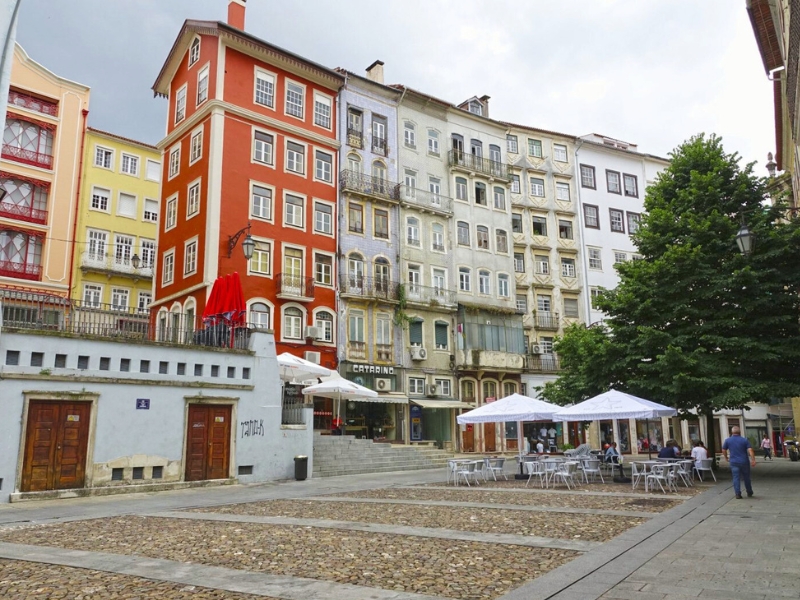
Praça do Comércio, also known as Praça Velha, the Old Square, is the long market square of Coimbra's Baixa, the lower town between the university hill and the Mondego. For centuries this was where the city came to buy and sell, and it still has a church at each end: the Romanesque São Tiago and the Baroque São Bartolomeu.
Praça do Comércio at a glance
- Where: in the Baixa, just off the pedestrian Rua Ferreira Borges and Rua Visconde da Luz, below the old town walls.
- Created: a market square since the Middle Ages; the Church of São Tiago on it was consecrated in 1206.
- What it is today: a pedestrian square with cafés and terraces between the two churches, and a stop on Coimbra walks through the Baixa.
- Time needed: 15 to 30 minutes, more if you sit down for a coffee or go inside the churches.
The market of the lower town
Coimbra grew in two parts: the Alta on the hill, with the castle, the cathedral and later the university, and the Baixa down by the river, where traders and craftsmen lived. Praça do Comércio was the Baixa's marketplace, the place where people from the town and the countryside came to shop. In the 16th century the Royal Hospital stood on the square; in 1790 most of it moved to the former Jesuit college near the New Cathedral.
The two churches are older than the square's present look. São Tiago was rebuilt in Romanesque style under King Sancho I and consecrated in 1206. In the 1540s a second church for the Misericórdia, the city's charity brotherhood, was built on top of it, and in 1861 part of its east end was cut away when Rua Visconde da Luz was widened. The upper church was removed in a 20th-century restoration, and São Tiago has been a national monument since 1910. São Bartolomeu, at the other end, has roots in the 10th century but was rebuilt in the 18th.
What to look for
- The portals of São Tiago: carved Romanesque capitals with plants and animals, including pairs of birds facing each other, and columns with spiral and vine patterns.
- The cut-off east end of São Tiago on the Rua Visconde da Luz side, a reminder of the 1861 street widening.
- São Bartolomeu's Baroque façade closing the other end of the square.
- The pillory: a reproduction of the 15th-century pelourinho, two stone pillars that stood for municipal power, facing São Bartolomeu.
- The tall, narrow merchants' houses around the square, with shops on the ground floor and balconies above.
An oath before Alfarrobeira
According to tradition, São Tiago is where Prince Pedro, Duke of Coimbra, and his friend Álvaro Vaz de Almada swore that neither would outlive the other, before setting out for the Battle of Alfarrobeira in 1449. Both died in that battle against the forces of the young King Afonso V, Pedro's nephew. Whether the oath was really sworn here cannot be proved, but the story is part of the church's local fame.
Tips for your visit
- Come in the morning, when the light falls on the façade of São Tiago and the terraces are still quiet.
- Enter from Rua Ferreira Borges by the short flight of steps, then leave by the other end towards Rua Visconde da Luz and Santa Cruz.
- Churches are places of worship: if a service is on, visit quietly or come back later.
Nearby
- Santa Cruz Monastery: the burial place of Portugal's first two kings, Afonso Henriques and Sancho I, a few minutes' walk north.
- Arco de Almedina: the medieval gate in the old town walls, the start of the climb from the Baixa to the upper town.
- Sé Velha: Coimbra's fortress-like Romanesque Old Cathedral, uphill beyond the Arco de Almedina.
- Largo da Portagem and the Mondego: the riverside square at the foot of the Baixa, with views across to Santa Clara.
See Coimbra with World City Trail
Our Coimbra scavenger hunt turns the old town into a game you play on your phone. The route links 10 stops and takes around 2 hours, with about 37 minutes of walking. Praça do Comércio is one of the stops, along with Santa Cruz Church. You can play in English, German, French, Italian, Spanish, Dutch and Portuguese.
If you prefer a different format, there is also a self-guided walking tour and an outdoor escape game in Coimbra.
Play the Coimbra scavenger hunt →
Take the self-guided walking tour of Coimbra →
Play the outdoor escape game in Coimbra →
Facts checked in October 2026.