
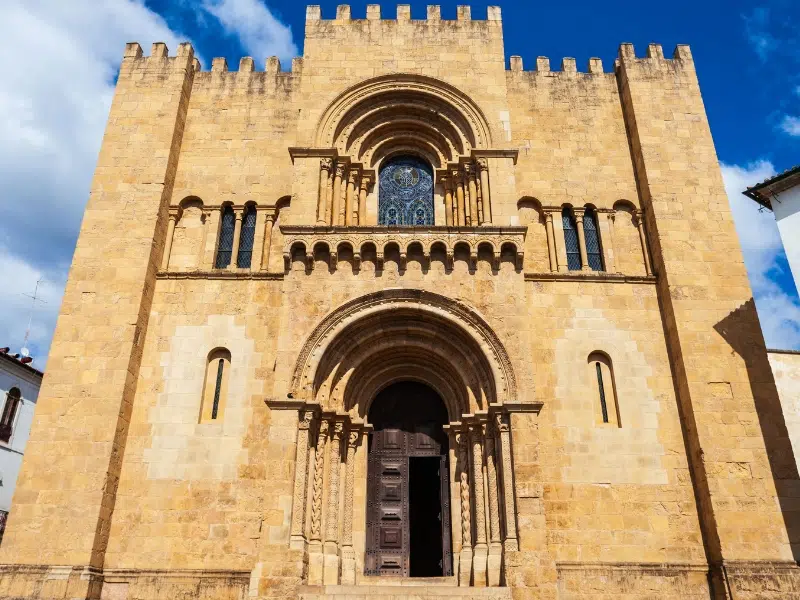
The Sé Velha, Coimbra's Old Cathedral, stands halfway up the hill of the old town, a squat block of stone with crenellated walls and few windows. It was begun in the 12th century, when Coimbra was the capital of the newly founded kingdom of Portugal, and it is the only one of the country's Romanesque cathedrals from the Reconquista to survive largely intact. From the outside it looks more like a fortress than a church.
Sé Velha at a glance
- Where: on Largo da Sé Velha in the upper town of Coimbra, at the top of the steep Rua de Quebra-Costas.
- Built: from the mid-12th century; the main building was finished in the early 13th century and the cloister was begun in 1218.
- By: attributed to Master Robert, possibly a Frenchman who also worked on Lisbon Cathedral; the works were led by Master Bernard and then Master Soeiro.
- What it is today: a parish church and a National Monument since 1910; the bishop's seat moved to the New Cathedral in 1772.
- Time needed: 15 minutes outside, 45 minutes with the interior and the cloister.
A cathedral for a new kingdom
In 1139, after the Battle of Ourique, Afonso Henriques declared himself King of Portugal and made Coimbra his capital. He decided to fund a new cathedral to replace an older one in poor condition, and Bishop Miguel Salomão helped pay for the works. By 1185 the building was advanced enough for his son, Sancho I, to be crowned here. The crenellations and thick buttresses reflect the times: the frontier with the Moorish south was still close.
Around 1500 Bishop Jorge de Almeida had the walls and pillars covered with tiles from Seville, and in the 1530s the French sculptor João de Ruão added the Renaissance Porta Especiosa on the north side. The Romanesque structure itself was left alone. After the Jesuits were expelled from Portugal, the bishop moved in 1772 to their former church, which became the Sé Nova, the New Cathedral, and the old building kept the name Sé Velha.
What to look for
- The west front: a tower-like centre with a deep round-arched portal and a matching window above, both carved with Romanesque motifs that show Arabic influence.
- The Porta Especiosa on the north side: a three-storey Renaissance doorway from the 1530s, badly weathered but still finely detailed.
- The carved capitals inside, around 380 of them, with plants, geometric patterns, birds and animals facing each other, but almost no human figures.
- The gilded high altarpiece, carved between 1498 and 1502 by the Flemish artists Olivier de Gand and Jean d'Ypres, filling the whole main chapel.
- The tomb of Vataça Lascaris, a Byzantine noblewoman who came to Portugal with Queen Isabel of Aragon, marked with a two-headed eagle.
Serenades on the steps
The Sé Velha is part of Coimbra's student life as well as its religious history. Every spring the student festival, the Queima das Fitas, opens with the Serenata Monumental: at midnight, students in black capes gather on the cathedral steps and in the square below to listen in silence to Coimbra fado, sung by men. The square fills up long before the music starts. And in 2019 scientists found a previously unknown family of fungi growing on deteriorating artworks inside the cathedral; it was named Aeminiaceae, after Aeminium, the Roman name of Coimbra.
Tips for your visit
- Walk up Rua de Quebra-Costas from the Almedina Arch: the cathedral appears suddenly at the top and you see the full fortress-like front.
- Look at the west front in the late afternoon, when the low sun brings out the carving on the portal.
- Don't skip the cloister: its pointed Gothic arches each frame two smaller round Romanesque arches, a clear sign of the change of style.
- It is still a working church, so dress modestly and keep quiet if a service or a wedding is on.
Nearby
- Machado de Castro National Museum: a short climb uphill, with Roman galleries under the building, the cryptoporticus of ancient Aeminium.
- University of Coimbra: the Paço das Escolas and the Joanina Library at the top of the hill, part of a UNESCO World Heritage Site.
- Almedina Arch: the old town gate at the bottom of Rua de Quebra-Costas, a remnant of the medieval walls.
- Sé Nova: the former Jesuit church that replaced the Sé Velha as cathedral in 1772, a few minutes' walk uphill.
See Coimbra with World City Trail
Our Coimbra scavenger hunt turns the old town into a game you play on your phone. The route links 10 stops and takes around 2 hours, with about 37 minutes of walking. It includes Santa Cruz Church and Praça do Comércio in the lower town. You can play in English, German, French, Italian, Spanish, Dutch and Portuguese.
If you prefer a different format, there is also a self-guided walking tour and an outdoor escape game in Coimbra.
Play the Coimbra scavenger hunt →
Take the self-guided walking tour of Coimbra →
Play the outdoor escape game in Coimbra →
Facts checked in October 2026.