
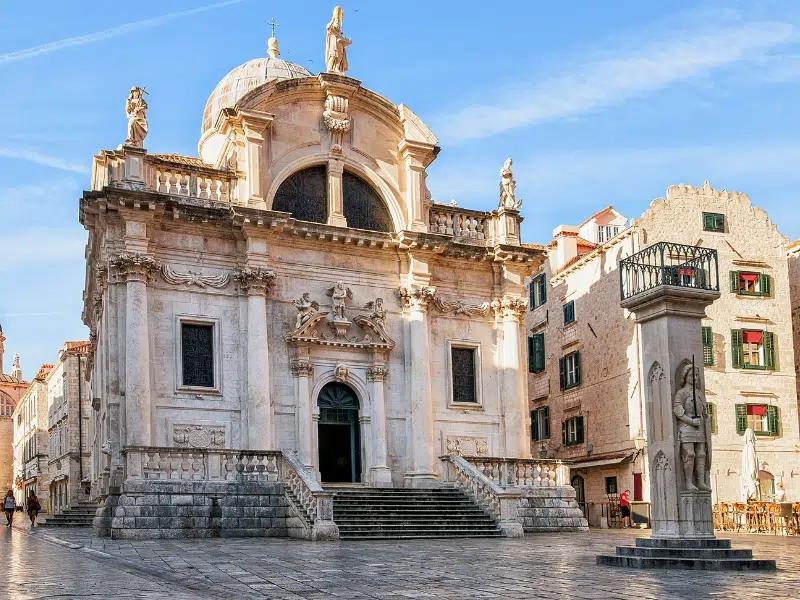
The Church of St Blaise (Crkva sv. Vlaha) is the Baroque church on Luža Square, at the eastern end of the Stradun in Dubrovnik's old town. It is dedicated to the city's patron saint, and above its main altar stands a 15th-century gilded silver statue of St Blaise holding a model of Dubrovnik as it looked before the great earthquake of 1667. That statue was the only major piece saved when the earlier church burned down in 1706.
St Blaise's Church at a glance
- Where: Luža Square, at the eastern end of the Stradun (Placa), opposite the Sponza Palace and a few steps from the Rector's Palace.
- Built: 1706–1715, on the foundations of a 14th-century church; dedicated in 1715.
- By: the Venetian architect and sculptor Marino Gropelli.
- What it is today: a working Catholic church and the focus of the Feast of St Blaise on 3 February, Dubrovnik's city day.
- Time needed: 15–20 minutes.
A church born of plague and fire
In February 1349, a month after the Black Death reached Dubrovnik, the Great Council of the Republic decided to build a church to St Blaise, the 4th-century bishop of Sebaste in Armenia who had long been the city's protector. The Romanesque church was finished in about three years and came through the devastating earthquake of 1667 fairly well.
Fire, not the earthquake, destroyed it: in 1706 the church burned down, and only the silver statue of the saint was rescued. Marino Gropelli rebuilt it on the old foundations, taking Sansovino's church of San Maurizio in Venice as his model, and the new church was dedicated in 1715. It has a Greek-cross plan under a central dome and a façade divided by four Corinthian columns, raised on a broad flight of steps. In 1971 the windows were filled with stained glass by the Dubrovnik painter Ivo Dulčić.
What to look for
- The silver statue of St Blaise in a high niche above the main altar. Look at the model in his left hand: it shows the city before the 1667 earthquake, with buildings that no longer exist.
- The main altar of white and coloured marble, with two carved angels drawing back a curtain on its front.
- Ivo Dulčić's stained glass windows from 1971, whose bold modern colours stand out against the Baroque marble.
- The façade: four Corinthian columns, a carved portal and the dome behind, all set on wide steps that work as one of the old town's favourite places to sit.
- Orlando's Column in front of the church: the stone knight put up in 1418, where the Republic's flag was raised and its decrees were read out. His forearm served as Dubrovnik's official measure of length, the Dubrovnik ell.
The legend of Stojko and the Venetian ships
According to legend, in the 10th century St Blaise appeared to a priest named Stojko and warned him that Venetian ships anchored off Lokrum and in Gruž were planning a surprise night attack on the city. Warned in time, Dubrovnik prepared its defences, the attack never came, and Blaise became the city's patron. The story can't be proven, but the saint is everywhere in Dubrovnik: look for his statue above the Pile Gate and the Ploče Gate and on the city walls, usually with the model of the city in his hand.
Tips for your visit
- Come early in the morning or late in the afternoon. In the middle of the day, the Stradun and Luža Square are at their busiest.
- Dress respectfully, with shoulders and knees covered, and keep quiet if a Mass is on.
- From the top of the steps, look west along the full length of the Stradun towards the Pile Gate: one of the classic views of the old town.
- If you are in Dubrovnik on 3 February, you will see the Feast of St Blaise, on UNESCO's list of intangible cultural heritage since 2009, with processions carrying the saint's relics through the old town.
Nearby
- Sponza Palace: the 16th-century palace across the square, mixing Gothic and Renaissance styles, now home to the Dubrovnik State Archives.
- Rector's Palace: the seat of the Republic's elected rector, now the Cultural History Museum, a minute's walk away.
- City Bell Tower: the clock tower on Luža Square, where two bronze figures nicknamed Maro and Baro strike the hours.
- Dubrovnik Cathedral: the Baroque Cathedral of the Assumption, a couple of minutes' walk south, whose treasury holds reliquaries of St Blaise.
See Dubrovnik with World City Trail
Our Dubrovnik scavenger hunt turns the old town into a game you play on your phone. The route links 10 stops and takes around 2 hours, with about 17 minutes of walking. Along the way it includes the Pile Gate and Onofrio's Great Fountain at the other end of the Stradun.
If you prefer a different format, there is also a self-guided walking tour and an outdoor escape game in Dubrovnik.
Play the Dubrovnik scavenger hunt →
Take the self-guided walking tour of Dubrovnik →
Play the outdoor escape game in Dubrovnik →
Facts checked in October 2026.