
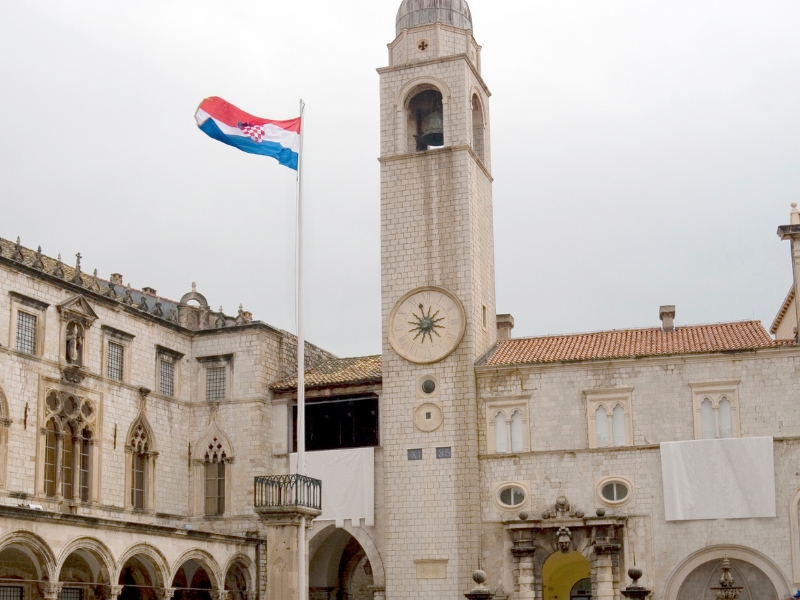
The Clock Tower (Gradski zvonik, the City Bell Tower) rises 31 metres over Luža Square at the eastern end of the Stradun, the main street of Dubrovnik's old town. It first went up in 1444, but the tower you see today is a faithful rebuild from 1929. On top, two bronze figures called Maro and Baro, the 'Zelenci' or green men, strike a bell cast in 1506 to mark the hours.
The Clock Tower at a glance
- Where: Luža Square, at the eastern end of the Stradun, between the Sponza Palace and the Church of St Blaise.
- Built: completed in 1444; demolished in 1928 because it was leaning and rebuilt to the original design in 1929.
- What it is today: the city's working public clock and bell tower, with replica bell-strikers; the original figures are in the Rector's Palace museum.
- Time needed: 10–15 minutes; try to be there on the hour to see and hear the bell.
From medieval clock to 1929 rebuild
Dubrovnik had a public clock as early as the late 14th century, and in 1444 the Republic of Ragusa, as the city-state was known, built this tower at the end of its main street so the clock could be seen down the whole length of the Stradun. The first figures that struck the bell were made of wood. In 1477 the city council ordered two bronze figures to replace them, and they were cast around 1478. The bell that hangs in the tower today was cast in 1506 by Ivan Rabljanin, a founder from the island of Rab known for his bells and cannons. The bell's strokes did more than tell the time: they also called the councils of the Republic together and warned of danger.
The great earthquake of 1667 damaged the tower, and by the early 19th century it had begun to lean towards the Stradun. In 1928 it was taken down and in 1929 rebuilt to the original design, with new bronze copies of the bell-strikers made at the Academy of Arts in Zagreb. Another earthquake, in 1979, damaged it again, and it was restored in 1987–1988. The original figures, cleaned and conserved after decades of corrosion, have been on display in the Cultural History Museum in the Rector's Palace since 2010.
What to look for
- Maro and Baro: the two figures at the top, each with a hammer, standing either side of the bell. Their green colour comes from the patina on the bronze, which gave them their nickname, Zelenci.
- The bell: the 1506 bronze bell between them, the oldest working part of the tower.
- The clock face: it shows not only the time but also the phases of the moon.
- The Orlando Column: the stone column in front of the tower, carved in 1418, with a statue of the knight Roland. The flag of the Republic flew from it, and public announcements and punishments took place here.
- The view down the Stradun: stand under the tower and look west along the polished limestone street to the Pile Gate at the other end.
Roland's forearm
Local tradition says the forearm of the Orlando statue in front of the tower was the official measure of length in the Republic, the Dubrovnik ell, so merchants on the square could check the cloth they were sold against it. Another story says Roland defended the city against pirates. Treat both as part of the city's lore; what is certain is that the column was the place where the Republic's decisions were read out and its flag was raised.
Tips for your visit
- Be on Luža Square just before the hour to watch Maro and Baro strike the bell; the square is quieter early in the morning before the cruise crowds arrive.
- For a photo of the whole tower with the Stradun in the frame, stand a little way back along the street; for the figures at the top, use your phone's zoom.
- Visit the Rector's Palace nearby to see the original Zelenci up close, then compare them with the copies on the tower.
Nearby
- Sponza Palace: the Gothic-Renaissance palace right beside the tower, once the customs house and mint, which survived the 1667 earthquake almost intact and now holds the State Archives.
- Church of St Blaise: the baroque church across the square, dedicated to the city's patron saint.
- Rector's Palace: the seat of the Republic's government, now the Cultural History Museum, a minute's walk from the tower.
- Small Onofrio Fountain: the little 15th-century fountain on Luža Square, the eastern twin of the large fountain by the Pile Gate.
See Dubrovnik with World City Trail
Our Dubrovnik scavenger hunt turns the old town into a game you play on your phone. The route links 10 stops and takes around 2 hours, with about 17 minutes of walking. It includes places such as the Pile Gate and Onofrio's Great Fountain.
If you prefer a different format, there is also a self-guided walking tour and an outdoor escape game in Dubrovnik.
Play the Dubrovnik scavenger hunt →
Take the self-guided walking tour of Dubrovnik →
Play the outdoor escape game in Dubrovnik →
Facts checked in October 2026.