
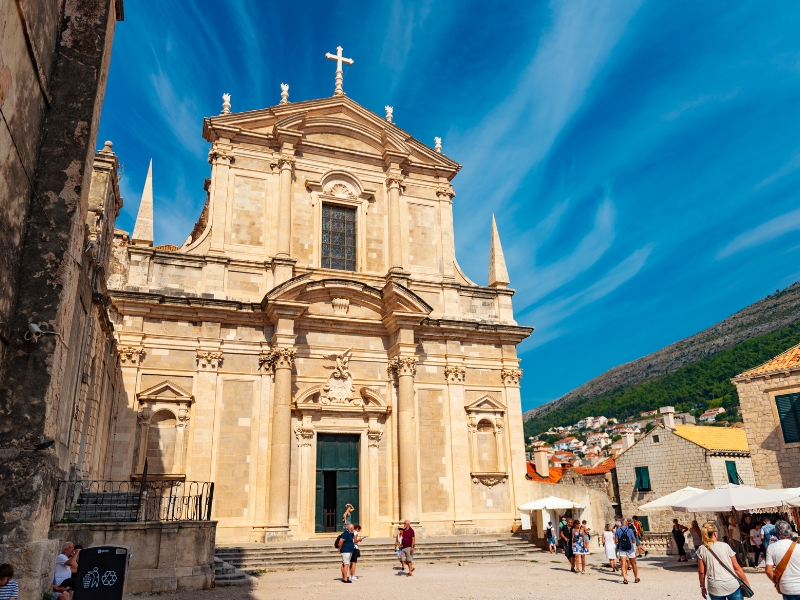
The Church of St Ignatius is the big Baroque Jesuit church on the upper, southern edge of Dubrovnik's old town, reached by a sweeping flight of steps from Gundulić Square. It was designed by Andrea Pozzo, the Jesuit painter and architect known for his work at the church of Sant'Ignazio in Rome, and built between 1699 and 1725. Inside it holds something few visitors expect in a Baroque church: an artificial rock grotto dedicated to Our Lady of Lourdes.
The Church of St Ignatius at a glance
- Where: Bošković Square (Poljana Ruđera Boškovića), at the top of the Jesuit Stairs above Gundulić Square, in the old town.
- Built: 1699–1725, after the earthquake of 1667 had ruined the first Jesuit college on the site.
- By: the Jesuit architect Andrea Pozzo; the apse frescoes are by Gaetano Garcia and the stairs by the Roman architect Pietro Passalacqua.
- What it is today: a working Catholic church beside the former Jesuit college, the Collegium Ragusinum, which now houses a diocesan grammar school and the seminary.
- Time needed: 20–30 minutes for the church and the stairs.
Jesuits, an earthquake and a Roman architect
The Jesuits came to Dubrovnik, then the independent Republic of Ragusa, in the late 1550s: Nicholas Bobadilla, one of the first companions of Ignatius of Loyola, stayed here from 1558. Their college was founded in 1658 with money left by the philosopher and theologian Marin Gundulić. Nine years later the Great Earthquake of 1667 wrecked the young college and killed many of its students, and building stopped until the end of the century.
In 1699 work began on a new church and college to plans by Andrea Pozzo, and the church was finished in 1725. In the 1730s Gaetano Garcia painted the apse, and Pietro Passalacqua renovated the complex and built the monumental stairs down to the square below. When the pope suppressed the Jesuit order in 1773, the college passed to local clergy and later to the Piarists, and it served for a time as a military hospital. Its most famous pupil was the scientist Ruđer Bošković, born in Dubrovnik in 1711; the square in front of the church was renamed after him in 1930.
What to look for
- The apse frescoes by Gaetano Garcia, scenes from the life of St Ignatius, including him sending Francis Xavier to the missions and his glorification surrounded by the four continents.
- The Lourdes grotto, built in 1885 from rough stone, with a statue of Our Lady of Lourdes: a very 19th-century addition to an 18th-century church.
- The bell tower, which is said to hold the oldest bell in Dubrovnik, cast in 1355, more than three centuries before the church itself.
- The Jesuit Stairs, built in the 1730s and often compared with the Spanish Steps in Rome. They were fully restored in 2025, for the first time since they were built.
- A carved stone plaque dated 1481 with the YHS monogram of Christ, at the base of the stairs.
The stairs on screen
Many visitors come here because of Game of Thrones. In the final episode of the fifth season, broadcast in 2015, Cersei Lannister begins her 'walk of atonement' at the top of the Jesuit Stairs, with a nun ringing a bell and calling 'Shame!' behind her. Long before television, the square and the stairs were already used as a stage: the Dubrovnik Summer Festival holds performances here.
Tips for your visit
- Come in the morning, when the market is on in Gundulić Square below and the stairs are still quiet enough for photos.
- This is a working church: cover your shoulders and knees, and don't walk around during Mass.
- The stone steps are worn smooth, so take care in wet weather or in flat-soled sandals.
- From the top of the stairs, turn round for a view over the market and the rooftops of the old town.
Nearby
- Gundulić Square: the market square at the foot of the stairs, with a statue of the 17th-century poet Ivan Gundulić.
- Dubrovnik Cathedral: the Baroque cathedral of the Assumption, with its treasury of reliquaries, a few minutes' walk away.
- Rector's Palace: the seat of the old Republic's government, now the Cultural History Museum, a short walk east past the cathedral.
- Rupe Ethnographic Museum: a 16th-century granary with deep storage pits cut into the rock, a short walk west.
See Dubrovnik with World City Trail
Our Dubrovnik scavenger hunt turns the old town into a game you play on your phone. The route links 10 stops and takes around 2 hours, with about 17 minutes of walking. It includes places such as the Pile Gate and Onofrio's Great Fountain.
If you prefer a different format, there is also a self-guided walking tour and an outdoor escape game in Dubrovnik.
Play the Dubrovnik scavenger hunt →
Take the self-guided walking tour of Dubrovnik →
Play the outdoor escape game in Dubrovnik →
Facts checked in October 2026.