
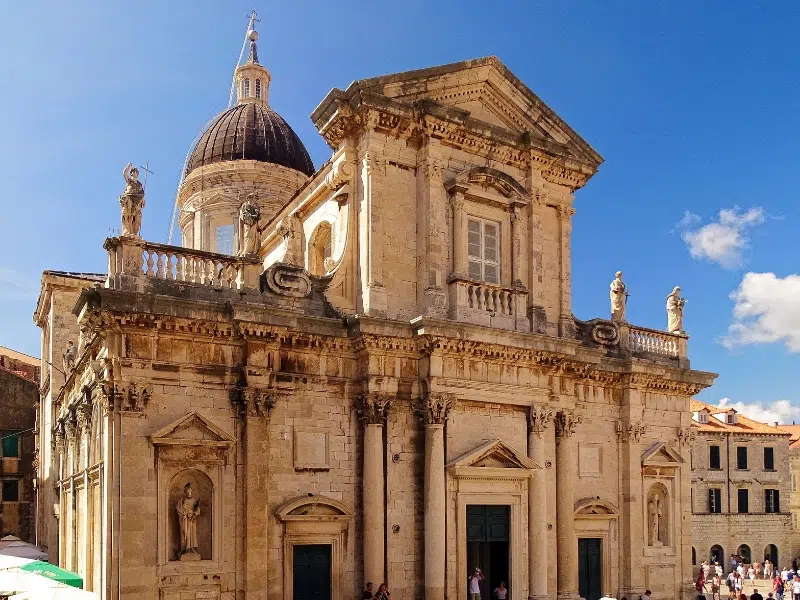
Dubrovnik Cathedral, the Cathedral of the Assumption of the Virgin Mary, stands just behind the Rector's Palace at the southern end of the old town. The church you see is Baroque and was finished in 1713, because its medieval predecessor collapsed in the great earthquake of 1667. Inside are an Assumption attributed to Titian and one of the richest church treasuries on the Adriatic, with the gilded relics of Saint Blaise, the city's patron.
Dubrovnik Cathedral at a glance
- Where: on the square south of the Rector's Palace, a short walk from the Old Port, inside the city walls.
- Built: 1671–1713, on the site of earlier Byzantine and Romanesque churches.
- By: designed by the Italian architect Andrea Buffalini; completed by the Dubrovnik builder Ilija Katičić.
- What it is today: the cathedral of the Diocese of Dubrovnik, with a treasury that can be visited.
- Time needed: 20 to 30 minutes, a little more with the treasury.
Rebuilt after the earthquake of 1667
Excavations under the present church found the remains of a large early medieval basilica, and later a Romanesque cathedral stood here, tall enough to dominate early views of the city. On 6 April 1667 a violent earthquake devastated Dubrovnik. The cathedral was destroyed, along with much of the city, and for a while there was even talk of abandoning the site. The Republic of Ragusa chose to rebuild, and the diplomat and Vatican librarian Stjepan Gradić, a native of Dubrovnik, raised money in Rome and found an architect, Andrea Buffalini.
Buffalini's plan, inspired by Roman Baroque churches, was approved in 1671, and building dragged on for four decades under a series of Italian master builders, with stonemasons brought from Italy working alongside local craftsmen. The church was completed in 1713 by Ilija Katičić, and the Senate placed a marble plaque on the façade in thanks to Gradić. The building was damaged again by the earthquake of 1979 and hit by shelling during the siege of 1991, and both times it was repaired.
What to look for
- The façade: four tall Corinthian columns around the main door, a big window under a triangular gable, and a balustrade lined with statues of saints.
- The statues in the deep façade niches: Saint Blaise and Saint Joseph with the Child.
- The polyptych of the Assumption of the Virgin above the high altar, attributed to Titian and his workshop, from the mid-16th century.
- The dome over the crossing and the large upper windows that fill the white interior with light.
- In the treasury: the gold-plated reliquaries of Saint Blaise's head, arm and leg; the head reliquary is shaped like a Byzantine emperor's crown and set with enamels and precious stones.
The legend of Richard the Lionheart
Dubrovnik tells a story about the cathedral's medieval predecessor. In 1192, the legend says, King Richard I of England was sailing home from the Third Crusade when a storm wrecked his ship near the island of Lokrum. He vowed to build a church if he survived, and once ashore he gave money for a new cathedral in Dubrovnik. Historians treat the tale with caution, but it is still told on every walking tour, and Lokrum is right there across the water from the Old Port.
Tips for your visit
- Come early in the morning or late in the afternoon, when the cruise-ship crowds in the old town are thinner.
- Dress respectfully, with shoulders and knees covered, and avoid visits during Mass.
- Look up at the façade from the steps of the square in front: the low morning sun picks out the columns and statues.
- Visit around 3 February if you can: the Feast of Saint Blaise is Dubrovnik's biggest festival, and the reliquaries are carried in procession through the streets.
Nearby
- Rector's Palace: the Gothic-Renaissance seat of the old Republic's government, now a museum, right next to the cathedral.
- Church of Saint Blaise: the Baroque church of the city's patron on Luža Square, a two-minute walk away.
- Gundulić Square: a small square with a morning market of fruit, lavender and dried figs, a few minutes' walk.
- Old Port: the harbour inside the walls, where boats leave for Lokrum, a few minutes' walk.
See Dubrovnik with World City Trail
Our Dubrovnik scavenger hunt turns the old town into a game you play on your phone. The route links 10 stops and takes around 2 hours, with about 17 minutes of walking. It includes the Pile Gate and Onofrio's Great Fountain, and at each stop you solve a puzzle and hear a story about the city.
If you prefer a different format, there is also a self-guided walking tour of Dubrovnik and an outdoor escape game.
Play the Dubrovnik scavenger hunt →
Take the self-guided walking tour of Dubrovnik →
Play the outdoor escape game in Dubrovnik →
Facts checked in October 2026.